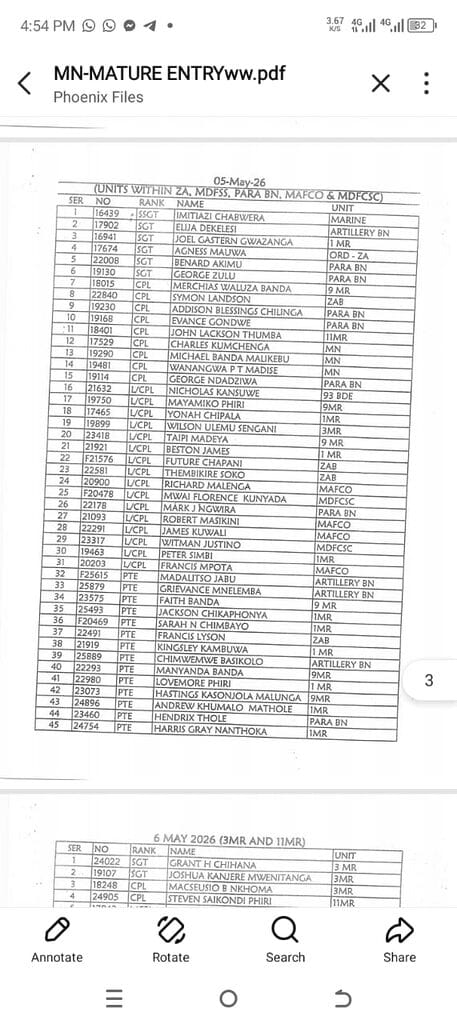
Malawi Defence Force (MDF): Concern Regarding Mature Entry Recruitment Criteria

I write to bring to your attention concerns regarding the current recruitment process within the Malawi Defence Force (MDF), particularly in relation to officer cadet entry pathways.
As you are aware, the MDF provides two routes for commissioned officer entry: direct entry (for civilians) and mature entry (for serving personnel). The minimum requirements for both pathways include possession of at least a degree, with age limits of 28 years for direct entry and 35 years for mature entry.

It has recently come to our attention that, under the leadership of Jaffu, the mature entry advertisement has been restricted to personnel holding the rank of Sergeant and below. This limitation appears inconsistent with established provisions and is perceived as unfair to many deserving serving members.
There are several personnel above the rank of Sergeant ranging from Staff Sergeant to Warrant Officer Class I who possess qualifications beyond a first degree and fall within the stipulated age limit of 35 years. Excluding such individuals introduces a parallel structure that departs from established practice and undermines merit-based progression within the MDF. It is particularly concerning that highly qualified individuals, including those holding Master’s and PhD degrees, may be excluded solely due to rank considerations rather than merit and eligibility.

In light of this, we respectfully request that this matter be brought to the attention of the Commander-in-Chief, Peter Mutharika, as it raises serious concerns regarding fairness, transparency, and adherence to the MDF Act. Promotion and career advancement should be guided by merit and eligibility, not restricted in a manner that disadvantages qualified personnel.

At present, many deserving soldiers feel discouraged and concerned about the direction this process is taking. We believe that corrective action is necessary to restore confidence and ensure that recruitment procedures remain just, transparent, and inclusive.

We therefore kindly urge that the ongoing recruitment process, including the interviews scheduled to commence on Monday, 4 May 2026, be suspended until these concerns are fully addressed and aligned with the provisions of the MDF Act.

We trust in your leadership and judgment, Maravi, and hope that you will escalate this matter to the appropriate authorities for timely resolution.

Yours sincerely,
Deserving Concerned Soldiers

NBM plc emphasises on procedure in customer transactions in Hotel inquiry

BLANTYRE-(MaraviPost)-A team from National Bank of Malawi (NBM) plc led by its Chief Executive Officer Harold Jiya appeared before the Parliamentary Accounts Committee (PAC) in Lilongwe where they emphasised on the importance of customer confidentiality and the rule of law while respecting the jurisdiction of Parliament on the inquiry.

The Bank was appearing before PAC which is investigating the controversial sale of Amaryllis Hotel by the Public Pensions Trust Fund (PPTF).

NBM Head of Legal and Company Secretary Zunzo Mitole flanked by Jiya and NBM Chief Risk Officer Charles Ulaya, said banks are limited with respect to the customer information that they can give out.

The Data Protection Act, under section 8, prohibits the disclosure of customer data or information without the explicit consent of the customer. Also, the Financial Crimes Act under section 24(1) prohibits the disclosure of the fact that a suspicious transaction has been made or even that a suspicion was formed with respect to a transaction.”

“Meanwhile, there is also The National Assembly (Powers and Privileges) Act provides that any witness appearing before Parliament or a Committee of Parliament is immune from being sued for any statements made to Parliament or a Committee of Parliament, meaning that a witness can disclose anything without fear of repercussions.”

“There is therefore a conflict between this Act and the Financial Crimes Act, the Data Protection Act the Directive on Financial Services (Fair Treatment of Consumers) 2024. In law, where two laws are in conflict with each other, the one that takes precedence is the one that addresses the issue at hand or in dispute.”

She therefore said that the Bank was obliged to follow the Financial Crimes Act and the Data Protection Act and would not disclose anything.

‘It is our view that since these two laws are superior to the National Assembly ( Powers and Privileges) Act, legal practice therefore demands that the bank should not disclose any FIA reporting and any customer data,” explained Mitole.

The bank did not disclose any transactions from the account which received the proceeds from the sale of the hotel by PPTF.

Jiya explained that they complied with regulations governing the banking industry.

PAC Chairperson Steve Baba Malondera suspended the meeting saying they will invite the bank again after looking at the relevant laws so that they get the information they are looking for.

How Faizal Aboo walked away unpunished after power grid collapse: MK500 million Ignored, Limbe left in darkness

 By Falles Kamanga

BLANTYRE-(MaraviPost)-In Malawi, tampering with electricity infrastructure can land an ordinary citizen in prison for years.

But in Limbe, one of the country’s most prominent property developers allegedly brought down part of the power grid—and to this day, has not been held accountable.

At the centre of this troubling story is Faizal Aboo, a Limbe-based businessman behind the Pacific Group of Companies.

On November 19, 2025, his construction activities near a critical substation led to the collapse of two 11kV power lines, plunging parts of Limbe’s busy commercial area into darkness.

Businesses shut down, essential services were disrupted, and livelihoods were thrown into chaos.

Yet months later, there has been no clear punishment, no public accountability, and no full explanation.

The sequence of events raises serious questions. Months before the incident, Pacific Group had approached the Electricity Supply Corporation of Malawi (ESCOM) after realising their construction site was obstructed by high-voltage infrastructure.

ESCOM responded formally, issuing a quotation of K500 million to safely relocate the power lines. This was not a suggestion; it was a requirement.

According to ESCOM spokesperson Pilirani Phiri, that is where compliance ended. The K500 million was never paid. No authorisation was granted. And yet, excavation works went ahead.

Heavy machinery dug deep trenches dangerously close to the substation. The ground became unstable. The soil gave way. Poles carrying the 11kV lines tilted and collapsed. Within moments, large parts of Limbe lost power.

This was not a natural disaster. It was not an accident caused by weather. It was the direct result of ignoring clear technical and legal instructions.

The law on this matter is not vague. Under Malawi’s Electricity Act, damaging or interfering with electricity infrastructure is a serious criminal offence. Those found guilty face up to 30 years in prison without the option of a fine.

Legal experts say the actions in Limbe go beyond negligence—they amount to economic sabotage.

Yet, despite the scale of the damage, the response has been muted.

While small traders and ordinary citizens are often arrested for illegal connections or meter tampering, this case has followed a different path.

Instead of arrests or charges, the matter appears to have been handled quietly. ESCOM formed an internal task team.

An agreement was reached for Pacific Group to construct a retaining wall to stabilise the damaged area. And that was it.

No prosecution. No public sanction. No clear recovery of the K500 million that was initially required.

For many, this feels less like justice and more like accommodation.

The role of the Blantyre City Council has also come under scrutiny. However, questions have been raised about how land so close to a high-voltage substation—an area that should have strict safety controls—was approved for commercial development in the first place.

When pressed for answers, officials passed responsibility from one office to another. Public relations pointed to planning.

Planning declined to comment. Engineering focused only on damaged roads, not the bigger issue of how such a risky development was allowed. The result has been a wall of silence.

Critics say this is not just about one developer. It is about a system that bends for the powerful.

Willy Kambwandira of the Centre for Social Accountability and Transparency says the case exposes a serious governance failure.

He questions how a private company could ignore official instructions, damage national infrastructure, and still avoid meaningful consequences while ordinary citizens face swift punishment for far lesser offences.

From a human rights perspective, the impact has been severe.

Michael Kaiyatsa of the Centre for Human Rights and Rehabilitation says electricity is not a luxury—it is essential for health, safety, and livelihoods.

When the power went out, clinics struggled to keep medicines cold, businesses lost income, and dark streets increased the risk of crime.

For traders in Limbe, the blackout was not just an inconvenience. It was a financial blow. For some, it meant losing perishable goods. For others, it meant days without income.

And yet, the man at the centre of it all has remained largely silent.

Despite initial indications that he would respond, Aboo has not publicly explained his actions or addressed the damage caused.

Today, the situation remains fragile. ESCOM admits that only a few lines are operational, and efforts to fully restore the infrastructure have been slowed by heavy rains.

Limbe’s power supply hangs in the balance—ironically dependent on emergency measures put in place after the damage.

What stands in Limbe now is more than a construction site. It is a symbol of something deeper: a system where rules exist, but are not applied equally.

Where the powerful can ignore a K500 million obligation, bring down part of the power grid, and still walk away without clear consequences.

Until there is a full, independent investigation, cost recovery, and accountability, one question will continue to linger in the darkness:

If this had been an ordinary Malawian, would they still be free?

MaBLEM calls for Amaryllis Hotel shutdown amid unending probe

….Set for vigils, demos on May 18, 2026…

LILONGWE-(MaraviPost)-The country’s civil rights group under the Malawi-Led Black Economic and Empowerment Movement (MaBLEM) is calling on authorities to shut down the controversial Amaryllis Hotel.

MaBLEM has cited unruly behaviour of the facility’s owners Yusuf Investment who snubed the ongoing and unending Parliamentary Committee on Public Accounts (PAC)’s purchase probe.

In an interview on Thursday, May 7, MaBLEM National Coordinator Fryson Chodzi hinted that the hotel’s closure will give ample time for concerned parties including civil servants to confirm that indeed their pension funds have not been lost with reports that hotel’s bank accounts are frozen.

Chodzi observed that “It is hard to believe that MK90 billion out of MK128 billion has been frozen when the hotel is using the same funds for operations.

“The moment National Bank refused to disclose detailed usage of the hotel purchase proceeds, it meant the hotel is still benefiting from the sale as it is in full operation”.

He added, “These are Public servants funds and must be protected. So, the best way to safeguard taxpayers money is to shutdown or suspend Amaryllis Hotel operation until the matter is completely resolved. 

“In all fairness, where MK90 billion out of MK128 billion was paid, there is no justifiable reason for Yusuf investments to continue running the hotel as they don’t hold any reasonable shares in the facility” stated chodzi.

He charges, “In partnership with civil servants we are to go for vigils, demonstrations which tentatively have been slated for May 18, 2026 at Amaryllis Hotel.

“The vigils will be at the Hotel itself. Dubbed Occupy Amarylils, payback the money or handover the hotel to the Government”.

The hotel’s purchase probe remains sketchy as PAC is unable to complete the inquiry as key players are unavailable including former Secretary to the President and Cabinet Colleen Zamba.

Meanwhile, PAC has asked government to help in repatriating Zamba to Malawi to appear before the Committee.

NBM plc gives MK10 million to Rotary Club of Blantyre for international conference

BLANTYRE-(MaraviPost)-National Bank of Malawi (NBM) plc has donated MK10 million to the Rotary Club of Blantyre in support of an upcoming Rotary District 9210 conference scheduled to take place in Salima from 29 April- May 3, 2026..

The conference is expected to bring together participants from Malawi, Zambia, Zimbabwe, and Northern Mozambique, providing a platform for discussions and exchange of ideas on growth, development, and community impact.

Speaking during the cheque presentation on Monday, NBM plc Marketing and Corporate Affairs Manager, Akossa Mphepo-Hiwa, said the donation reflects the Bank’s broader commitment to national development.

“National Bank of Malawi sees itself as more than just a financial services institution. We are a provider of financial solutions that support development and economic growth, and we see ourselves as a partner for change,” said Mphepo-Hiwa.

She said the Bank found it important to support the conference as it offers a platform for generating ideas that can drive growth and community development.

Mphepo-Hiwa also noted that the event presents an opportunity to promote Malawi on an international stage.

“This is not just about discussions and networking. It is also a chance to showcase Malawi—its culture, climate, tourist attractions, and its people,” she said.

She added that the Bank has a history of working with Rotary Club of Blantyre on various initiatives and looks forward to continued collaboration.

Rotary Club of Blantyre Past District Governor’s Representative, Peter Nkosi, described the conference as a significant event not only for the club but also for the country.

“It is a great honour for us as a country, and for us as Malawians, to host this event, which covers four countries in our region,” he said.

Nkosi expressed gratitude to NBM plc for the financial support, noting that the funds will help cover key logistical costs.

“We are very grateful, and we thank National Bank of Malawi plc for coming forward to assist us. This amount of money will go a long way in helping us meet expenses such as hotels, accommodation, transport, and related logistics,” he said.

He further appealed to other stakeholders to emulate the bank’s gesture, saying support is still welcome ahead of the conference.

Africa’s health workforce expands but shortages, unemployment and migration intensify: WHO report

Geneva, Switzerland, 05 May 2026- /African Media Agency (AMA)/- Africa is producing more health workers than ever before, yet millions of people still lack access to care; hundreds of thousands of trained health professionals are unable to find jobs; and many of them are migrating. A deliberate shift linking education, employment, retention, quality, productivity and investment is needed to alter the paradox of growing health personnel numbers and unmet needs, a new report by the World Health Organization (WHO) finds.

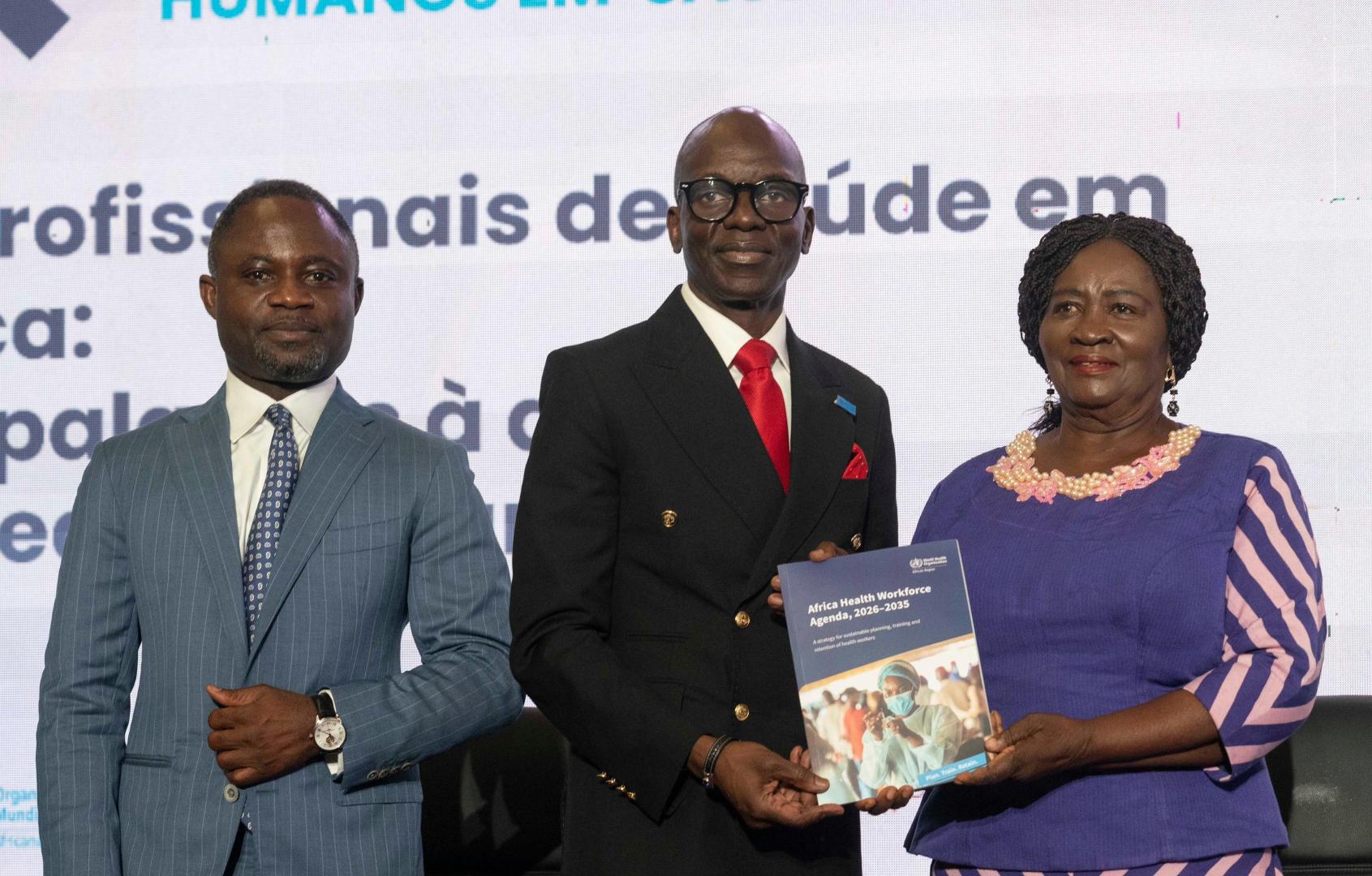
Launched on 6 May 2026 at the Second Africa Health Workforce Investment Forum in Accra, the State of the Health Workforce in Africa 2026: Plan. Train. Retain. highlights a deepening crisis driven not by a lack of training alone, but by systemic failures in health worker employment, distribution and retention.

“Africa’s future depends on the strength of its human capital. Investing in our health workforce is not just a health priority, it is an economic and development imperative. This forum provides a critical platform to turn commitments into action and ensure that every African has access to quality care delivered by a skilled and motivated workforce,” said said Professor Jane Naana Opoku-Agyemang, Vice- President of Ghana.

The report is being launched as leaders gather in Accra to accelerate action.

“Hosting this forum reflects Ghana’s commitment to transforming health systems through sustained investment in our workforce. The evidence is clear: training alone is not enough. We must create jobs, strengthen skills, and retain talent if we are to deliver quality care for our populations,” said Honourable Kwabena Mintah Akandoh, Minister of Health, Ghana

Africa’s health workforce has grown to 5.72 million in 2024, up from 4.3 million in 2018. Yet this progress is not keeping pace with demand. The African region currently has only 46% of the health workers it needs.

A defining challenge is the persistence of a dangerous paradox: severe shortages alongside high unemployment. In 2024, an estimated 943 000 trained health workers were unemployed, even as health systems remain understaffed.

WHO has revised the projected health workforce shortage in the African Region by 2030 from 6.1 million to 5.85 million. This is an important signal that progress is being made. However, the reduction is marginal and fragile. It does not yet represent a structural transformation of the health labour market, and it could easily be reversed if countries do not accelerate investment in education, employment, and retention.

“Africa’s health workforce crisis is no longer defined by scarcity alone, but by systemic failure. We are training more health workers than ever before, yet too many remain unemployed while millions go without care. Without bold investment and coordinated reform to plan, train and retain health workers, progress toward universal health coverage will remain out of reach,” said Dr Mohamed Yakub Janabi, WHO Regional Director for Africa.

Training capacity has expanded significantly, with more than 325 000 graduates annually, but the report shows that training alone will not solve the crisis. More than half of new graduates in some countries remain unemployed or work in precarious roles, reflecting weak alignment between education systems, labour markets and health system financing.

Even where health workers are available, quality of care remains uneven. Health workers correctly diagnose only about 62% of cases and provide appropriate treatment in just 40% of those, exposing health clients to avoidable risks.

Retention pressures are intensifying. Nearly 46% of health workers report intentions to migrate, driven by poor working conditions and limited career opportunities, while absenteeism continues to erode system capacity, with losses estimated at up to 20% of the wage bill.

Despite these challenges, the report presents a strong investment case. Every US$ 1 invested in the health workforce can generate up to 10 times in financial returns and more than 30 times in broader social and economic benefits. Yet current investment levels remain insufficient. Countries would need to increase spending by approximately US$ 4 per capita per year, or expand workforce budgets by about 15% annually, to close the gap.

Participants are expected to review progress under the Africa Health Workforce Investment Charter and mobilize new commitments to accelerate reforms and financing. The forum will also introduce the Africa Health Workforce Agenda 2026–2035, a new regional strategy to drive coordinated action to plan, train and retain health workers at scale.

Distributed by African Media Agency (AMA) on behalf of World Health Organisation.

The post Africa’s health workforce expands but shortages, unemployment and migration intensify: WHO report appeared first on African Media Agency.

Exit mobile version