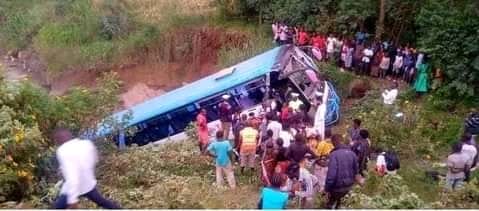
BLANTYRE-(MaraviPost)-Reports reaching The Maravi Post indicate that 32 people sustained various degrees of injuries after Tam-Tam bus they were traveling in veered off the road and plunged into Namanyungwi river near Kalinyeke Toll Gate in Dedza.
The accident happened yesterday April 24, 2022 at around 5:00 pm.
Tam-Tam bus in road accident
According to Dedza Police Deputy Publicist Cassim Manda, the accident happened when the bus which was on its way to Lilongwe applied emergency break in course of avoiding hitting unknown vehicle which was overtaking four vehicles.
The casualties were rushed to Dedza District Hospital where they are currently receiving treatment .
Meanwhile, police are urging drivers to exercise extreme caution when driving their motor vehicles.
BLANTYRE-(MaraviPost)-Malawians should expect more power outages from Monday April 25 to Friday April 29, 2022 as the country’s power generating company, Electricity Generation Company Malawi Limited (EGENCO) will shutdown 19.1 Megawatts of its Tedzani IV power station.
In a statement, EGENCO says the move is to pave a way for maintenance works at the said power station as the rocks boulders blocked the machine’s tailrace also known as water exist channel due to Cyclone Ana.
Electricity Generation Company Malawi Limited (EGENCO) staff
This is making difficult for the maintenance team to close the water channel when they want to dewater it during the maintenance works.
The company says the works will therefore, involve building an isolating wall around the mouth of the machine’s exist channel to create a dry working area and facilitate removal of the rock boulders.
“The works are coinciding with a one year anniversary of the machine’s commissioning and will enable the Tedzani IV Project Consultants (TEPSCO) and contractors carry out contractual machine inspection and warranty repairs during the same period,” reads the statement in part.
Meanwhile, the company says in order to minimize the impact of outage and inconvenience to the public, it will use its diesel generators to supplement the available hydro-power station.
Adding that it has also commissioned one machine at its Tedzani II station ( 10MW) which was undergoing rehabilitation works since December 2021.
LILONGWE-(MaraviPost)-Bankers from the Reserve Bank of Malawi have been locked up in police custody at Area 30 on one count, insulting Police officers whilst on duty.
Blue Eagles FC have maintained and extended their lead on the table with five points following their home one nil victory over Silver Strikers FC on Sunday, April 24,2022.
It was crucial encounter for both sides as the visitors were looking forward to win so that they get themselves on good position and repeat what they did last season defeating the cops both home and away but it wasn’t to be as the hosts planned a revenge mission which went on successfully.
Some Blue Eagles FC players celebrating with vice Chairman Ian Mwalungila
Silver Strikers FC started on very well in the first half but in about 15th minute the home team settled too. Chawanangwa Kaonga who took the bankers hopes got injured hence Maxwell Phodo was introduced while Blessings Tembo was replaced by Duncan Nyoni.
These early changes seemed to disturb the plans of Daniel Kabwe, at 23rd minute Phodo squandered a clear chance for Silver as he got possession when Sankhani Mkandawire and goalie Brighton Munthali mis-communicated.
At 35th minute Gilbert Chirwa had his free header from Kuwali cross going over the bar for Silver to survive. This half didn’t produce any fruits.
Blue Eagles FC made early changes in the second half taking out Arthur Moffat for Chifuniro Mpinganjira, however, the second half didn’t produce exciting display from both sides as the spectators anticipated but rather marred with tempers.
At 70th minute Eliah Kananji made another substitution bringing in defender Ian Chinyama and Laurent Banda for Onesimo Mbendera and Trouble Banda while Silver brought in Frank Banda, Tatenda M’balaka and Chikondi Kamanga for Taonga Chimodzi, Mark Fodya and Zebron Kalima.
Few minutes after these changes saw the host’s play extremely changed than the visitors and at 75th minute Eagles failed to utilize the chance as Chifuniro Mpinganjira and Gaddie Chirwa disturbed each other.
The men in unform continued piling pressure as the clock was fast ticking to regulation time, and as it was thought that the two will share the spoils Laurent Banda registered his account with Blue Eagles FC at 90th minute after tapping in a pass from Gaddie Chirwa who received the ball from a beautiful throw in from Ian Chinyama in the left flank.
When the Bankers were trying to level the matters the Center Referee Easther Zimba blew the whistle signalling the end of the match and it was confirmed the cops locked the bankers behind bars at Nankhaka to remain on the summit with 19 points from 7 games five points a drift from the reigning Champions Nyasa Big Bullets FC who dropped points in Karonga against the crocodiles after a nil nil draw.
McDonald Yobe assistant coach for Silver Strikers was disappointed with the defeat saying his boys squandered a lot of scoring chances especially in the first half.
Yobe added all is not lost they will sit down as technical panel to rectify the noted problems of failing to scoring.
His counterpart Christopher Sibale Assistant Coach Blue Eagles FC was delighted with the victory.He said his charges showed hard working spirit and praised the substitutes they made to say they changed the tempo of the game.
“It was a revenge mission, they beat us home and away last season they had to repay it today.Each and every team who enters the competition aims at winning the league so we are not exceptional”, Sibale said.
Next on the menu for area 30 based side are rookies Sable Farming away at Mipira Stadium on Saturday April 30, 2022.
“Landmark recommendations on the use of the first vaccine against malaria – WHO Regional Director for Africa, RTS,S – were released by the World Health Organization (WHO) late last year”, said WHO Regional Director for Africa Matshidiso Moeti, referring to a protein-based malaria inoculation.
“This vaccine will be used to prevent malaria among children aged six months to five years, who live in moderate- to high-transmission settings”, she added.
Use measures wisely
Noting that the day is marked annually on 25 April to focus global attention on the mosquito-borne infectious disease, and its devastating impact, especially in Sub-Saharan Africa Dr. Moeti said that this year aligns with her call to urgently scale up innovation and deploy new tools to battle malaria, while also advocating for equitable access to prevention and treatment – within the context of building health system resilience.
“While this is a ground-breaking advance in the development of new tools to fight this disease, with the potential to save millions of lives, supplies are currently limited”, she said.
As such, it is important to ensure that available doses are being used for maximum impact, while continuing to be accessible to those most at risk.
Considerable threat
Malaria remains a significant public health and development challenge, according to WHO.
In the last year, about 95 per cent of the estimated 228 million cases occurred in the WHO/AFRO Region, along with 602,020 reported deaths.
Six of those worst-impacted countries reportedly account for up to 55 per cent of cases globally, and for 50 per cent of these deaths.
“Despite some slowing of progress to reduce malaria cases and deaths, and the disruptions to health services caused by COVID-19, we are still much further ahead than we were in 2000. We need to reignite that momentum, and build on the recent advances”, the WHO official attested.
Strategizing
Meanwhile, the UN agency UNITAID said that more than two-thirds of all deaths from malaria occur in African children under age five.
With pilots co-funded by UNITAID, the Global Fund and GAVI, the world’s first malaria vaccine is being delivered to children as part of a comprehensive package of preventive care.
Vector control, which targets disease-spreading mosquitoes, is a highly effective and vital component of malaria elimination strategies.
And with work to improve screening and treatment for relapsing P. vivax malaria – the most common type of malaria outside of sub-Saharan Africa – UNITAID is helping improve care for people in Asia-Pacific and Latin American countries.
The WHO global malaria strategy calls for a 90 per cent worldwide reduction of cases and death by 2030 – a goal that requires urgent investment to develop and deploy crucial innovations to protect people everywhere from malaria.
This requires a focus on research; leveraging evidence for the efficient use of resources while producing measurable results; working on drug and insecticide resistance; and attention on new strains arising in the region that are more difficult to detect and treat.
Commitment to fight
World Malaria Day is an occasion to “renew political commitment and encourage continued investment in malaria prevention and control”, said Dr. Moeti, calling on countries and communities affected by malaria to work closely with development partners to eliminate the disease while also contributing to achieving the other Sustainable Development Goals (SDGs).
“I personally, and the WHO Regional Office in Africa, remain fully committed to the fight against malaria,” she spelled out, assuring that “we can overcome the challenge if we collaborate closely with governments, partners and communities… to achieve a malaria-free Africa”. Sourced from United Nations Africa Pages
Malawi Police are hunting robbers who have killed a guard in Mzimba
By Mapwiya Muulupale
A revolution can be defined as a radical change in the established order. Revolutions typically happen when dissatisfied citizens conclude that government institutions have failed or no longer serve their intended purpose. As a result, people take matters into their own hands, and when they do, there is no telling how it will end.
While we are talking revolutions, a quick look at attempted and successful revolutions will help set the scene.
In April 1989, popular Chinese Communist Party (CCP) general secretary Hu Yaobang died. Before his ousting from the Communist party, he promoted economic and political reform. Two days after his death, on 17 April, several hundred students marched to Tiananmen Square and laid a wreath at the Monument to the People’s Revolutionary Heroes.
They demanded greater freedom of speech, economic freedoms and curbs on corruption. These demands irked hardliners in the Communist Party. The protesters were estimated to be up to one million at peak.
At first, the government took no direct action against the protesters as party officials haggled on what to do. Some were backing concessions; others wanted a harder line. The hardliners prevailed, and martial law was declared in Beijing in the last two weeks of May. On 3 to 4 June, troops came, opened fire, crushed and arrested protesters. At the end of June 1989, while the Chinese government said 200 civilians and several dozen security personnel had died, independent sources said 10,000 had died.
Here in Malawi, in March 1992, Catholic Bishops issued a Pastoral Letter criticizing the then ruling MCP for corruption, poverty and lack of democratic governance. Demonstrations and strikes by urban workers and university students quickly followed. MCP’s tool for suppression of public dissent was the paramilitary Malawi Young Pioneers (MYP), which increasingly became arrogant and violent. One particular act of violence proved catastrophic.
On 1 December 1993, MYP cadres shot and killed two soldiers at a pub in Mzuzu.
The matter was reported to Moyale Barracks (Mzuzu) and further conveyed to the Headquarters (Lilongwe). Soldiers, tense and anxious, keenly waited for direction from the army leadership.
This happened during the weekend, and the Army Commander was at a wedding in Zomba. After being briefed about the deaths, he responded that he would see what to do when he reported to the office on Monday.
It was a mistake. Rightly or wrongly, soldiers deduced that he was either afraid to confront Dr Kamuzu Banda or simply didn’t care.
Soldiers continued with the vigil and were on standby awaiting orders. After waiting for forty-eight hours, emotions exploded. Led by junior officers, they took matters into their own hands and thus commenced ‘Operation Bwezani’.
You all know how that ended.
In Tunisia, on 17 December 2010, a young man called Mohamed Bouazizi set himself on fire outside a municipal office in central Tunisia. Bouazizi, who supported his family by selling fruits, was driven to the limits by local officials who repeatedly demanded bribes and confiscated his merchandise.
After authorities refused to hear his complaint, he doused himself with gasoline and set himself alight.
His plight symbolized the injustice and economic hardship afflicting many Tunisians and inspired nationwide protests against corruption, high unemployment, poverty, and political repression.
The Jasmine Revolution, as it came to be called, forced Pres. Zine al-Abidine Ben Ali to step down in January 2011. It also inspired the Arab Spring.
According to Karl Marx, history repeats itself, first as a tragedy, second as a farce, meaning when history repeats itself again, people’s refusal to learn is comical.
The amusing aspect is best illustrated by former President Peter Mutharika, who lost power in the February 2020 revolution for the same arrogance that saw the DPP lose popularity between 2009 and 2012.
This previous week could have birthed the first major protests against President Lazarus Chakwera’s government. We will never know how it would have ended, but the stage was set for a revolution.
The genesis is Zunneth Sattar’s arrest in October 2021 by British law enforcement on corruption allegations. The syndicate implicated in the Sattar’s sag has been very busy trying to kill the local version of the investigations in the hope of defeating justice.
Justice, in their eyes, is Madam Martha Chizuma, the ACB Czarina loved and revered by millions and yet hated to death by a handful of corrupt low-lives and scum of the earth deemed worthy of public office by President Chakwera.
In a move started by a little known Frighton Phompho, a Court Order to investigate and authenticate the leaked audio linked to Madam Chizuma was obtained.
In the height of supreme irony, execution of the order was delegated to the most corrupt institution in Malawi (as per Afrobarometer), the Malawi Police Service, which summoned Madam Chizuma for interrogation last Friday.
The general public quickly rallied and unanimously resolved that Madam Chizuma “would not walk alone” to the Police Headquarters. In the mother of all escorts, they would accompany her. The implications were not lost on the Police, and a wise decision was made to “postpone” the interrogation. The postponement has since been overtaken by events because the High Court issued a stay order later in the day and ordered a review of the Mzuzu Magistrate’s Court Order.
There are a few things I want to highlight. The day chosen by the Police was remarkable in three aspects. First, Chizuma would have been locked up the whole weekend if they were to detain her. The implication is that Malawi, at least Lilongwe, would have been burning weekend long.
Second, the State President was out in Mozambique, and third, the Vice President was flying to the USA. The implication is that the chaos would have gone unchecked.
Were the masses escorting Madam Chizuma to run riot, the Inspector General (IG) would have either had his hands tied or could have issued orders beyond his power in dealing with the riot. For the IG, both were lose-lose situations where he would be damned if he acted and damned if he did not.
More crucially, as in China in 1989, as with Operation Bwezani in 1992 and the Jasmine Revolution (Tunisia) in 2010, there is no way of predicting the triggers of mass riots and revolutions. However, public dissatisfaction and corruption have always played a significant role.
Given that:
• Malawians have had enough of corruption, • the promise to end corruption is perhaps the only job they expected President Chakwera to deliver on given his background, and that • President Chakwera has not impressed vis-à-vis the Sattar mess;
interfering with Madam Chizuma when the ACB has concluded investigations could have been the last straw because, whereas the overwhelming majority of Malawians trust Madam Chizuma, their opinions of the President, the Attorney General, and the Director of Public Prosecutions are now very low.
Why?
Because these three men don’t seem to understand that President Chakwera’s social contract is premised on ending corruption and that despite the President’s seeming change of mind on ending corruption, it remains Malawians’ number one agenda. This view, as per the recent Afrobarometer report, is shared by 58% of MCP supporters.
As things are, anything foolish can trigger a disaster, as it almost happened on Friday.
President Chakwera should never forget that revolutions are triggered by seemingly unremarkable events and must tread carefully if he is to govern up to the next General Election.
After all, you can’t play with fire and not get burnt! Hands off Martha, hands off the ACB.
French President Emmanuel Macron on Sunday secured his second term by defeating far-right leader Marine Le Pen in presidential elections.
Macron won by 58.2 percent of the vote compared with Le Pen on 41.8 percent, according to the electoral commission.
The result is narrower than their second-round clash in 2017, when the same two candidates met in the run-off and Macron polled over 66 percent of the vote.
The relatively comfortable margin of victory will nonetheless give Macron some confidence as he heads into a second five-year mandate, but the election also represents the closest the far-right has ever come to winning power in France.
A victory by Le Pen, accused by opponents of having cosy ties with Russian President Vladimir Putin, would have sent shockwaves around the world comparable to the 2016 polls that led to Brexit in Britain and Donald Trump’s election in the United States.
The outcome, expected to be confirmed by official results overnight, will cause immense relief in Europe after fears a Le Pen presidency would leave the continent rudderless following Brexit and the departure of German chancellor Angela Merkel.
Left-leaning EU leaders including German Chancellor Olaf Scholz had pleaded with France in the run-up to the vote to choose Macron over his rival, in an unusual intervention published in Le Monde newspaper.
Macron will be the first French president to win re-election since Jacques Chirac in 2002 after his predecessors Nicolas Sarkozy and Francois Hollande left office after only one term.
Macron will be hoping for a less complicated second term that will allow him to implement his vision of more pro-business reform and tighter EU integration after a first term shadowed by protests, then the pandemic and finally Russia’s invasion of Ukraine.
But he will have to win over those who backed his opponents and the millions of French who did not bother to vote.
On the basis of the official figures, polling organisations estimated that the abstention rate was on course for 28 percent which, if confirmed, would be the highest in any presidential election second-round run-off since 1969.
The outcome of the first round on April 10 had left Macron, 44, in a solid but not unassailable position to retain the presidency.
Convincing supporters of the hard-left third-placed candidate Jean-Luc Melenchon to hold their noses and vote for the former investment banker was a key priority for Macron in the second phase of the campaign.
Macron will also need to ensure his party finds strong grassroots support to keep control of a parliamentary majority in legislative elections that come hot on the heels of the presidential ballot in June and avoid any awkward “cohabitation” with a premier who does not share his political views.
High on his to-do-list is pension reform including a raising of the French retirement age which Macron has argued is essential for the budget but is likely to run into strong opposition and protests.
He will also have to rapidly return from the campaign trail to dealing with the Russian onslaught against Ukraine, with pressure on France to step up supplies of weapons to Kyiv and signs President Vladimir Putin is losing interest in any diplomacy.
For Le Pen, her third defeat in presidential polls will be a bitter pill to swallow after she ploughed years of effort into making herself electable and distancing her party from the legacy of its founder, her father Jean-Marie Le Pen.
Critics insisted her party never stopped being extreme-right and racist while Macron repeatedly pointed to her plan to ban the wearing of the Muslim headscarf in public if elected.
She has suggested this could be her last campaign and speculation is now expected to mount about the future of her party and the French far-right, which splintered during the campaign.
When Jean-Marie Le Pen reached the second round in 2002, the result stunned France and he won less than 18 percent in the subsequent run-off against Chirac.
French far-right leader Marine Le Pen hailed her score in presidential elections on Sunday as a “brilliant victory”, despite her projected defeat to Emmanuel Macron.
Promising to “carry on” her political career and vowing that she would “never abandon” the French, the 53-year-old said: “The result represents a brilliant victory.”
A lighting advert by electronics giant Philips has sparked anger among some Ghanaians.
The company has erected several billboards on streets of major cities in the West African nation drawing attention to its products.
Among others, the billboards subtly suggest that the lighting products of Philips last longer than the sexual strength of men.
Some of the boards also suggest that the Philips products last longer than the terrible traffic situation in Kasoa, one of Ghana’s fastest growing communities.
But these messages have not gone down well with some Ghanaians who have begun social media campaigns to demand that the billboards are brought down.
– –
Some of the campaigners argue that the sexual connotations of the advertisements will promote the use of unlicensed aphrodisiacs and its associated health risks in the country.
The electronics giant has not reacted to the concerns over the ads but not everyone is angry with the ads.
Some consumers say they these are simply creative ways of advertising products.
Members of the All Progressives Congress (APC) willing to participate in the presidential primary election have been directed to pay N100 million for the nomination and expression of interest forms. Similarly, the nomination and expression of interest forms for those seeking the party’s ticket to contest the governorship election in their respective states cost N50 million. Aspirants for the Senate, House of Representatives and Houses of Assembly are to cough out N20 million, 10 million and N2 million respectively. The party granted a financial waiver to all female aspirants on its platform and approved a 40% discount for aspirants aged 35 and below.
By asking the young people to pay N60 million (being 40 percent discount off the said N100 million) the APC has made a mockery of the Not Too Young to Run Act enacted by the Federal Government under its control. It is undoubtedly clear that the N100 million deposit fixed by APC for its presidential aspirants has excluded the majority of the alleged 40 million members of the party from participating in the party primary elections. The APC ought to have realised that by restricting politics to the affairs of fat cats it has violated Article 13(1) of the African Charter on Human and People’s Rights (Ratification and Enforcement) Act which states that “every citizen shall have the right to participate freely in the government of his country, either directly or through freely chosen representatives in accordance with the provisions of the law.”
The apparent endorsement of the controversial nomination fees by President Muhammadu Buhari smacks of hypocrisy because, in 2014, he had told Nigerians that he had to borrow N27.5 million to buy his nomination form. In condemning the skyrocketing nomination fees at the material time, I did say that “Under section 131 of the Constitution any Nigerian citizen who has attained the age of 40 years and is a member of a political party and sponsored by that party and has been educated up to secondary school level is qualified to contest for the presidential election in Nigeria. Section 87 of the Electoral Act which provides for the nomination of candidates by political parties has not prescribed that aspirants shall pay any fee. In the circumstance, political parties may only be permitted by law to charge administrative fees.”
However, in a careless attempt to play on the collective intelligence of Nigerians, the Peoples Democratic Party (PDP) accused the APC of “inflicting maximum pains on its members” and that the fees cast the ruling party “in the image of rogues and hypocrites”. However, the PDP had earlier pegged its fees for both the expression of interest and nomination forms at N40 million for the President, and N21 million for Governorship aspirants. Those aspiring for Senate, are to pay N3.5 million, N2.5 million for those aspiring for the House of Representatives, while state House of Assembly aspirants will pay N600,000
The party’s NEC also approved a 50 per cent reduction in nomination fees for youths aged 25 to 30 years for various elective positions. In justifying its own high nomination fees the opposition party said that ” We are a mass movement for the Nigerian people. This is why our nomination fees are soft and democratic”.
Since the national minimum wage is N30,000 per month the deposit of N100 million or N60 million has excluded millions of workers from contesting the presidential election in Nigeria. Even retired professors, judges and permanent secretaries are not in a position to pay the deposit demanded by the APC and PDP from their meagre pension. Ironically, Nigeria houses the second largest population of poor people in the world but the nomination fees collected from aspirants by APC and PDP are the highest in the world. Tunji Ariyomo, the National Coordinator of Nigeria Focus Group has said, “To run for a governorship position in any state in the US in 2022, your political party’s primary filing and nomination fee can range from as low as $0 (yes, zero) to $3,750 (or N1.8m). The average fee is thus circa $2,000 (or N980,000). These charges cover what is labelled in Nigeria as nomination and expression of interest forms’ fees.”
Indeed, in Bullock v Carter 405 U.S 134 (1972) the appellants who sought to become candidates for local office in the Democratic primary election challenged in the District Court the validity of the nomination fees up to $8, 999. It was held that the fees contravened the Equal Protection Clause of the 14th Amendment. It was the view of the Judge that “By requiring candidates to shoulder the costs of conducting primary election through filing fee by providing no reasonable alternative means of access to the ballot, the State of Texas has erected a system that utilizes the criterion of ability to pay as a condition to being on the ballot, thus excluding some candidates otherwise qualified and denying an undetermined number of voters the opportunity to vote candidates of their choice.”
In Canada, candidates are no longer required to pay deposits for federal elections. In the case of Szuchewycz v. Canada (Attorney General) 2017 ABQB 645, Justice Avril Inglis of the Court of Queen’s Bench of Alberta declared that the deposit requirement infringed on Section 3 of the Canadian Charter of Rights and Freedoms and could not be justified under Section 1 of the Canadian Charter of Rights and Freedoms. Before the Szuchewycz v. Canada ruling, a candidate for Member of Parliament needed to place a $1,000 deposit.
Since the Constitution of the Federal Republic of Nigeria, 1999 is the basic law of the land, any Act or law or policy which is inconsistent with the same will be struck out. Thus, the payment of outrageous nomination fees which is not one of the conditions for contesting elections under the current democratic dispensation is illegal and unconstitutional on grounds of inconsistency with the Constitution. In the case of the Independent National Electoral Commission v Alhaji Abubakar Balarabe Musa & 4 Ors (2003) 10 WRN 1, certain guidelines issued by the Independent National Electoral Commission for the registration of political parties were struck down by the Supreme Court on the ground that they were not in consonance with sections 40 and 222 of the Constitution.
Thereafter, in the case of the National Conscience Party & 23 Ors v Independent National Electoral Commission (Suit No FHC/ABJ/CS/ 42/2003), the Plaintiffs challenged the announcement of the defendant to charge as “processing fees” amounts ranging from N500,000 for presidential candidates to N25,000 naira for those seeking election as local government councillors. The presiding Judge, the Honourable Justice Binta Murtala-Nyako agreed with the submissions of the Plaintiffs’ counsel, Chief Gani Fawehinmi SAN and said, “Going through the constitution and the electoral act 2002, I fail to see where INEC was empowered to prescribe and demand such processing fees…I, therefore, declare the processing fees charged by the defendant illegal and unconstitutional.”
In the same vein, in National Conscience Party v Ekiti State Independent Electoral Commission (2015) NHRLR (Part 1) on Page 1, the Ekiti State High Court nullified the demand for the payment of nomination fees and production of tax clearing certificate as preconditions for contesting the 2004 local government elections. In upholding our submissions
the presiding Judge, the Honourable Justice Babalola said that “The demand for the production of tax receipt or tax clearance certificate showing evidence of tax payment as at when due for the last 3 years before the date of election and the demand of N5,000.00 deposit in the case of candidates contesting as councillor to the commission are in my view attempts to add or alter sections 106 and 107 of the Constitution of the Federal Republic of Nigeria, 1999. The two demands are inconsistent with the provision of section 7(4) and 106 of the Constitution of Nigeria, 1999 and therefore declared null and void to the extent of their inconsistency”. The appeal filed against the judgment by the Ekiti State Independent Electoral Commission was dismissed by the Court of Appeal.
In Osun State Independent Electoral Commission v National Conscience Party (Unreported Appeal No SC.40/2009) the Osun State High Court nullified the payment of nomination fees by all registered political parties as a condition to contest March 27, 2013, local government election on the state. The Appellant had issued guidelines which required each chairmanship candidate to pay a sum of N50,000 and each councillorship candidate to pay N25,000 to the coffers of the Appellant. The High Court held that the Defendant lacked the power to prescribe conditions for the eligibility, qualifications and disqualifications of candidates to contest Local Government Elections in Osun State outside the conditions stipulated by the Constitution of the Federal Republic of Nigeria 1999.” The appeal filed by the appellant against the judgment was dismissed by the Court of Appeal and later by the Supreme Court.
In the Peoples Democratic Party v Edo State Independent Electoral Commission & Another (Unreported Suit No. B/18/OS/13), the Honourable Justice N.A. Imoukhuede declared the requirement of a non-refundable deposit of N100,000.00 (One hundred thousand Naira) for Chairmanship candidates and N50,000.00 (Fifty thousand Naira) for Councillorship candidates was in breach of the provisions of sections 7(4), 106 and 107(1) of the Constitution of the Federal Republic of Nigeria, 1999 (as amended). Consequently, the learned trial judge set aside the collection of the deposits by the Edo State Independent Electoral Commission.
It is submitted that if the electoral bodies that are vested with the power to conduct elections are prohibited from collecting meagre nomination fees from candidates what is the legal basis for collecting billions of Naira from aspirants by political parties? However, while political parties cannot charge outrageous nomination fees they may be permitted to direct aspirants to pay nominal fees for administrative expenses. In Independent National Electoral Commission v Balarabe Musa, the Supreme Court (supra) refused to strike down the N100, 000 as part of the conditions prescribed by INEC for the registration of political associations as political parties. According to Justice Niki Tobi of blessed memory: “It is common knowledge that the process of registration involves money. The application forms and other accompanying documentation involve money. As I said above, I do not expect the first appellant to play the role of a Father Christmas. Somebody has to defray part of the expenses, and it should be the political association that wants to be recognised as a political party under Section 222. Considering the cost of production of material and labour, I do not see the amount of N100,000 as too much.”
The administrative fee of N100,000 was allowed by the Supreme Court because it was the era of paper documentation. But with the incredible advancement in technology, paper documentation is no longer necessary. Since the applications are going to be filled and submitted while payment of nomination fees
will be made online by aspirants no political party should charge more than N10,000 for administrative purposes. After all, the registration fee charged by the Joint Matriculation Examination Board is less than N5,000 per candidate. Therefore, the APC and PDP should withdraw the outrageous fees and charge administrative fees of not more than N10,000 per aspirant.
It is submitted that if the electoral bodies that are vested with the power to conduct elections are prohibited from collecting meagre nomination fees from candidates what is the legal basis for collecting billions of Naira from aspirants by political parties? However, while political parties cannot charge outrageous nomination fees they may be permitted to direct aspirants to pay nominal fees for administrative expenses. In the Balarabe Musa case, the Supreme Court refused to strike down the N100, 000 as part of the conditions prescribed by INEC for the registration of political associations as political parties. According to Justice Niki Tobi of blessed memory: “It is common knowledge that the process of registration involves money. The application forms and other accompanying documentation involve money. As I said above, I do not expect the first appellant to play the role of a Father Christmas. Somebody has to defray part of the expenses, and it should be the political association that wants to be recognised as a political party under Section 222. Considering the cost of production of material and labour, I do not see the amount of N100,000 as too much.”
The administrative fee of N100,000 was allowed by the Supreme Court because it was the era of paper documentation. But with the incredible advancement in technology, paper documentation is no longer necessary. Since the applications are going to be filled and submitted while payment of nomination fees will be made online by aspirants no political party should charge more than N10,000 for administrative purposes. After all, the registration fee charge) ed by the Joint Matriculation Examination Board is less than N5,000 per candidate. Therefore, the APC and PDP should withdraw the outrageous fees and charge administrative fees of not more than N10,000 per aspirant.
Finally, Nigerian courts have repeatedly maintained that the National and Independent Electoral Commission and State Independent Electoral Commissions lack the legal capacity to add to, alter, enlarge, curtail, or repeat the conditions contained in sections 106 and 107 of the Constitution which have covered the field with respect to the qualifications and disqualifications of candidates contesting elections in Nigeria. Therefore, as political parties are incapable to prescribe conditions for the eligibility of candidates outside the provisions of the Constitution the nomination fees of N100 million or N40 million pegged by the APC and PDP respectively are illegal and unconstitutional as they constitute a flagrant) of) 40, 106 and 107 of the Constitution as well as article 13(1) of the African Charter) n Human and Peoples Rights Act. The illegal, insensitive and immoral nomination fees should be cancelled without any further delay.
Scientists on Saturday began a five-month mission to study how plastic pollution in Africa’s main rivers and climate change stresses are impacting microorganisms in the Atlantic ocean, they announced.
The survey is being staged from the 33-year-old Tara research schooner which arrived in South Africa’s Cape Town on Friday ahead of the expedition up the West African coast.
The researchers will analyse how nutrients and pollution in major African rivers – the Congo, Orange, Gambia and Senegal – are affecting the Atlantic.
They will trace the sources of plastic pollution at river mouths, to understand their distribution and the types of material involved.
The research station will also cast nets that can go up to 1,000 metres below the ocean’s surface, to collect samples from ecosystems called “microbiomes”, to be analyzed in labs on land. The data gathered will help answer key questions about the world’s oceans.
The researchers will also study the Benguela Current, which moves up from South Africa to the Namibian and Angolan coasts.
It pulls up cold water from the ocean depths in a process known as upwelling, bringing nutrients to the surface.
“You get more nutrients here than anywhere else in the world,” Emma Rocke, a 42-year-old research fellow at the University of Cape Town, who is working on the vessel, told AFP.
“Understanding that, and characterizing it at a microbiome level is something that hasn’t been done really ever, and more importantly, it’s not incorporated in climate change models”.
She said the UN’s Intergovernmental Panel on Climate Change reports published so far don’t consider the microbiome, “yet without it, ocean life would not exist”.
Marine biologists will later study an upwelling current off the Senegalese coast, the world’s third most powerful after Benguela and the Peru-Chile upwelling system.
The Tara vessel is on its 12th global mission and it involves 42 research institutions around the world.
Tara Ocean Foundation executive director Romain Trouble, 46, said that this is the first time the ship has traversed the West African coast.
“There’s very little data on this kind of microbiome, microscopic species, in this ecosystem,” he said.
University of Pretoria’s microbial ecology and genome professor Thulani Makhalanyane, 37, will be focusing on the effect of agriculture and plastic pollution from African rivers.
“In coastal communities, we expect to see evidence of a high degree of pollution,” said Makhalanyane. “We are also interested in other polluters that are perhaps not as well characterised, things like antibiotic resistance genes”.
The vessel left its homeport of Lorient in France in December 2020 to embark on a 70,000-kilometre journey. Since then, it has traversed the coasts of Chile, Brazil and Argentina, as well as the Weddell Sea in Antarctica.
LILONGWE-(MaraviPost)-The CCAP Nkhoma Synod has told President Lazarus Chakwera in the face that Malawi is losing formidable leadership that serves peoples interests not particular individuals that majority of Malawians are grappling with object poverty coupled with corruption, nepotism and among others.
The CCAP Nkhoma Synod says nepotism and corruption continue to thrive under Chakwera whom the synod has also accused of being slow and indecisive.
President Chakwera has also been condemned for his failure to deliver its own campaign promises
The synod released a pastoral letter on Sunday, April 24, 2022 titled ‘Kukhala Maso’ (Keep eyes open).
CCAP Nkhoma Synod Pastoral Letter
In the letter, the synod says corruption is evident in the failure to account and recover the MK6.2 billion and to provide an expenditure report for the 41st SADC Heads of States Summit.
On nepotism, the church says Chakwera has been offering jobs to cronies and family members while some friends have been rewarded with jobs on the civil service.
“We believe this does not reflect Malawi Wokomera Tonse (A better Malawi for everyone).
“May God grant us Malawi Wokomera Tonse and not Malawi Wokomera Ochepa Okha (A Better Malawi for a few people),” reads the letter in part.
The Nkhoma Synod, which mainly operates in the Central Region of Malawi where the ruling Malawi Congress Party (MCP) usually gets most of its votes, has also faulted Chakwera for delay in removing corrupt ministers and civil servants and his government’s delay in bringing to book corrupt politicians.
The synod argues that this is evidence of “poor governance and failed leadership”.
On Tonse Alliance campaign promises, the church says many of the promises Chakwera and the alliance made ahead of the 2020 Presidential Elections are turning out to be empty promises.
The synod has mentioned reduction of fertilizer to less than K5,000 which was only done in the first year of the Chakwera administration but has since been abandoned.
The Tonse Alliance is yet to reduce passport fees to K14,000 and to promote large scale farming through mechanization.
…..’’Time has come when the word of mouth of our Government executives should tally with what is happening on the ground, seemingly the journey to Canaan seems of fetching,’’….reads the Pastoral Letter in part.
The Synod has also bashed the Tonse Alliance for its failure to create one million jobs within a year and to subject minsters to performance contracts.
“Time has come when the word of mouth of our government executives should tally with what is happening on the ground,” says the synod.
The Nkhoma Synod has therefore urged church members to desist from corrupt practices and join the fight against the vice.
The Synod has also called upon church members to seriously pray for the nation.
Malawi breaking news and World News. News about Malawi, Malawi Business, Malawi Tourism, Malawi Politics, Malawi News, World and Africa Top News.