Tag Archives: George Kainja

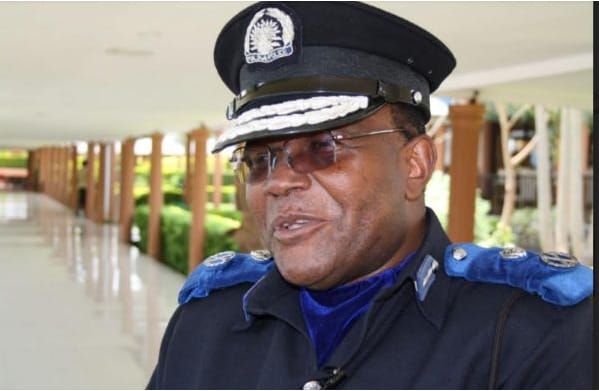
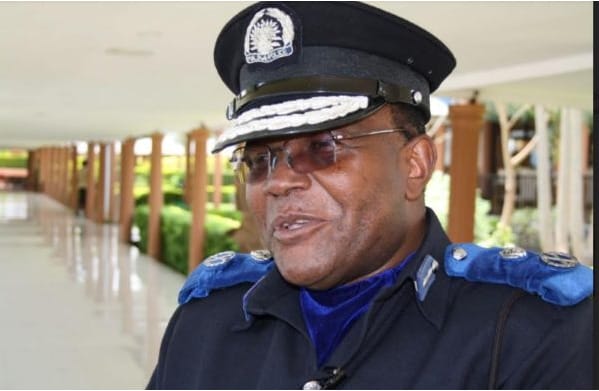
Malawi Police Chief George Kainja cornered in shameful nepotism, regionalism acts; Sidelines South in top hierarchy

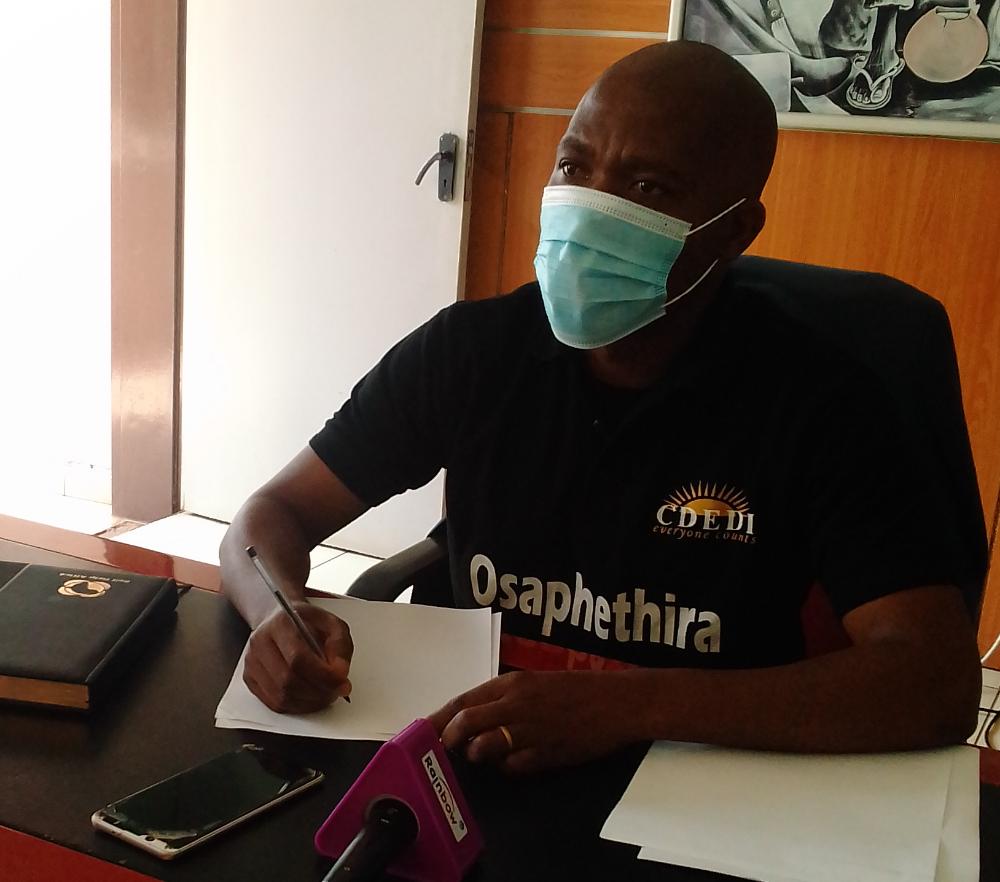
CDEDI Executive Director Sylvester Namiwa.

LILONGWE-(MaraviPost)-The country’s watchdog Centre for Democracy and Economic Development Initiatives (CDEDI) has exposed Malawi Police Service (MPS)’s Inspector General (IG) George Kainja’s pure nepotism and regionalism infesting in the force.

CDEDI told the news conference on Wednesday, October 6, 2021 that Kainja’s leadership on promoting nepotism, regionalism, favoritism defeats President Lazarus Chakwera’s Tonse administration agenda for one Malawi.

The grouping observes that there is no police officer from the Southern Region in the current Police High Command, which comprises three officers from the north, and 10—including the IG and his two deputies—from the
Central Region.

CDEDI has therefore given IG Kainja seven days ultimatum to rectify the anomaly in police service work force

“During a recent meeting CDEDI had with the IG, we put it to him that the Southern Region was not represented in the current Police High Command, but he vehemently denied this. Instead, he claimed that the police top brass was designed in such a way that it took into consideration traditional, cultural as well as geographical aspects of the country; hence his claims that three out of the 13 officers in the Police High Command, were from the South.

“Kainja’s claim prompted CDEDI to go further with its investigations, and we sourced a list of the Police High Command, from the previous administration, which is indicating that it comprised two officers from the North, five from the Centre, and five from the South. But the current composition of the Police High Command contradicts Dr. Kainja’s claims. While denying the tendencies of nepotism in MPS, in the meeting Dr Kainja blamed the Police Service Commission (PSC) for the imbalance in the current composition of the Police High Command, arguing that PSC was solely responsible for the hiring of the senior officers,” says CDEDI Executive Director Sylvester Namiwa.

Namiwa added, “CDEDI is, therefore, reminding Dr. Kainja, that the Tonse Alliance administration was ushered into government with a promise to correct the wrongs of the immediate-past administration.Now, if we compare the current list of the Police High Command with the previous one, it shows that are moving in reverse. Needless to say, that the police is not a political institution to practise retribution.

“CDEDI is, therefore, reminding Dr. Kainja, that the Tonse Alliance administration was ushered into government with a promise to correct the wrongs of the immediate-past administration.Now, if we compare the current list of the Police High Command with the previous one, it shows that are moving in reverse. Needless to say, that the police is not a political institution to practise retribution”.

There was no immediate reaction from Kainja from nepotism accusations.


ENTRENCHED NEPOTISM IN POLICE; SHRINKING SPACE FOR FREE SPEECH: THREATS TO NATIONAL UNITY AND DEMOCRACY


The Centre for Democracy and Economic Development Initiatives (CDEDI) has noted with deep concern glaring nepotism being manifested in the Malawi Police Service (MPS) under the leadership of Inspector General of Police (IG) Dr. George Kainja. And hereby gives the IG seven (7) days to address the anomaly.

Our investigations show that there is no police officer from the Southern Region in the current Police High Command, which comprises three officers from the north, and 10—including the IG and his two deputies—from the
Central Region.

During a recent meeting CDEDI had with the IG, we put it to him that the Southern Region was not represented in the current Police High Command, but he vehemently denied this. Instead, he claimed that the police top brass was designed in such a way that it took into consideration traditional, cultural as well as geographical aspects of the country; hence his claims that three out of the 13 officers in the Police High Command, were from the South.His claim prompted CDEDI to go further with its investigations, and we sourced a list of the Police High Command, from the previous administration, which is indicating that it comprised two officers from the North, five from the
Centre, and five from the South. But the current composition of the Police High Command contradicts Dr. Kainja’s claims. While denying the tendencies of nepotism in MPS, in the meeting Dr Kainja blamed the Police Service Commission (PSC) for the imbalance in the current composition of the Police High Command, arguing that PSC was solely responsible for the hiring of the senior officers.

Nonetheless, CDEDI has established that the IG sits on the PSC interviewing panel, and makes recommendations to the commission. This means that the IG has veto powers for the hiring and firing of the senior officers in the Police High Command. These findings have again contradicted Dr. Kainja’s claims that he was not involved in the process.

CDEDI is, therefore, reminding Dr. Kainja, that the Tonse Alliance administration was ushered into government with a promise to correct the wrongs of the immediate-past administration.Now, if we compare the current list of the Police High Command with the previous one, it shows that are moving in reverse. Needless to say, that the police is not a political institution to practise retribution.

SHRINKING SPACE FOR FREE SPEECH


CDEDI has also noted with great concern growing attempts by the Malawi Congress Party (MCP) and its operatives to mute dissenting voices. A case in point is that of the unwarranted threats being directed at the Democratic
Progressive Party (DPP) spokesperson Hon. Shadric Namalomba, who is being forced to resign from his position as Chairperson of the Public Accounts Committee (PAC) of Parliament on accusation that he is playing partisan
politics.

We at CDEDI neither agree with nor support Hon. Namalomba’s statement, which he authored on behalf of the DPP. But what is clear is that it has become a tradition for politicians in the country to double positions.

For instance, the country’s President Dr. Lazarus Chakwera, also doubles as MCP President; the Speaker of the National Assembly, Hon. Catherine Gotani-Hara doubles as MCP Deputy Secretary General (SG) whereas all Cabinet ministers double as political party functionaries.

This tradition, therefore, makes it impossible to separate party from government business affairs, hence the need to review the country’s laws in order to rectify this anomaly.

CDEDI has, unfortunately, observed that the perceived new MCP has inherited intimidation styles from DPP, which also tried but failed to silence dissenting voices.

We are, therefore, challenging the MCP, to accept that Malawi is a democratic nation where citizens are guaranteed a wide range of freedoms, including freedom of speech.

If Malawi is to make progress in all aspects, then it’s high time we all gave room to dissenting views and co-existence despite our ethnic, religious and political affiliations, for the sake of our hard-won democracy.

Signed By SYLVESTER NAMIWA, CDEDI EXECUTIVE DIRECTOR
CDEDI dates Malawi Police Chief Kainja on various human right concerns

Namiwa for good relationship with the police (from right)

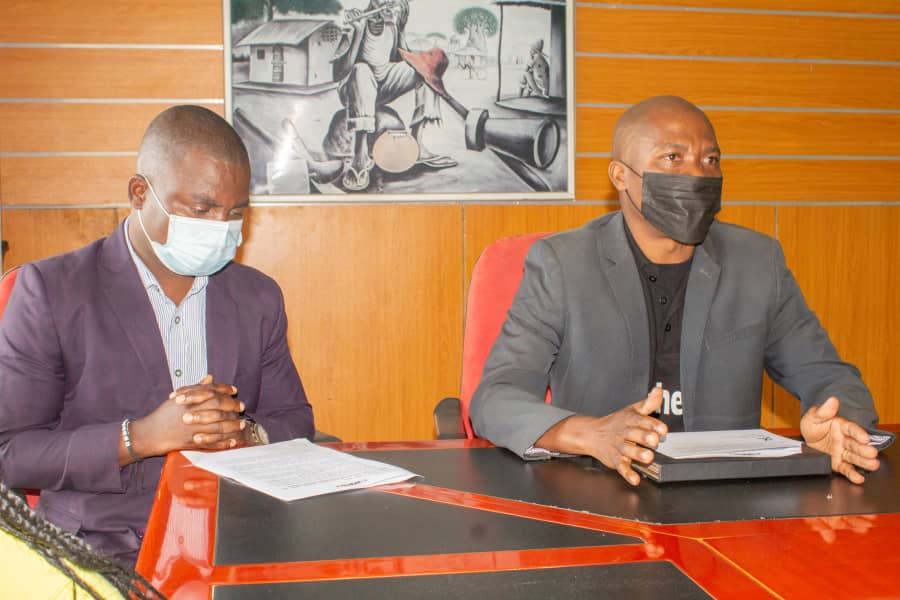
LILONGWE-(MaraviPost)-The country’s social right body Center for Democracy and Economic Development Initiatives (CDEDI) on Friday, October 1, 2021 engaged Malawi Police Service (MPS)’ Inspector General (IG) Dr. George Kainja on various human rights concerns that needed urgent attention of his office.

According to exclusive press release made available to The Maravi Post CDEDI presented various concerns which law enforcers are off track when executing duties including police and primary school learners fracas, use of excessive force and torture, preferential treatment of suspects and cases, entrenched nepotism in the MPS under the IG’s watch, abuse and ill-treatment of police officers, MPS relationship with the Rwanda police, implementation of Covid-19 enforcement measures, media freedom and among others.

CDEDI Executive Director Sylvester Namiwa indicated that the meeting ended in a good note as IG Kainja assured the grouping of serious intervention on the matters raised for improvement.

Below is the exclusive out of the meeting:

BRIEF OUTCOME OF THE AUDIENCE BETWEEN CDEDI AND THE OFFICEOF DR. GEORGE KAINJA, THE INSPECTOR GENERAL (IG) OF THE MALAWI POLICE SERVICE (MPS), FRIDAY, 1st OCTOBER, 2021


Center for Democracy and Economic Development Initiatives (CDEDI) had an audience with the Inspector General of Malawi Police, Dr. George Kainja, on Friday, 1st October, 2021, in order to seek answers on several questions the
Malawi citizens have been asking, in relation to the conduct of the police.

The meeting lasted about two hours. Dr. Kainja was flanked by the Deputy Inspector General (DIG) Operations Demister Chigwenembe and six other senior officers from the Criminal Investigation Department; the Department of
Operations; and the Legal Affairs Department.

Right at the onset, CDEDI would like to commend the IG, for accepting our call for the meeting. He acknowledged we had brought forward pertinent issues.

We agreed on some issues; and agreed to disagree on others. Nonetheless, the IG extended his apologies on some issues, while defending and being elusive on others.


The following in italics are the key points that were captured from the meeting against what was presented:
Police intimidation and torture While describing the developments in Thyolo and Mulanje as unfortunate, the IG
has pledged to launch investigations on the following issues which CDEDI had highlighted:


o The Estate owners in the tea growing districts of Thyolo and Mulanje arepaying the police to skin alive the landless people, that are seeking for justice to be served after their land was violently grabbed at gun point by
the white settlers from Britain;
o November 18,2020: The police invaded Kadaya, Kumadzi, Salubeni and Ngamawani Villages in T/A Kapichi in Thyolo, beating up and arresting women whose husbands were suspected to have committed various crimes, and were suspected to have run away at that material time;
o June 2021: The police in Mulanje arrested a minor and kept him in custody for three days, accusing him of stealing sugar cane from the estate;
o June 2021: The police descended on a 64-year-old Estele Maviyaje, beat her up, and broke her arm. As if this was not enough, they kept her in a police cell for three days, while being fully aware that her condition required medical attention;
o September 4, 2021: The police ransacked Mikundi village in Traditional Authority Mabuka in Mulanje, demolishing houses, throwing teargas canisters, and beating up innocent citizens including women, children and the elderly, apparently searching for stolen property from Seyama Tea Estate, a subsidiary of Lujeri Estate;
o The dubious arrest of a former Member of Parliament (MP), from Kasungu district, Alex Major, following his accusations that some State House officials and Cabinet Ministers had pocketed MK50 million (about
US$65, 000), from Malawian business persons of Asian origin;

The police and primary school learners

Dr. Kainja has conceded that it was very bad for the police to throw teargas canisters at Primary school learners. He has since apologized on behalf of the concerned officers. He pledged to investigate and bring the culprits to book.
o September, 2021: The police shamelessly threw teargas canisters at primary school learners at Luchenza primary school, who were protesting the arrest of one of their teachers suspected of violating Covid-19 preventive measures;


Use of excessive force and torture

The IG tried to defend the recent incidents involving the arrest of the truck drivers, who were on strike, arguing that the police is allowed by law to use force, claiming that the drivers turned violent and accused them of blocking the
M1 road, and resorted to beating up fellow truck drivers who were not taking part in the industrial action. However, we failed to agree on what constitutes force.

o September 28, 2021: The police arrested and tortured non-violent and unarmed truck drivers, who were exercising their constitutional right by withdrawing their labour, in order to have their grievances heard by the authorities, as well as their employers;

Preferential treatment of suspects and cases

Dr. Kainja was very elusive on this issue,by indicating that Pastor Martin Thom, who was arrested recently, was detained for 6 hours, and claiming that the suspect is in India for medical treatment. However, CDEDI has demanded the IG’s office to respond to our earlier request for the suspect’s bail conditions to be made public.

Dr. Kainja, however, has pledged to launch investigations into the rest of the issues CDEDI had outlined as follows:
o Malawians now have more questions than answers over the way the Malawi police handled the arrest of Pastor Martin Thom, the former Special Assistant to the State President Dr. Lazarus Chakwera.

The police moved with speed and unparalleled efficiency, that within an hour, Pastor Thom was arrested, cautioned, and released on bail.

The following day, Pastor Thom was reported to have travelled outside Malawi, where he is enjoying life normally;
o There have been no investigations yet by the Malawi government, following the mysterious death of a motorbike taxi operator in the capital, Lilongwe, in 2020;
o A suspect being kept in a police cell with a handcuff on;
o No compensation yet for the family of the late Inspector Imedi, who died while in the line of duty;
o The Mathabi police in Mulanje district, are dragging their feet to investigate the death of Dinala Chiponde, who is suspected to have been beaten to death by Seyama Tea Estate security guards for suspected of stealing blue gum trees;

Entrenched nepotism in the MPS under the IG’s watch

While acknowledging that currently only 2 people out of the 13 in the Police High Command are from the southern region districts, Dr. Kainja observed that it is not his office that makes such decisions, but rather the Police Services
Commission (PSC). He insisted that the commission promotes officers on merit.The IG further argued that the High Command is supposed to present the society. He said he is not responsible for the promotion of the senior police officers. Dr.

Kainja has since denied that he is favouring police officers from the Central and Northern regions.
o Before you were even confirmed as IG by Parliament, you transferred all the senior officers, whose districts of origin are from the Southern region of Malawi, and posted them to areas not befitting their ranks, without
following the proper procedures for transferring such senior officers;
o Currently, there is none from the southern region districts, who is a Commissioner of Police in all the six regions, including the South East in Luchenza, where it was expected that you would deploy someone from the same area, who at least understands the social and cultural issues in that region;
o There is none in the Police High Command or head of a department from the southern region districts, despite having some officers from the south, with what it takes to be in such positions;


Abuse and ill-treatment of police officers
Dr. Kainja has admitted that the police will have to continue providing security to the President, every time he is travelling by road in Malawi, contrary to Dr. Lazarus Chakwera’s campaign promise, where he indicated that he would not allow this tradition to continue, once he was elected as the country’s President.

The IG claimed that an attempt was made to withdraw such security during the former President Dr. Joyce Banda’s regime, with the assistance of the British government, where the police were trained to provide security to the President, without necessarily lining up on the streets. However, the IG claimed that such a system cannot work in Malawi.

Dr. Kainja explained further, that he already explained to the President that the police will continue providing security to the President, every time he is travelling on the roads of Malawi.

Dr. Kainja has also defended the recent interdiction of some police officers, accusing them of leaving their posts for beer drinking, adding that the police follow a disciplinary code of conduct.

The IG also indicated that looking at the gravity of the offence, he has powers to effect interdiction, adding that the police is very strict on beer drinking while in uniform, abuse of powers, and the use of excessive force.

Apart from cases of uncaged animals, mentally disturbed people, and what he termed as the nature of our roads and the civility of the road users to give way to presidential motorcade, Dr. Kainja said currently, Malawi faces terrorist scare, especially with what is happening in Mozambique.

The IG also explained that the police are provided with the necessary requirements when they are proving security to the President on the streets, such as food rations.

o Prior to the court sanctioned June 23, 2020 polls, Dr. Chakwera promised that the police would no longer stand for hours on the streets, waiting for the President to pass. The State House is now changing tune, claiming that it is the IG’s office that is still clinging to that tradition.

Why is the IG’s office clinging to this tradition when Dr. Chakwera already abolished it?
o Violation of principles of natural justice, where police officers are being interdicted without being given an opportunity to be heard;
o Police officers being made publicly to carry speakers for a Public Address system, to enable President Chakwera to address a crowd of people at a political rally;
o Police officers being made to stand on the streets, providing security to the President for hours, without any food or water;

The MPS relationship with the Rwanda police
Dr. Kainja claimed that Rwanda is an area of excellence in fighting terrorism, adding that it is not only Malawi police service that is interested in that area, but also other countries such as South Africa and Kenya. He nonetheless said that they are cautious about Rwanda’s human rights record, and that there is no need for Malawians and the Rwandan nationals to panic.
o Malawians were shocked to hear from the visiting Rwandan Police chief Dan Manyuza, that Rwanda intends to train the MPS.

There are fears that since Rwanda is not anywhere nearer to a model where other countries such as Malawi can learn anything from, due to its bad human rights record, one tends to wonder as to why Malawi has accepted to sign
a bilateral agreement with such a country. What are we really going to learn from Rwanda, when their police is used even to hunt and rain terror on its citizens that are currently in the diaspora?


Implementation of Covid-19 enforcement measures
Dr. Kainja claimed that his office already apologized to Malawians, due to the suffering they endured when the police were enforcing the Covid-19 preventive
measures. He has since extended the same apology through CDEDI.
These are the issues that were discussed during the meeting:

o Malawians have seen for themselves their own police administering corporal punishment to those suspected to have violated Covid-19 preventive measures;
o Hundreds of thousands of Malawians have been arrested for not putting on a face mask, and have been holed up in filthy and congested police cells, where there are no face masks either!


Media freedom
The IG has pledged to protect media freedom, and to ensure that the media practitioners operate freely, within the confines of the law. This as after CDEDI highlighted the following to the IG:
o Journalists being threatened, harassed, and beaten by some heavy handed and overzealous police officers. Some of the journalists include Watipaso Mzungu of Nyasatimes online publication; Enock Balakasi of Joy Radio; Oliver Malibisa of Likoma Community Radio; Henry Mhango, a correspondent for The Telegraph (United Kingdom), and the BBC Africa Eye;

The meeting ended with a pledge from Dr. Kainja, for continued engagement between CDEDI and the IG’s office, for the improvement of service delivery by the Malawi Police Service.

Signed by: SYLVESTER NAMIWA, EXECUTIVE DIRECTOR

Malawi police chief George Kainja given 14 days to act on police brutality against unarmed citizens

By Iommie Chiwalo

BLANTYRE-(MaraviPost)-The country’s human rights watchdog, Centre for Democracy and Economic Development Initiatives (CDEDI) has bemoaned the continued unwarranted use of force on unarmed citizens and has since given Police Tsar George Kainja 14 days to institute investigations so as to bring all the culprits to book.

In a statement made available to this publication and signed by CDEDI Executive Director Sylvester Namiwa the brutal acts by the police are affecting unarmed citizens especially women, children and the elderly in the pretext of maintaining law and order when misunderstanding arise.

Namiwa says cases in point have involved locals and estate owners in the tea growing districts of Thyolo and Mulanje.

He cited an incident which happened early this month whereby the Police in Mulanje went on rampage in Mikundi Village, in Traditional Authority Mabuka’s area, demolishing houses, beating up innocent villagers and throwing tear gas canisters, allegedly in an effort to deal with vandalising and stealing of Seyama Tea Estate property as an example.

The CDEDI Executive Director is of the view that there is no justification of police using force on unarmed and helpless citizens; hence calling the conduct as regrettable looking at the animosity created by the police in Mulanje between the estate owners and the villagers.

“We fear the unprofessional handling of the villagers over the said matter has potential to deny the area peace, which everyone desires,” he says.

On the demise of Dinala Chiponde, who was beaten by the estate’s security guards, allegedly after finding him stealing trees belonging to the estate, Namiwa says CDEDI has noted the shameless attempt by Mulanje Police to let alleged looting and stealing of Seyama Tea Estate property overshadow the death of the deceased.

It is reported that the deceased breathed his last while receiving medical treatment at Mulanje District Hospital on September 4, 2021. 

“We do not condone stealing, but we categorically condemn use of unwarranted force on any suspect as we believe police and courts are readily available to handle such matters, lest we continue losing lives needlessly, as has happened in Mulanje,” says Namiwa

He says CDEDI believes that Malawi police have professional civil methods that are supposed to be used when searching for stolen property and/or dispersing or controlling crowds, unlike the use of tear gas and excessive force, which is turning out to be the norm. 

“The Mulanje incident reminds us of other acts, which include recent firing of teargas on learners at Luchenza Primary School and the terror police in Thyolo unleashed, three months ago, on 64-year-old Estele Maviyaje, fracturing her arm in the process,”

Meanwhile, CDEDI has challenged Lujeri Tea Estate, which owns Seyama Tea Estate, to devise a mechanism to reconcile with the company and community members, including helping the traumatised women, children and the elderly to recover from the unwarranted police brutality.

Malawi Human Right Commission condemns Chakwera’s police for activist Sylvester Namiwa’s brutality; Demands IG Kainja’s explanation

LILONGWE-(MaraviPost)-The country’s state right watchdog Malawi Human Right Commission (MHRC) on Tuesday, August 17, 2021 condemned in the strongest terms any State sponsored attacks on human rights defenders and in particular the detention of rights activist Sylvester Namiwa of Centre for Democracy and Economic Development Initiatives (CDEDI).

The commission has expressed worrisome on how President Lazarus Chakwera’s Tonse government police manhandled Namiwa arguing that law enforcers hand no mandate harass him while he was exercising his rights to demonstrate.

In a press statement made available to The Maravi Post, the commission worried with police conduct that Namiwa was placed in a solitary cell at Lilongwe Police Station and was put in leg irons as if he was a dangerous criminal.

The commission’s chairperson Scader Louis therefore demands Inspector General of Police (IG) George Kaija explanation on Namiwa’s torture justification.

“IG Kaija must also explain and justify why a leader of a public demonstration should be put in leg irons. The Commission is concerned that Mr. Namiwa was not granted police bail on the same day of his arrest, although the reasons for his arrest were unjustified and he did not resist the arrest.Meanwhile, recent events have shown that some suspects being accused of serious criminal offences are being granted police bail.There must be consistency and fairness in treating all persons without discrimination.

“The Commission condemns in the strongest terms any State sponsored attacks on human rights defenders and in particular the detention of rights activist Mr. Sylvester Namiwa of Centre for Democracy and Economic Development Initiatives (CDEDI). All the actions of manhandling him and denying him bail were unnecessary and uncalled for. These actions are contrary to the police reforms that have been championed for decades.The Commission will therefore conduct full investigations into the matter and will release findings of the investigations in due course,” reads part of MHRC statement.

The Commission also calls upon the Commissioner of the Independent Police Complaints Commission to conduct independent investigations into this matter.

Malawi police are mute on Namiwa’s brutality but reports show that Msundwe battalion under Chakwera’s Malawi Congress Party (MCP) sanctioned the assault.

Below is Malawi Human Rights Commission (MHRC) statement:

PRESS STATEMENT CONDEMNING THE ARREST AND ILL TREATMENT OF HUMAN RIGHTS ACTIVISTS


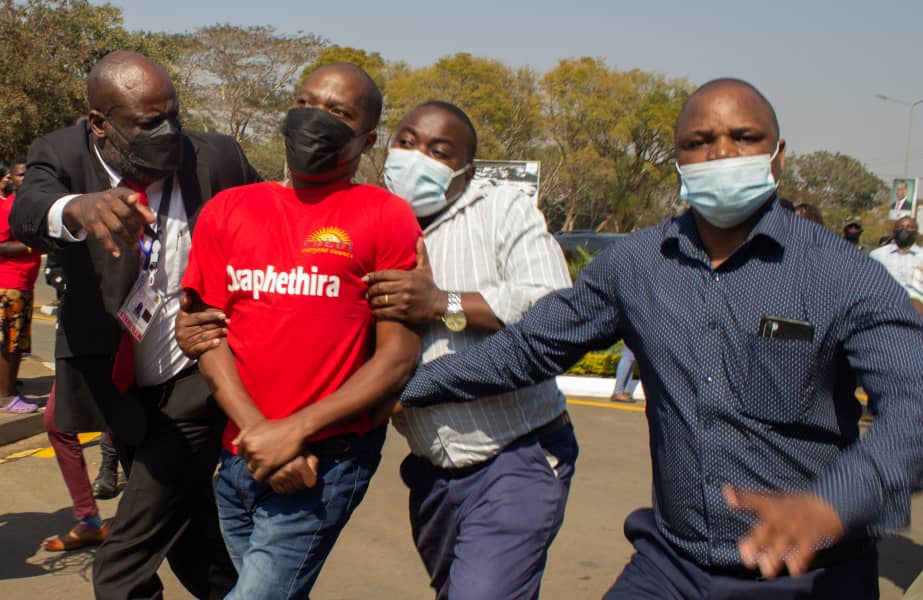
The Malawi Human Rights Commission (the Commission) has followed the developments surrounding the arrest of Mr. Sylvester Namiwa, the Executive Director for Centre for Democracy and Economic Development Initiative (CDEDI). Mr. Namiwa was arrested on Wednesday 11th August 2021 for allegedly organizing an illegal demonstration.

Mr. Namiwa had led demonstrations at the entrance of Parliament Buildings in Lilongwe. The demonstrations were
triggered by an allegation of the smuggling of a bill to Parliament by a Presidential aide and a public officer in the Ministry of Finance.

According to the police, Mr. Namiwa was arrested because the demonstrations were not sanctioned by Lilongwe City Council. Mr. Namiwa was released on court bail on Friday, 13th August 2021.

The Commission has conducted preliminary investigations on the matter and has noted a number of human rights violations.

Firstly, the Commission is concerned that a human rights activist was arrested for merely exercising his right. Albeit existing irregularities, the police ought to have stopped the demonstrations and not arrest the human rights activist.

Secondly, the Commission is concerned with the manner in which Mr. Namiwa was roughed up by the police during his arrest. This was undignified. As if that was not enough, he was handcuffed and whisked away to Linthipe Police Unit in Dedza, yet the events leading to his arrest happened in Lilongwe.

There was no justification for this action which in the process denied his relatives, lawyers and fellow comrades the right to communicate with him.

After he was taken back to Lilongwe, Mr. Namiwa was placed in a solitary cell at Lilongwe Police Station and was put in leg irons as if he was a dangerous criminal.

The Commission strongly condemns police action which is not in line with the Constitution of Malawi as well as international human rights standards.

Section 42 of the Constitution states that every arrested person must be held under conditions that are consistent with human dignity.

Placing a suspect of crime under leg irons is inconsistent with human dignity and should be condemned without any reservations.

It is a relic of the past and should not be condoned under the new democratic regime where our police service is expected to abide by human rights standards in the performance of their duties.

There is no justification at all for any suspect to be treated as if they are a condemned prisoner. One must always be presumed innocent until proven guilty by a competent court of law.

Again Section 42 of the Constitution states that a detained person must be given the means and opportunity to communicate with and to be visited by his or her spouse, partner, next of kin, relative, religious counsellor and medical practitioner of his or her choice.

The same section states that an arrested person must be allowed to consult confidentially with their legal practitioner.

The actions of the police by whisking Mr. Namiwa away from Lilongwe to Dedza made it very difficult for all these rights to be exercised.

The Inspector General of Police must explain why this was done and for what justification. He must also explain and justify why a leader of a public demonstration should be put in leg irons.

Furthermore, the Commission is concerned that Mr. Namiwa was not granted police bail on the same day of his arrest, although the reasons for his arrest were unjustified and he did not resist the arrest.

Meanwhile, recent events have shown that some suspects being accused of serious criminal offences are being granted police bail.There must be consistency and fairness in treating all persons without discrimination.

Finally, the Commission condemns in the strongest terms any State sponsored attacks on human rights defenders and in particular the detention of rights activist Mr. Sylvester Namiwa of Centre for Democracy and Economic Development Initiatives (CDEDI).

All the actions of manhandling him and denying him bail were unnecessary and uncalled for. These actions are contrary to the police reforms that have been championed for decades.

The Commission will therefore conduct full investigations into the matter and will release findings of the investigations in due course.

The Commission also calls upon the Commissioner of the Independent Police Complaints Commission to conduct independent investigations into this matter.


Dated this 17th Day of August 2021
Ms. Scader Louis
CHAIRPERSON