Togolese President Faure Gnassingbé has been appointed as the African Union’s new mediator in the ongoing conflict between the Democratic Republic of Congo and the Rwandan-backed M23 rebel group.
This role marks a significant shift in the AU’s efforts to resolve the crisis, as Gnassingbé replaces Angolan President João Lourenço, who stepped down to focus on Angola’s presidency of the AU.
The conflict in eastern DRC has intensified since January 2025, when the M23 launched a rapid offensive, capturing key cities like Goma and Bukavu in North Kivu province.
Despite previous mediation efforts by Angola, progress has been limited. Talks scheduled in Luanda failed after the M23 withdrew following EU sanctions on some of its leaders.
As the new mediator, Gnassingbé will work towards achieving “sustainable peace, reconciliation, and stability” in the Great Lakes region.
– Advertisement –
He faces the challenge of coordinating with other mediation efforts, notably those led by Qatar, which recently facilitated direct talks between the Congolese and Rwandan presidents in Doha.
Gnassingbé will also collaborate with a panel of five former African presidents appointed as facilitators by the Southern African Development Community (SADC) and the East African Community (EAC).
This team includes former presidents Uhuru Kenyatta of Kenya, Olusegun Obasanjo of Nigeria, Kgalema Motlanthe of South Africa, Catherine Samba-Panza of the Central African Republic, and Sahle-Work Zewde of Ethiopia.
The appointment of Gnassingbé signals a renewed push by the AU to resolve the conflict. However, the parallel mediation efforts by Qatar and the complex regional dynamics pose significant challenges. Gnassingbé’s diplomatic skills and Togo’s experience in regional mediation will be crucial in navigating these complexities and achieving lasting peace in the region.
LILONGWE-(MANA)-President Lazarus Chakwera has said strengthening bilateral relations with Mozambique is critical in enhancing development between the two countries.
The President made the remarks on Wednesday at Kamuzu International Airport before his departure for Maputo, Mozambique for a two day official visit.
Chakwera said at the invitation of his Mozambican counterpart, President Fillipe Nyusi, the two will discuss how the two governments can cement existing bilateral relations in critical areas of human and economic development such as trade and investment.
“This week the Southern Africa Development Community (SADC) will also hold a Heads of State Summit in Harare, Zimbabwe. The two events, demonstrate that we are part of the region and we have excellent ties with our neighbours,” he stated.
According to a statement from the Ministry of Foreign Affairs, it is expected that the two governments of Malawi and Mozambique will also sign agreements in several areas of joint permanent cooperation.
After the Mozambique visit, President Chakwera will proceed to Harare, Zimbabwe where he will attend the 44th Ordinary Summit of SADC Heads of State and Government to be held on August 17, 2024.
JOHANNESBURG, South Africa, May 11, 2023/ — Southern Africa Development Community (SADC) countries have taken commendable action to strengthen legal protections; however, there has been little or no progress by other Member States, and greater efforts are needed across the board to end child marriage.
Child marriage remains a widespread and persistent problem across Southern Africa. Two policy briefs on ending child marriage, highlighting the Gaps and Opportunities in Legislative Frameworks (https://apo-opa.info/41qHdka) and Domesticating the SADC Model Law in Child Marriage (https://apo-opa.info/3O17ORN) by the United Nations Population Fund (UNFPA) and Equality Now were presented to the Standing Committees of the Southern African Development Community (SADC) Parliamentary Forum.
The policy briefs focus on the progress of domesticating the SADC Model Law on Eradicating Child Marriage and Protecting Children Already in Marriage (Model Law) (https://apo-opa.info/41tqXiv) amongst SADC member countries, and focus on the gaps and opportunities in the laws that SADC countries have in place.
They identify obstacles impeding progress, including inconsistencies in national laws and a general lack of effective implementation of these laws, leading to low prioritization that impacts decisions to address child marriage. It also highlights positive legal advances, and makes recommendations to governments for strengthening eradication efforts.
SADC Model Law on child marriage
Child marriage is a formal or informal union where one or both parties are under 18 years old. Poverty, gender inequality, and cultural or religious beliefs affect girls. Child marriage places girls at increased risk of physical, sexual, and emotional abuse, and it keeps many trapped in a cycle of poverty. There is also a close correlation between early pregnancy and child marriage, which can be dangerous for the young mother and the baby.
The Model Law recognizes child marriage as a violation of children’s rights, including the right to health, education, and protection from harm. It sets the minimum age of marriage as 18 for both boys and girls without exceptions and promotes a comprehensive, multi-sectoral approach to ending child marriage.
The Model Law calls for a range of actions, including the unequivocal prohibition of marriage of children, the elimination of all legal and customary laws that permit it, and legal penalties for violations. It promotes the registration of births and marriages and requires that any marriage involving a child be declared null and void.
Gaps in protection
Despite commendable efforts by some governments, UNFPA and Equality Now identified various gaps in applying the Model Law. Deeply entrenched cultural practices, poverty, and limited access to education and sexual and reproductive healthcare are slowing progress and hindering efforts to reform marriage and family laws.
While legal reform remains a key strategy in addressing child marriage, the report recommends that governments close the divide between legal approaches and approaches aimed at influencing social and community norms. This requires balancing community awareness-raising with the prosecution and punishment of perpetrators.
“We call upon SADC Member States to prioritize legal reform to comply with international and regional human rights obligations and ensure that the minimum age of marriage is set at 18 across the board, without any exceptions. These laws also need to be effectively implemented using a multi-sectoral approach with adequate budgetary allocation,” summarises Divya Srinivasan, a human rights lawyer at Equality Now.
UNFPA East and Southern Regional Office Deputy Regional Director, Justine Coulson concludes, “Legal approaches need to be better embedded in the overall approach to ending child marriage. The Model Law is not just a proposed minimum standard indicating a need for compliance. It is an expression of social values and zero tolerance for child marriage, GBV and contributing to the improvement of SRHR such as reduction of teenage pregnancy.”
Distributed by APO Group on behalf of Equality Now.
LILONGWE-(MaraviPost)-Despite the country registers zero terrorism, Malawi has join the rest of SADC member states in encountering terrorism and violent extremism.
Minister of Homeland, Jean Sendeza disclosed this on Friday during a national round table on countering terrorism and violent extremism in Lilongwe.
SADC Members state against terrorism
Sendeza said the meeting will train security agencies and the judiciary in the country to be prepared in case the case of terrorism emerged.
She said terrorists are exploiting social media, encrypted communications and the dark web to spread propaganda, recruit new followers and coordinate attacks and our national strategy needs to be as responsive and multifaceted if the threats arise.
The minister said government will support civil society organisations who make a unique and invaluable contribution to tackling terrorism and preventing violent extremism.
She said CSOs will be engaging women and young people so that they can play meaningful roles in developing, monitoring and implementing counter-terrorism policies and programmes.
“There has been a shift towards less sophisticated attacks against softer targets that are more difficult to detect and prevent,So as the threat from terrorism continues to evolve, we must adapt and learn lessons from what works and what does not,” said Sendeza.
She therefore applaud United Nations Office on Drugs and crime(UNODC) for including Malawi as a beneficially to its project on Supporting SADC Countries to Strengthen Rule of Law-based Criminal Justice Responses for Preventing and Countering Terrorism and Violent Extremism’ under the UN Peace and Development Trust Fund.
In her remarks Chief Resident Magistrate, Madalitso Chimwaza said the training will help the judicially as well as all the security agencies in the country to administer fair justice on issues related to terrorism.
Chimwaza said the judicially is waiting for the upcoming bill in Parliament for proper consideration of terrorism cases.
BLANTYRE-(MaraviPost)-In his capacity as the Southern Africa Development Community ( SADC) President of the Republic of Malawi Lazarus Chakwera on Sunday December 12,2021 leaves for Botswana where he is expected to visit Secretariat Headquarters in Gaborone on December 13,2021.
According to a statement from SADC, President Chakwera will arrive on December 12, 2021 for a working visit and he will be received by the Minister of International Affairs and Cooperation Lemogang Kwape, on behalf of Boswana State President Mokgweetsi Keabetswe Masisi.
On Tuesday December 14, 2021, chakwera will pay a courtesy call on President Masisi.
” The SADC chairperson will be appraised on the status of implementation of SADC programs, decisions, and the 41st SADC theme ‘ Bolstering productive capacities in the face of COVID-19 pandemic for Inclusive, Sustainable and Economic Industrial Transformations. The SADC chairperson will also interact with the SADC Secretariat staff, provide guidance, and sign SADC legal instruments”, reads the statement in part.
President Lazarus Chakwera because the chairperson of SADC on August 17, 2021 during the 41st SADC Summit Heads of States and Government held in Lilongwe Lilongwe, Malawi.
As is customary, Chairpersons of SADC visit the SADC Secretariat Headquarters during their tenure to appreciate work done by the Secretariat in facilitating the SADC regional intergeneration agenda to provide guidance on the Secretariat’s implementation of SADC programmes.
Chakwera oversees the highest level of the governance structure of SADC, and among others, has the overall mandate of providing policy direction, and controlling the functions of SADC.
SADC is an organization of 16 Member of States in 1900.
The mission of SADC is to promote sustainable, and equitable economic growth and social-economic development through efficient, productive systems, deeper cooperation and integration, good governance and durable peace and security; so that the region emergencies as a competitive and effective player in international relations and and the world economy.
Dr Luwe (left) receives the hand sanitizers from Chakaniza
LILONGWE-(MaraviPost)-Ethanol distiller, Ethanol Company Limited (EthCo) has provided sanitizers to delegates at the 5th Southern Africa Development Community (SADC) Industrialization Week and Exhibition currently underway in Lilongwe.
EthCo Chief Executive Officer Lusubilo Chakaniza said during the donation of the SafeHandsTM brand of sanitizers in Lilongwe on Monday, November 22, 2021 that the sanitizers will be used by all delegates at the industrialization meetings for the whole week urging people not to relax in the fight against the Covid-19 pandemic.
“As EthCo, the safety of our stakeholders is a priority. Having been made aware that industrialists from the SADC region will be interacting at the Industrialization Week and Exhibition, we decided to play our role in continuing to prevent the spread of Covid 19 by donating SafeHandsTM hand sanitizers,” said Chakaniza.
Receiving the donation, Chairperson of the Health sub-committee of the exhibition Dr Yankho Luwe thanked EthCo for the donation of the hand sanitizers.
“We are very grateful for this donation from EthCo. It is of paramount importance that we should not relax in following COVID 19 preventive measures,” said Luwe.
Hosted by President Lazarus Chakwera in his capacity as Chairman of SADC, the event was officially opened on Monday by the Mozambican President Filipe Nyusi who was Guest of Honor.
SALIMA-(MaraviPost)-World Vision Malawi’s Indoor Residual Spray (IRS) being piloted in some parts of the country is said to be on track in Malaria fight.
World Vision Malawi Chief of Party, Bizwick Mwale said after the mass campaign, the organization saved money and Ministry of Health and the Global Fund allowed it to pilot the IRS in Mangochi district.
IRS intervention, according to Mwale, aims at reducing Malaria incidences by killing indoor-resting mosquitoes that carry malaria-causing mosquitos.
He was speaking on Thursday, November 11, 2021 in Salima during the commemoration of Southern Africa Development Community (SADC) Malaria Day and the launch of the 2021 bed nets distribution mass campaign.
“Since we started the IRS Campaign in 2019 in Mangochi district, children’s lives in the district have been saved. The district was recording 380 cases of Malaria out of every 1,000 people. In 2020, this fell to 254 and today, the district is at 183 which is way ahead of the national target for 2022.
“Based on these milestones, the Global Fund provided more funding and the project was in 2020 scaled up to Balaka and Nkhata Bay districts where preliminary results show some good progress too,” said Mwale.
According to Mwale, the 2021 IRS campaign commenced on 18 October in Balaka District and on 25 October in Mangochi and Nkhata Bay districts and will run for 36 days.
Minister of Health and Population, Khumbize Kandodo Chiponda however disclosed that Malawi government will provide treated bed nets to half of the country’s population in a bid to eliminate Malaria by 2030.
Chiponda said the government will ensure that “each of the targeted nine million citizens share their bed net with another person which will eventually protect at least the entire nation from Malaria”.
The government will implement the 2021 bed nets distribution mass campaign with support from various local and international development partners including World Vision Malawi, Global Fund and UNICEF.
The beneficiaries are reportedly expected to use the bed nets for the next three to five years.
Chiponda said Malaria still remains one of the main public health threats, which requires concerted efforts in Malawi and the SADC region in order to be eliminated.
“That is why, at the three day SADC ministers conference held in Lilongwe just before this event, Malaria was one of the main issues under discussion. Strategies were discussed of ensuring that Malaria is no longer a public health threat by 2030.
“Africa spends about 12 billion dollars on Malaria annually. There are 400,000 Malaria induced deaths in the SADC region annually. So, as SADC member states, we are coming together to ensure that we fight Malaria head-on,” said Chiponda.
In his remarks, SADC Executive Secretary Magosi implored member states to put together their strategies, resources, efforts, attributes and behaviours in order to eliminate Malaria across the region.
“Member states should also ensure that the policies and strategies and regulations are aligned to the regional approach so that all of them are actually acting accordingly. Resources need to be put to good use. There is also the need for more partnerships with all international cooperating partners so that they provide the resources to member states. As SADC secretariat, we will provide further strategies and tools to help member states to achieve their 2030 targets on elimination of Malaria,” Mogosi said.
As of 9th November 2021, (Day 20 of the IRS Campaign), almost 245,000 eligible structures were identified in the 3 districts and out of these 228,000 structures /houses have already been sprayed out of a total target of 539,000 eligible structures for the whole Campaign.
This represents 42.3%and we are on course to meet the target of covering at least 85% of the targeted structures houses.
At the end of the IRS Campaign, about 2.5 million people including women and children are expected to be protected from Malaria.
A similar mosquito nets distribution mass campaign was last done in 2018 where the Government of Malawi, through the Ministry of Health and the Global Fund, entrusted World Vision to distribute about 10.9 million bed nets to Malawians to prevent Malaria.
LILONGWE-(MaraviPost)-The southern Africa regional bloc, Southern Africa Development Committee (SADC), has agreed to extend the presence of regional troops battling insurgents in northern Mozambique.
Mozambique’s President Filipe Nyusi confirmed the extension late Tuesday, October 5, 2021 at the end of an extraordinary summit.
The first phase of the regional troop deployment was scheduled to end on 15 October.
The summit was called to assess the performance of the regional troops.
President Nyusi said that Mozambique was satisfied with the assessment made so far and that the situation had improved significantly in the affected areas.
The summit paid homage to three soldiers who died while on the mission in Mozambique. The three were from Tanzania and Botswana.
A TempCras dashboard remotely monitoring temperatures in cold rooms
By Pius Nyondo
TempCras – a new innovative technology that makes it easy to track and monitor temperature of cold rooms, refrigeration systems and cold vans – has hit the Southern Africa Development Community (SADC) region technology market and the developer, Engineer Alinafe Kaliwo, has challenged delegates in the ongoing 41st Ordinary Summit of SADC Heads of State and Government to use the platform as an opportunity to explore means on how they can support young technology entrepreneurs.
“After our successful business deals with various government agencies, commercial and non-commercial outfits we continue to get sound feedback and requests from would-be clients from across the SADC region. We currently have established ourselves in South Africa, and are ready to start rolling out big projects with our new clients here.
“It is my prayer that leaders meeting in the ongoing SADC summit dedicate more time to discuss technology for our region, and how young entrepreneurs in this part of Africa can be encouraged and supported in their various initiatives,” Kaliwo, who is chief executive officer (CEO) of Mechro Systems, said in an interview from Cape Town, South Africa.
SADC is holding its summit in Malawi’s capital Lilongwe which has pooled together 400 delegates from the sixteen member states. The theme of the summit is “Bolstering Productive Capacities in the Face of COVID-19 Pandemic for Inclusive, Sustainable, Economic and Industrial Transformation”.
Kaliwo said the TempCras technology is a user-friendly system that is easy to install and implement.
“We offer in-transit temperature monitoring solutions featuring alarming capabilities as well as reporting, and GSM cellular technology. One can access their temperature data while it’s on the go and save themselves the hassle of having to manually monitor temperature for their sensitive goods.
“For a very long-time producers of perishable goods such as fruits, meat and milk have had the problem of adverse temperature conditions damaging their products. This happens without any warning whatsoever which leads to loss of thousands if not millions of cash and resources. But for the last four years TempCras has been able to perfectly deal with such problems for some of the largest retail chain stores in Malawi,” he said, adding that the TempCras technology employs novel and advanced technologies such as Artificial Intelligence (AI), Machine Learning (ML) and Blockchain to seamlessly deliver satisfactory services to users.
Some of the largest retail chain stores in Malawi include Game Stores, Shoprite and Chipiku Plus, among others.
According to Kaliwo, it now lay in the hands of the present generation to think technology in averting various day-to-day trials including economic challenges.
“I was actually impressed when the state vice president, Saulos Chilima, presented a lecture last week on the need for SADC member states to embrace digitalization in this Covid-19 era and how he related digitalization and industrialization. That is the way to go,” he said.
According to information available on the TempCras website, Kaliwo has been awarded, recognized and won prizes across the world for his innovation including the Malawi Innovators Design Competition (2017) for Overall Best Project; MBC Innovations Awards (2017); Gist Tech-I Semi Finalist (2018) by AAAS America; SAS Awards Finalist (2018) for Southern Africa Region; Nigeria’s Tony Elumelu Entrepreneur of the Year (2018) and Gist Tech-I Semi Finalist (2019) by AAAS America.
Engineer Alinafe Kaliwo – TempCras developer, and Mechro Systems CEO
In his public lecture last week, titled ‘Promoting digitalization for revival of the Sadc industrialization agenda in the Covid-19 era’, vice president Chilima said there was “an urgent need for serious investment and that budgets in the Sadc region should support ICT as a transition to digital economies.”
The lecture, organised by the government of Malawi through the National Planning Commission (NPC), discussed, among others, how digitalization can turn out to be effective for Africa amidst Covid-19.
“I hope some of the recommendations made can be adopted and put into use both within Sadc bloc and locally,” said Chilima who is also minister responsible for economic planning and public sector reforms.
He said harnessing digitalization would be a “game changer for the Sadc region” towards a digital economy as the region continues to feel the pinch of the Covid-19 pandemic.
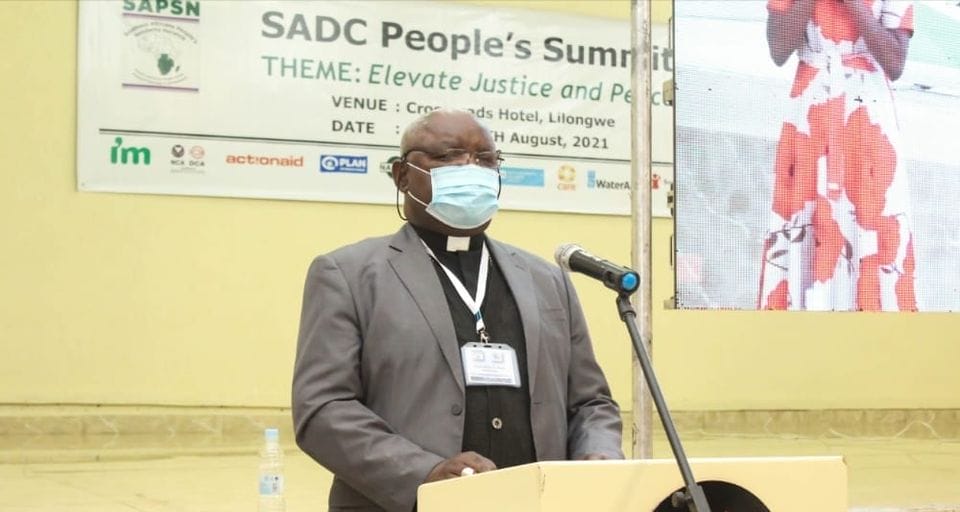
Bishop Mtumbuka challenges SADC leaders to embrace rule of law
BLANTYRE-(MaraviPost)—Malawi Economic Justice Network (Mejn) board chairperson Bishop Martin Mtumbuka has challenged Southern Development Community (Sadc) leaders to embrace tenets of rule of law saying lack of it is exacerbating corruption and governance conflicts in the Region.
Mtumbuka was speaking when he officially opened the Southern African People’s Solidarity Network (Sapsn) summit currently underway in Lilongwe.
Mtumbuka described Sapsn, a summit of regional civil society organisations, as critical in breaking what he called capitalist policies and decisions advanced by heads of states and government by presenting real issues affecting the poor on the ground.
“Lack of rule of law in our countries is amplifying inequalities to the effect that the rich are getting richer through dubious corrupt means while the poor are getting poorer and have no voice. Rule of law is a sure remedy to all this because it is an equaliser, no one should be above the law,” he said.
The People’s Summit is being held under the theme: Elevate Justice and Equality.
Meanwhile, President Lazarus Chakwera has now officially been handed over the leadership of SADC from Mozambican counterpart Felipe Nyusi.
In his acceptance speech, Chakwera has called for equality in the global distribution and production of Covid-19 vaccines.
He says Africans have a moral duty to refuse to be treated as second-class citizens. He says Africans have a moral duty to ratify the African free trade agreement.
Chakwera says Africa must insist on getting at least one seat on the Security Council of the United Nations.
Chakwera has also touted the Shire Valley Transformation programme as one local project that could spearhead regional industralisation. He says the bloc will introduce industralisation conference to be held in Malawi at a date to be announced.
Malawi breaking news and World News. News about Malawi, Malawi Business, Malawi Tourism, Malawi Politics, Malawi News, World and Africa Top News.