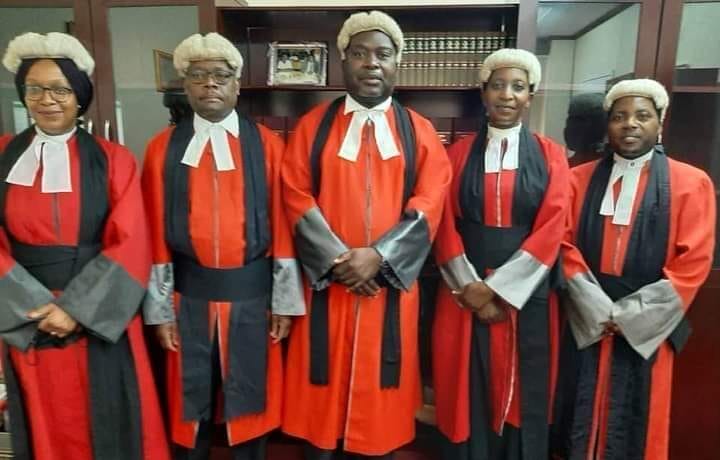
BLANTYRE-(MaraviPost)-The Malawi Attorney General (AG) Thabo Chakaka-Nyirenda on Wednesday, April 6, 2022 apologized for the arbitrary detention of Platform for Investigative Journalism (PIJ) Managing Director Gregory Gondwe.
Gondwe was detained by the Police on Tuesday April, 5, 2022 over the AG’s leaked legal opinion on government’s contracts agreement.
AG Thabo Chakaka-Nyirenda
He was then forced to disclose the source of a document he used in the story.
MISA Malawi Chairperson Teresa Temweka Ndanga confirmed in a statement that they held a meeting on Wednesday April 6, 2022 with Nyirenda in his office at Capital Hill in Lillongwe where he apologized for the blunder and made a comment that the government will repeal or review some archaic laws that restrict media freedom, freedom of expression and Violate right to privacy.
“The laws in question include sedition laws and and sanctions of protected flag, Emblems and Names Act which are used to punish government critics and are inconsistent with the Constitution of Malawi which guarantees freedom of opinion, freedom of expression and media freedom,” said Ndanga in a statement.
She added” Section 21 of the Malawi’s Constitution provides that every person shall have the right to personal privacy.
” Forcing a Journalist to reveal sources of their own information is against protection of legally privileged information and whistle blower protection provisions of the Access to Information ( ATI) Act.
” It is unfortunate that we are retrogressing instead of defending and building our nascent democracy”.
Police released Gondwe on bail but held on the computer and phone they confiscated overnight before returning them in the morning of Wednesday April 6,2022.
LILONGWE-(MaraviPost)-Malawi government through the office of the president and cabinet has forced the Governor of the Reserve Bank of Malawi (RBM) Wilson Banda to use his prerogative and appoint the Attorney General (AG), Thabo Chakaka Nyirenda who is on secondment in the Ministry of Justice to a position of a Director which is against the Banks promotion policy.
Thabo Chakaka Nyirenda caught greedy
Chakaka who was part of the legal team that represented President Chakwera while he was working at Reserve bank during the court appearances, which resulted into a re run was promoted from a position of supervisor to that of a manager after Malawi Congress Party (MCP) leads Tonse government took over power in 2020. This was a thank you as a token of appreciation for representing well MCP.
After being appointed Attorney General Chakaka has been pressuring office of President and Cabinet to appoint him a Director at the Reserve Bank of Malawi, as a way of securing his future at the central bank after serving the office of the Attorney general.
No employ from Reserve bank of Malawi is promoted while on secondment, the setting is that when one returns from secondment, he or she can ably be promoted but not when in secondment at another government department, ministry of agency.
Questionable appointment
The Governor of the Reserve Bank has been promoting his relatives in the Bank and those of his close associates.
Sources within the bank reveal that Wilson Banda has been recruiting sons and daughters of politicians just to secure his tenure and that of his political associates.
At the rate of appointments happening at Reserve Bank, members of staff have vowed to sabotage his tenure by allowing the kwacha to lose value through deliberately twisting figures.
LILONGWE-(MaraviPost)-The Attorney General (AG) Thabo Chakaka Nyirenda on Tuesday, February 1, 2022 failed to appear before Malawi Parliament’s Public Appointments Committee (PAC) to answer the law of statutory corporations.
According PAC,Chairperson ,Joyce Chitsulo said the AG did not communicate to her as a Chair of which the committee later heard from his secretary that Chakaka left for Blantyre for other duties.
Chitsulo said the committee seeks the AG to scrutinize the law of the statutory corporation, PAC as it observed that the mandate of the Department of Statutory Corporations established through a presidential Decree of 1982, was overtaken by the various Acts of Parliament .
Chitsulo observes that the establishment of independent Statutory Corporations by the Act of Parliament have,among others, granted the authority for the appointment of Chief Executive Officers and the management of the affairs of the corporations to the Boards of Directors for the Corporations.
She said the two sectors contradicts to the legal frameworks for that the Boards of Malawi Communications Regulatory Authority (MACRA), Malawi Energy Regulatory Authority (MERA), Lilongwe Water Board (LWB) and many other Statutory Corporations established by Acts of Parliament continue to refer their decisions on the appointment of CEOs to the office of the President and Cabinet for endorsement by the Minister responsible for Statutory Corporations.
Chitsulo added that the Committee, therefore, seeks your opinion as to whether the Statutory corporations are required by law to seek the endorsement by the said Minister responsible for Statutory Corporations where the Boards are granted the authority to make appointments.
She said the Committee seeks AG opinion on the relevance of the Department of Statutory Corporations in the management of the Statutory corporations considering that the authority over the affairs of the Boards is now in the hands of the Boards of Directors.
The PAC chair said the committee is concerned by the increase in appointments that are found wanting by the Ombudsman of which in some cases, the Ombudsman has nullified appointments.
She therefore said the committee’s feels that victimization of innocent persons for mistakes made by those that made the appointments In some cases, the nullification have exposed the government to contractual compensations.
Chitsulo therefore said committee wishes to inquire more from the AG as to what action government takes against the individuals that are involved in making irregular appointments.
BLANTYRE-(MaraviPost)-The country political activist Bon Kalindo popularly known as Winiko has given Anti-Corruption Bureau (ACB) Director General Martha Chizuma seven days to explain to Malawians as to why her office allowed the British National Crime Agency (NCA) to start probing arms deals Malawi purchased through Asian businessmen.
Kalindo has dared Chizuma to which law of the land did she use to allowed the Britons to have access to Malawi security agencies to the arm deals in the name of probing fraud.
The politician in an audio message to the public on Sunday, January 16, 2022 available to this publication has cautioned the ACB boss for hasty decision when carrying her duty saying she has personal agenda to achieve than that of the nation.
Kalindo wondered if Chizuma is credible enough to handle ACB office considering her corrupt and nepotistic tendencies at former office of Ombudsman.
The former UTM Youth Director claimed that Chizuma employed her relation at Ombudsman on nepotism grounds not on merit.
“Using Access of Information Act, I’m requesting Office of Attorney General and ACB to explain to Malawians on how the British firm was allowed to start probing British firm on arms deals without consulting Parliament or the nation at large.
“Do ACB and AG know the implications of engaging external agencies on national security. Where on earth does arms deal discussed on public forums? This is putting the nation on threats from our enemies who might later invade us knowing our arms strength,” queries Kalindo.
He dares Chizuma , “I’m giving you five days till Friday this week to explain to Malawians why did you allow this British firm to come to Malawi without respecting our sovereignty while arresting people without enough evidence.
“Much as I dont condone corruption in Malawi, but ACB boss Chizuma is cruising fast which might cost this nation heavily. She has ill-motive when handling issues at ACB which we will not allow. Chizuma must come clear on her involvment in hiring a relation as former Ombudsman if the nation must trust her.”
Kalindo also asked Attorney General Chakaka Nyirenda to explain to the nation on which law did the British firm use to invade Malawi territory on arms deal probe.
“We will mobilize Malawians to stage at your offices until you give good reasons for allowing the Britons to muzzles us otherwise better resigns as you have proved to be incompetent”.
Chizuma is currently under fire conniving with social media influencers by disclosing national security matters while ignoring ACB role in probing corrupt deals.
LILONGWE-(MaraviPost)-Malawi Attorney General (AG) Thabo Chakaka Nyirenda on Monday, January 10, 2022 had no clear answer on former President Lazarus Chakwera’s aid and personal friend pastor Martin Thom who was arrested on allegations that he took part in smuggling loan bill worth MK93 billion.
The pastor Thom was in July 2021 arrested but was released without formally charged the move that surprised many on selective justice President Chakwera’s Tonse is advancing.
When asked about the pastor’s case during government face the press on Monday in the capital Lilongwe, AG Nyirenda failed to give details on the matter instead said the matter was still under investigation.
The following week after arrested pastor was in August seen flying out to New Delhi, India via (Doha) Qatar on a Business class.
It was surprising to see someone who was on bail but he is able to fly out.
Thom Martin as a suspect was supposed to surrender all his traveling documents but he is free to fly out under Tonse administration led by Chakwera.
All what Chakwera promised Malawians were false hopes. He promised rule of law but he is the first to break it while Martha Chizuma is just watching.
Thoma Martin is flying on Kenyan KQ 731 airways. Our sources say he has been sent by his president to meet the Bank of Baroda in India to assure them that deal is still on.
His firing was to limit public anger .
Chakwera is said to have already got his cut as an advanced commission.
We understand that Chakwera now fears that the loan may not go through with the people protesting against the lawless procedure Chakwera followed
President is said to have sent his brother in crime to travel to India to meet the bank directors to sort out the mess.
He was traveling on E_ ticket no. 1576369644375 // and will be returning on 23 August from India arriving in Lilongwe on 24th August.
Malawians must know that the arrest was just a smoke screen yet the culprit is walking freely in our streets and addressing the nation as a saint yet he is behind all these scandals.
Till now, no comment from State House, Malawi Police and Foreign affairs on Pastor Thom’s trip purpose as the public continues to speculate.
Prof Chirwa: The Attorney General has no authority to terminate government contracts. The office can advise, but it’s a party to the contract that can terminate
PRETORIA-(MaraviPost)-One of the country’s renown Law of Professors, Danwood Chirwa says Malawi Attorney General Thabo Chakaka Nyirenda has no mandate to terminate government contracts.
Professor Chirwa writes:
The weekend is private time. Plus I said we’ve lost the game already. This is my last post on this ‘regime’. The answers to the questions are:
The Attorney General has no authority to terminate government contracts. The office can advise, but it’s a party to the contract that can terminate.
There’s no amnesty law in Malawi and as such the Attorney General has no legal authority to issue amnesty from criminal prosecution. There is no precedence for it and such a practice won’t start now. There can be no justification for such a law, in any case. It would empower the Attorney General to act like God in a democratic state where equality before the law is sacrosanct.
The Attorney General has no legal authority in criminal matters, both investigations and prosecutions. The office can issue general directions to the Director of Public Prosecutions (DPP) and Director of the ACB, but it cannot usurp the powers of the DPP or the ACB Director. So the press statement is simply unlawful.
Lastly, the press statement amounts to unlawful interference by the Attorney General with the independence of the DPP and the ACB Director. The DPP and the ACB must continue with their work free from influence.
LILONGWE-(MaraviPost)-The Attorney General Thabo Chakaka Nyirenda faces heavy criticism for giving 60-day general amnesty to top government officials suspected to have connived with some Asian business persons who have been defrauding Malawi government.
In a statement made available to the publication Chakaka Nyirenda said the 60-day general amnesty is online with Pursuant to justice and restitution balancing act.
“AG wishes to announce a 60-day general amnesty to all those who might have defrauded Government or illicitly acquired wealth whether through procurement fraud and corruption or otherwise, but willing to restitute or voluntarily surrender the said wealth within 60 days from the date hereof,”
He added: “The amnesty extends to the 77 Cashgate files that are currently before the prosecution authorities, the commercial banks that facilitated Cashgate.”
Reacting to the development, some Malawians on the social media has asked AG to name and shame those people suspected to have connived with Asian business spokesperson before giving them 60-day amnesty.
According to some of the comments on facebook, a majority of Malawians thinks the move by Chakaka Nyirenda aims at protecting Tonse administration officials implicated the Asian business persons scandal.
“No to amnesty, and firstly we need to know the people involved otherwise this can be a way of protecting cronies and bigwigs involved. Is there a law which supports such Amnesty?” a social media user Morgan Banda posted on facebook.
“This Chakaka Nyirenda has no moral grounds to issues such an order while his Chakwera aids still at large after committing numerous corruptions offence,” James Kalawe added.
The Anti-Corruption Bureau (ACB) recently arrested President Lazarus’s trusted cabinet Minister Kezzie Msukwa in connection to land deals probe.
The ACB further announced to make more arrest in connection to the scandal.
Chakwera is said to be protecting corrupt ministers including Msukwa has failed to be charged in the court of law.
LILONGWE-(MaraviPost)-The Office of the Attorney General has described as baseless an application for permission of judicial review and an injunction stopping government from implementing Mandatory COVID-19 vaccination to some groups of people.
Attorney General (AG) Thabo Chakaka Nyirenda ‘s remarks comes as Center for Democracy and Economic Development Initiative (CDEDI) and journalist Mundango Nyirenda have applied for an injunction seeking to restrain government parliament and institutions from implementing the mandatory COVID-19 vaccination.
Nyirenda said CDEDI and the journalist have sued wrong parties as the office of the Attorney General and parliament have never made a decision for mandatory Covid-19 vaccination.
The AG also said the ministry of health is an improper party to the case as no decision has been made and implemented yet arguing that there are only plans to introduce mandatory vaccination in January.
He said the law provides that one does not commence proceedings on future events but one can only commence proceedings on things which have happened and have caused a injury arguing CDEDI has not suffered any injury yet.
Secondly, Nyirenda said there is nothing unconstitutional about vaccination saying the constitution only bars forced medical experiments or trial saying that vaccination is not a medical experiment or trial .
Further Nyirenda said the constitution does not talk about vaccination.
Thirdly, the AG has said human rights have corresponding responsibilities insisting that there is no human right that is superior to the other.
”Plus, there is evidence that the vaccinated stands a less chance of infecting others and getting infected. If one says that he or she has a right not to be forced to receive the vaccine- he or she has also a right not infect another person with a virus.” Nyirenda said in an interview.
The court injunction is expected to be heard on January 3, 2022.
AG Thabo Chakaka Nyirenda outshined the DPP legal team
There is a lot of excitement from the ruling party supporters following the judgment which was in their favour. Felicitations!!!
Unfortunately, many DPP supporters have expressed their disappointment with the ruling citing a number of anomalies. That is not surprising too.
In any court case, there is usually one winner. Judges use a multiplicity of criteria to come up with a verdict.
It is not right to think that all court determinations are correct and just. In fact, various judges and magistrates can handle the same case differently.
However, the painful truth remains the same; whether the verdict is biased or not, it must be carried out or implemented. It is therefore important to accept the judgment and move on. Yes, what next then?
The AG, Thabo Nyirenda
Many people underestimated his legal prowess cognizant of his record of losing court cases especially when he was a legal counsel for the Anti-Corruption Bureau (ACB) and the Reserve Bank of Malawi (RBM).
Despite his good connections with the Judiciary staff, the AG managed to put up a good argument against the embattled Democratic Progressive Party ( DPP).
It was Thabo Nyirenda who convinced a panel of five judges that the issue at hand is res judicata, a case whose final determination was already delivered.
Yes, Judge Kenyatta Nyirenda had ruled that the rescission of the appointment of the impugned Malawi Electoral Commission (MEC) commissioners did not affect the results of the elections. This is why DPP did not challenge Judge Kenyatta Nyirenda’s verdict.
But still a question remains unanswered. Didn’t the rescission of MEC commissioners’ appointment affect the quorum of MEC?
The Constitutional court deliberately eluded this question because they would definitely contradict Judge Kenyatta’s verdict.
I still find Judge Kenyatta Nyirenda’s line of argument erroneous despite later being adopted by a panel of five judges.
Still, congratulations are in order to AG Thabo Nyirenda for winning the case. This has elevated your legal profile.
DPP
Life must move on despite experiencing losses in a series of court cases.
I reiterate that I still find the questions raised by DPP still unanswered.
Contrary to the assertions by the Constitutional Court that DPP can appeal the case, it still remains a mystery how DPP can appeal the case when it is not challenging Judge Kenyatta’s verdict. DPP is now pushed to the tight corner with no practical legal remedy.
I also find that DPP shot itself in the foot. How could the whole professor of law, Peter Mutharika, comment on issues that were before the court?
At a rally in Blantyre, Peter Mutharika insinuated that he would stand as a presidential candidate if 2020 fresh presidential elections are nullified. Gosh!!! These utterances could have given judges a loophole that APM masterminded the whole court case. APM could have crossed the bridge when he reached it.
So DPP must accept that the next elections are in 2025. Forget about any court cases, start building your party for the next general elections.
Immediately, call for an early elective convention. Choose a new successor as soon as possible. Let APM be the patron of the party.
Judges and the judiciary
There are a lot of contradictions coming from the case’s verdict.
Yes, we understand that different judges can handle different cases differently.
However, Malawians expect the Judiciary system to deal with court cases with the required objectivity, consistency and professionalism.
One unfortunate incident was when 2020 Constitutional court judges were allowed to override the decisions of the higher court, Supreme Court of Appeal. This is an anomaly.
I am still skeptical if the Judiciary has time to review all case verdicts and later provide guidance to its staff for consistency sake.
The former AG, Chikosa Silungwe
Nescience forces people to think that all attorney generals will give the same legal opinion on issues. This is wrong.
I still find the legal opinion given by the former AG very unconfrontational, amicable and professional.
Most atheists like Dr. Chikosa Silungwe handle issues with the required professionalism and integrity.
If the embattled commissioners were offered their appointment letters as opined by the former AG, all these useless court battles would have been avoided. Much respect to Dr. Chikosa Silungwe.
Let us sow seeds of tranquility and peace rather than seeds of retribution.
The citizens
Democracy is the government of the people, for the people and by the people.
We are the masters of all politicians. We put all politicians in power and therefore we can also remove them.
We have the power to shape our country to doom or to prosperity.
As citizens, we have a responsibility to hold all politicians accountable.
Don’t be a mediocre by supporting and defending politicians who are geared to defraud our government coffers.
If we made a mistake in 2020 elections, we have another chance in 2025 to change the destiny of this country.
The High Court in Blantyre, sitting as Constitutional Court, has thrown out the Democratic Progressive Party’s application for the nullification of the 2020 Fresh Presidential Elections, describing it as an abuse of the court process and an attempt by the DPP to benefit from its own illegality.
The former governing party sought a constitutional interpretation after the High Court in Lilongwe, hearing Malawi Congress Party (MCP) vs President of Malawi, ruled that four Malawi Electoral Commission (MEC) commissioners were appointed illegally.
The DPP argued that since the four commissioners were part of the commission that managed the 2020 presidential elections, then the elections cannot be valid.
However, in preliminary objection, Attorney General (AG) Thabo Chakaka Nyirenda prayed for the case to be dismissed before the hearing of the main case because, arguing the DPP wanted to benefit from its own illegality.
In its ruling, the panel of five judges led by Justice Selvester Kalembera agreed with the AG on several grounds he raised before the court, praying that the case be dismissed
The Court agreed with the AG, saying nullification of Fresh Presidential Election as asked by the DPP will have the effect of having the DPP benefit from its own illegality as status quo in the presidency will revert to the period before the fresh elections.
“We cannot imagine a more classic example of one seeking to benefit from their own illegality than this.
“What we have are illegal nominations by the DPP followed by illegal appointments by the former President who incidentally is also the president of the DPP,” the court said.
The court also found that the issues DPP took to the court were already disposed of by the court in Malawi Congress Party (MCP) vs President of Malawi and what was needed after that case was an appeal, not a fresh case as commenced by the DPP.
“We find that it is an abuse of court process for the DPP to bring this application in the manner they have done.
“We have established that this matter is not only an appeal in disguise but also re-litigation. The fact that the DPP is crying out constitutionalism and rule of law does not change the nature of proceedings before us into a constitutional matter and does not compel us to sanction abuse of court process,” the court said.
“The Claimant is trying to re-litigate through the backdoor. In a popular parlance: he is trying to take a second bite at the cherry. This we will not condone.”
“We agree with the Attorney General that this Court cannot allocate to itself powers that have not been conferred upon it by the law.”
The Court further determined that DPP filed the suit incompetently by suing a wrong party.
“The Claimant commenced these proceedings against “The Attorney General (on behalf of the ‘Office of the President of the Republic of Malawi’)”. The Court’s finding is that there exists no juristic person known as the ‘Office of the President of the Republic of Malawi’.
“Whilst the Attorney General can be sued on account of the actions or omissions of the Government or a public officer, he is not sued in abstract. Since the ‘Office of the President of the Republic of Malawi’ is not a legal person, the Attorney General has been sued in abstract and is therefore a wrong party. The action is futile and the Court upheld the preliminary objection on this issue.”
The Court. therefore, struck out the Claimant’s action in its entirety and further ordered the DPP to pay the cost to the Attorney General.
In June this year, the High Court quashed the appointment of four DPP commissioners Jean Mathanga, Linda Kunje, Steven Duwa and Arthur Nanthuru, saying their appointment was invalid and unconstitutional.
The court acted after the governing Malawi Congress Party had challenged the appointment of the commissioners.
In his ruling, Judge Kenyatta Nyirenda further said the quashing of the appointments did not affect the validity of the June 2020 re-run presidential election.
Below is a summary of the ruling:
Issue 1: Whether the Attorney General must take an oath of office in order to have standing in court.
2. The finding of the Court is that the framers of the Constitution did not intend for the Attorney General to take an oath of office. The Court finds that the Attorney General was properly before the Court. Consequently, the Court dismissed this preliminary objection.
Issue 2: Whether the High Court has jurisdiction to overturn or review its own decision, whether a High Court judgment can constitute a cause of action, and Page 2 of 5
whether the present proceedings are aimed at reviewing or appealing against a decision of the High Court on similar issues.
a. Effect of certification
3. The Claimant advanced the view that the certification rendered it mandatory for the Court to proceed with the determination of the questions in the Referral and to disregard the preliminary issues. Having found that the certification was made subject to the Referral and that Order 16 rule 6 of the CPR allows a court to consider preliminary issues, the Court concluded that the said preliminary issues were rightly before the Court and the Court was within its legal mandate in entertaining them. The certification does not have the effect alleged by the Claimant and the dismissed what the Claimant advanced herein.
b. Whether this matter is an appeal
4. The Court having established that the issues in these proceedings are the same as those in Malawi Congress Party v The President of the Republic of Malawi which was decided by the High Court, Lilongwe District Registry. Therefore, this was an appeal in disguise and this Court has no jurisdiction to entertain it. Consequently, the Court upheld this preliminary objection.
b. Whether this matter is res judicata
5. The finding is in the affirmative as the three prerequisite elements establishing res judicata (re-litigation) namely, existence of a final judgment, identity of parties and identity of subject matter obtain in this matter. Consequently, the Court upheld this preliminary objection.
d. Whether or not this court is functus officio
6. The concept of functus officio is inapplicable in the present case for the reason that it was not this Court which rendered the judgment in Malawi Congress Party v The President of the Republic of Malawi, which was registered as Judicial Review Cause no. 34 of 2020 and heard at the High Court Lilongwe Registry. Consequently, the Court dismissed this preliminary objection. But the matter is still caught by res judicata.
e. Whether or not the judgment in Malawi Congress Party v The President of the Republic of Malawi constitutes a cause of action
7. The Defendant argued that these proceedings were incompetent because the Claimant was relying on the judgment in Malawi Congress Party v The President of the Republic of Malawi as its cause of action. The Court having established that the judgment does not constitute a cause of action. Consequently, the Court upheld this preliminary objection.
Page 3 of 5
Issue 3: Whether the present proceedings should have been commenced by way of petition as opposed to summons.
8. The Court rejected the Defendant’s assertion that this is an election matter which should have been commenced by way of petition. The reason is that the three factors that must obtain in an election petition have not been satisfied, in that (i) the complaint did not arise “due to an act or omission during an election,” (ii) the Claimant had no right to be elected at an election and (iii) the Claimant was not a candidate at such election. The dismissed this preliminary objection. Notwithstanding the Court’s position on this issue, the Court has maintained its finding that this action is an appeal in disguise and/or an attempt by the Claimant to have a second bite at the cherry.
Issue 4: Whether or not the present proceedings are statute barred under section 100 of the PPEA, having been commenced more than seven days from the declaration of the result of the election.
9. Having established that these proceedings do not constitute an election matter the limitation period of seven days under section 100 of the PPEA does not apply. The Defendant’s preliminary objection was accordingly dismissed.
Issue 5: Whether a political party has locus standi to challenge the results of an election and whether the Defendant is a proper party to the present proceedings.
b. locus standi of the Claimant
10. Having established that this present action is an appeal in disguise and/or a re-litigation of the issues, the finding is that the Claimant lacks standing to approach the Court in the manner it has done by commencing fresh proceedings. The Court therefore dismissed this preliminary issue on that premise.
b. status of the Defendant as a party
11. The Claimant commenced these proceedings against “The Attorney General (on behalf of the ‘Office of the President of the Republic of Malawi’)”. The Court’s finding is that there exists no juristic person known as the ‘Office of the President of the Republic of Malawi’. Whilst the Attorney General can be sued on account of the actions or omissions of the Government or a public officer, he is not sued in abstract. Since the ‘Office of the President of the Republic of Malawi’ is not a legal person, the Attorney General has been sued in abstract and is therefore a wrong party. The action is futile and the Court upheld the preliminary objection on this issue.
12. Notwithstanding the Court’s position on this issue, the Court maintained the finding that this action is an appeal in disguise.
Page 4 of 5
Issue 6: Whether non-compliance with section 4 of the Civil Procedure (Suits by or against the Government or Public Officers) Act is fatal to the proceedings commenced against the Attorney General and whether the present proceedings can be dismissed for failing to comply with section 4 of the said Act.
13. The finding that the requirement for the section 4 notice requirement of 3 months cannot be dispensed with for the reason that these proceedings were commenced by a summons under Order 5 of the CPR. The Court upheld the preliminary objection on this issue.
Issue 7: Whether the Claimant having deliberately contravened the law in recommending the appointment into the Commission, more than three nominees, should be allowed to benefit from its own illegality and whether it should be estopped from challenging the decisions of the members of the Commission who were appointed into the Commission in contravention of section 4 of the Electoral Commission Act.
Issue 8: Alternatively, whether the present proceedings seek to benefit the Claimant from its own unlawful and illegal act.
14. These two issues were addressed simultaneously. The Court in Malawi Congress Party v The President of the Republic of Malawi specifically held that the conduct of the Claimant in nominating more than three names and the appointment of more than three Commissioners representing the Claimant to the Sixth Cohort of the Commission were illegal. The finding is that the principle relief sought by the Claimant, namely, nullification of the results of the FPE 2020 and the subsequent Parliamentary and Local Government by-elections, if granted, would have the effect of benefiting the Claimant from its own illegality, in that the status quo would revert to the pre-FPE 2020 political set up. The preliminary objection is upheld.
Issue 9: Whether or not the present proceedings are frivolous, vexatious and an abuse of the court process and a waste of the Court’s time.
15. Having found that these proceedings are an appeal in disguise or an attempt to re-litigate the issues in Malawi Congress Party v The President of the Republic of Malawi which are caught by the doctrine of res judicata, the Court concluded that the present proceedings are frivolous, vexatious and an abuse of the process of the court. The preliminary objection was upheld.
Issue 10: Whether or not the courts are there to offer gratuitous constitutional or legislative interpretation.
16. Under section 9 of the Constitution the Judiciary has the responsibility of interpreting the law within the context and framework of legally relevant facts and final settlement of legal disputes. The issues raised in this matter were dealt with to finality in the case of Malawi Congress Party v The President of the Republic of Malawi. The Claimant accepted both the rescission letter and the judgment in Malawi Congress Party v The President of the Republic of Malawi. This implies that there is no dispute for this Court to determine and that the
Page 5 of 5
Claimant merely seeks the Court’s advisory opinion. The finding is that the present matter is not within the jurisdiction and competence of this court. The preliminary objection was upheld.
Issue 11: Whether or not the matters herein are moot or academic.
17. Having established that no cause of action has arisen and that the Claimant has not shown that any dispute has been triggered and that the Claimant only seeks this Court’s advisory opinion, the Court concluded that the present matter is moot, hypothetical and academic. The preliminary objection is upheld.
Issue 12: Forum Shopping
18. Before making the final pronouncement the Court shared its observations on the malpractice of forum shopping, also known as judicial tourism, which the Court observed that it happened in this case.
ORDERS
19. In consequence of the foregoing findings the Court had made the following orders: c. The action is struck out in its entirety on account of, inter alia: i. the proceedings being an appeal in disguise;
ii. the proceedings being res judicata;
iii. the judgment relied upon not constituting a cause of action;
iv. a non-existent party being sued;
v. the Claimant’s failure to comply with the notice requirement under section 4 of the Civil Procedure (Suits by or against the Government or Public Officers) Act;
vi. the Claimant being precluded from benefitting from its own illegality; and
vii. the proceedings being frivolous, vexatious and an abuse of the court process.
d. The Claimant’s action having been struck out the Claimant is condemned in the Attorney General’s costs.
Malawi breaking news and World News. News about Malawi, Malawi Business, Malawi Tourism, Malawi Politics, Malawi News, World and Africa Top News.