world & Malawi National News and Headlines. – View the latest National news and breaking news today for Malawi from maravipost.com, world, weather, entertainment, politics and health at maravipost.com
BLANTYRE-(MaraviPost)-Malawi Football National men team, Flames coach Kalisto Pasuwa has named a 27-man squad for the TotalEnergies CAF African Nations Championship (CHAN), Kenya, Tanzania, Uganda 2024 qualifier against Comoros next week.
The Flames will face Comoros in an away assignment at Bingu National Stadium on Sunday March 2 and in a home fixture at the same venue on Saturday March 8.
CAF has confirmed the fixtures of the two matches with Comoros playing their home match in Malawi as they do not have a homologated venue.
Pasuwa, who was confirmed as Flames full time coach on a two-year deal last week, has maintained the bulk of the backroom staff he worked with during his tenure as interim coach during the last two 2025 AFCON qualifiers against Burkina Faso and Burundi in November last year.
The only two new faces are Team Doctor Felix Mwalule and Analysts Michael Ngole.
The winner between Malawi and Comoros will face the winner between South Africa and Egypt in the last round of the qualifiers with the winner of that tie booking a place at the final tournament to be held in Kenya, Tanzania and Uganda in August.
The Flames are expected to regroup at Mpira Village in Blantyre today.
The following is the full squad:
Goalkeepers: Richard Chimbamba (Nyasa Big Bullets), George Chikooka (Silver Strikers) Amos Sande (Ekhaya FC)
Defenders: Khumbo Banda (Premier Bet Dedza Dynamos), Cris Lwemba (Creck Sporting) Mark Lameck, Maxwell Paipi, Nixon Mwase (Silver Strikers) Timothy Silwimba (Mighty wanderers), Alick Lungu (Nyasa Big Bullets), Joseph MacDonald (Ekhaya FC)
The emergency polio outbreak response in the Gaza Strip is continuing, with a mass vaccination campaign scheduled from 22 to 26 February 2025. The novel oral polio vaccine type 2 (nOPV2) will be administered to over 591 000 children under 10 years of age to protect them from polio. This campaign follows the recent detection of poliovirus in wastewater samples in Gaza, signaling ongoing circulation in the environment, putting children at risk.
Pockets of individuals with low or no immunity provide the virus an opportunity to continue spreading and potentially cause disease. The current environment in Gaza, including overcrowding in shelters and severely damaged water, sanitation, and hygiene infrastructure, which facilitates fecal-oral transmission, create ideal conditions for further spread of poliovirus. Extensive population movement consequent to the current ceasefire is likely to exacerbate the spread of poliovirus infection.
Two previous vaccination rounds in the Gaza Strip were successfully conducted in September and October 2024, reaching over 95% of the target. As poliovirus is found to remain in the environment, additional vaccination efforts are needed to reach every child and strengthen population immunity. The presence of the virus still poses a risk to children with low or no immunity, in Gaza and throughout the region.
In 2024, health workers faced significant challenges accessing certain areas of central, north and south Gaza, which required special coordination to enter during the conflict. In inaccessible areas such as Jabalia, Beit Lahiya, and Beit Hanoun, where humanitarian pauses for the vaccination campaign were not assured, approximately 7 000 children missed vaccination during the second round. The recent ceasefire means health workers have considerably better access now.
No additional polio cases have been reported since a ten-month-old child was paralyzed in August 2024, but the new environmental samples from Deir al Balah and Khan Younis, collected in December 2024 and January 2025, confirm poliovirus transmission. The strain detected is genetically linked to the poliovirus detected in the Gaza Strip in July 2024.
The upcoming vaccination campaign aims to reach all children under 10 years of age, including those previously missed, to close immunity gaps and end the outbreak. The use of the oral polio vaccine will help end this outbreak by preventing the spread of the virus. An additional polio vaccination round is planned to be implemented in April.
The campaign will be led by the Palestinian Ministry of Health and implemented with support from the World Health Organization (WHO), United Nations Children’s Fund (UNICEF), United Nations Relief and Works Agency for Palestine Refugees (UNRWA) and other partners.
Polio vaccines are safe and there is no maximum number of times a child should be vaccinated. Each dose gives additional protection which is needed during an active polio outbreak.
WHO, UNICEF, and partners welcome the recent ceasefire and urge for a lasting ceasefire that leads to long-term peace.
15Let the peace of Christ rule in your hearts, since as members of one body you were called to peace. And be thankful. 16Let the message of Christ dwell among you richly as you teach and admonish one another with all wisdom through psalms, hymns, and songs from the Spirit, singing to God with gratitude in your hearts. 17And whatever you do, whether in word or deed, do it all in the name of the Lord Jesus, giving thanks to God the Father through him. — Colossians 3:15-17
When I treat other people with kindness and love, it is part of my way of paying my debt to God and the world for the privilege of living on this planet. – Ben Carson, brain surgeon, member of Trump one cabinet member (Housing Dept.) 2016-2020
In a democracy “the people have the responsibility to take care of the indigent in our society. It’s not the government’s job. You can read the (or any) Constitution all you want; it never says that it is the government’s job…” that’s because it does not have the capacity to do this. Democracy means everybody having a role to play in the running of the affairs of the country like Malawi. Everybody must do their part to make the country a success. On its part, the government (elected officials in the executive branch, the judiciary, the parliamentarians, and civil servants) are employees of the people. They are elected or employed to serve the people, by among others providing services such as education, health, transportation, security. This is a “making smooth the playing field for all citizens and residents.
It is regrettable that many citizens were made to think, accept, and expect the governors to be a one-stop shopping centre for all the needs of our problems. All 22 million of us. That is not the government’s job. It is a sad development that after the 1993 road to establishing a multiparty system of government, the Malawi nation removed the self-help spirit we had under Kamuzu Banda. And in these past 30 years, Malawians have wrongly looked to, blamed and expected the government as the solve-all Trojan horse. Many times, it has been the politicians joined by non-government and other civil society players, continually telling the people this viewpoint: that government players owe the citizens answers to their needs. What are the roles of these two sides?
Before tackling the role of the people, it is important, paramount, that the people in the government as employees of the people, continually work to help citizens by informing the people their roles in the democratic environment. This must be on the agenda of all governors, people in governing positions, or those desiring governing positions either employed or elected.
The role of the people
The first and vital role of the people, the citizens, is to participate in elections by voting in leaders that will follow through with working with the people to usher in development projects that will be beneficial to all Malawians, including routing out corrupt practices and tough on crime (corporate and small criminal activities.
The second is equally important, is that of at the local, village, city levels to work with and or help around you that need help. Instead of expecting or telling the government to do something to help destitute people in our areas, let us help our neighbors.
God’s answer to “Am I my brother’s keeper?” is a resounding “Yes, you are your brother’s/sister’s keeper! You are to be the good neighbor that is talked about in the scriptures. It is a lie that people must wait for the government to help destitute people. By the time the government comes in with relief aid, it should be on the heels of local efforts to “help each other.” This was part of the beauty of the “self-help spirit” that was advanced and worked beautifully.
All Malawians must embrace and run with this democratic belief and principle.
The role of the government
Apart from leveling the playing field for all the people in the country, the government is there to secure our borders through the defense force, and give local security through the police in a non-political manner. But most important is for the government to “do its job,” stop eating up the coffers from taxpayers, and ensure that essential services are delivered in a timely manner. Two examples suffice for this exercise. Passports and the Electoral Commission work on election issues.
On passports, there are numerous passport officers from around the embassies that were recalled last year. Up to today, their replacements have not been dispatched to the embassies. This has meant Malawian who’s passports have expired are having to travel back to the homeland to renew such passports in person in Malawi. This is not something all Malawians living outside the country can afford.
“Even if we could afford this, it is presumably that such vast amounts of forex can be put to better use, such as boosting the country’s forex levels,” one Malawian in the US told me anonymously.
It is a travesty of justice to withhold passport renewals to one’s citizens living abroad. A current, unexpired passport is a crucial document when one has traveled or resides outside the country. The introduction of immigration officers stationed at Malawi embassies, was an ingenious and helpful assistance to one’s citizens by the government of Malawi. It is unhelpful and in fact throwing one’s citizens living abroad under the bus. And the government “not doing its job of protecting all its citizens everywhere.”
The second concern is of the Malawi Electoral Commission. This is a constitutional entity that, like the Anti-Corruption Bureau (ACB), is supposed to operate without being politically beholden to the ruling political party. Since Malawi became a multiparty democratic nation, it has struggled with political party occupants of the Executive wing of government to leave its clause from the powerful agencies and other non-political wings of the government.
It has one sad story after another of the MEC bungling on its elementary to-do list such as registering voters. This inability or paralysis of the MEC becomes suspicious when it predominantly surfaces only in strongholds of opposition parties. The politicization of these non-political agencies has been the norm since Malawi became a multiparty democracy, with very little exceptions.at every bungling of strong-arm wrestling the CEOs of this independent agency.
The Executive branch of the government must stop treating the MEC as a personal chattel of the political party at the State House. The independence, neutrality and professionalism, and freedom to operate according to the MEC TOR, are essential for preserving our democratic culture.
Quoting Ben Carson again: “We’ve been conditioned to think that only politicians can solve our problems. But at some point, maybe we will wake up and recognize that it was politicians who created our problems.” Their close ally in the mix in our country are the non-governmental activists; they have or are given a megaphone to blast out messages against the politicians, requesting citizens into protest marches.
Regrettably, none of the two groups (politicians and NGOs) put food on people’s plates.
Giving or allowing citizens to learn how to proactively help themselves and others around them (part of the self-help mantra), have certainty of putting food on plates, citizens ability to build their own shelters, and lastly buy clothes for their families.
Ironically the three essentials during the first 30 years of Malawi’s independence, are STILL essentials in democratic Malawi: food on plates, having decent housing, and clothes to wear!
Zeria Chakale, who defected from the Democratic Progressive Party (DPP) to join the Malawi Congress Party (MCP), has lost the primary elections held in Lilongwe-Lumbadzi.
Chakale, who was once a prominent figure in the DPP, garnered a mere 5 votes, while her competitor, Alexander Kusamba Dzonzi, secured an overwhelming 612 votes.
The primary elections, which were conducted through a secret ballot, have been commended for their transparency and fairness.
Unlike the traditional method of queuing behind one’s preferred candidate, the secret ballot allowed voters to cast their ballots freely, without fear of intimidation or retribution.
This approach has been hailed as a refreshing change from the usual practices and has set a new standard for future elections.
Chakale’s defeat is a significant blow to her political ambitions, particularly given her high-profile defection from the DPP.
As a former vice president of the DPP in the Central Region, Chakale was seen as a key figure in the party’s structures.
Her decision to join the MCP was widely reported, and many had expected her to make a significant impact in her new party.
However, Chakale’s loss in the primary elections suggests that she may not have enjoyed the same level of support within the MCP as she had within the DPP.
Despite her efforts to rebrand herself as an MCP member, Chakale’s past associations with the DPP may have worked against her in the eyes of MCP supporters.
As the MCP looks to the future, the party’s leadership will need to carefully consider the implications of Chakale’s defeat.
While the party has commended the secret ballot process, it remains to be seen whether this approach will be adopted more widely in future elections.
In the meantime, Alexander Kusamba Dzonzi will go on to represent the MCP in the forthcoming elections.
As he prepares to take on the challenges ahead, Dzonzi will need to build on the momentum generated by his landslide victory in the primary elections.
The people of Lilongwe-Lumbadzi have spoken, and their voices have been heard loud and clear.
As Malawi continues on its journey towards greater democracy and transparency, the MCP’s adoption of the secret ballot process is a significant step in the right direction.
WHO said in a news release that more than 591,000 children under 10 years old will receive the vaccine to protect them from the highly infectious disease, beginning this weekend for an anticipated period of five days.
The campaign follows the recent detection of poliovirus in wastewater samples in the shattered enclave which signal that the infection is still circulating in the enclave and putting children at risk.
“Individuals with low or no immunity provide the virus an opportunity to continue spreading and potentially cause disease,” WHO said.
The UN health agency added that dreadful sanitary conditions in Gaza which include overcrowding in shelters and severely damaged water and sewer networks had created “ideal conditions for further spread of poliovirus”.
The mass return of people to north and south Gaza during the ongoing ceasefire is also likely to increase the spread of polio, WHO warned.
The campaign will be led by the Palestinian Ministry of Health with support from WHO, UN children’s agency UNICEF, the Palestine refugee relief agency (UNRWA) and other partners.
The agency stressed that polio vaccines are safe and there is no maximum number of times a child should be vaccinated, with each dose providing extra protection. An additional round of shots is planned for April.
Former Inspector General of Police and now Democratic Progressive Party (DPP) Secretary General, Peter Mukhito, has sent shockwaves through Lilongwe City Centre Constituency with a bold and confrontational declaration of his political ambitions.
Addressing a gathering of DPP supporters and local leaders, Mukhito made it clear that he is ready to take the political battle directly to the ruling Malawi Congress Party (MCP), which he accused of catastrophic failures in governance.
Mukhito’s speech was marked by fiery rhetoric, as he confidently declared, “Tell MCP, the landlord is here!”—a phrase that resonated strongly with his supporters.
By calling himself the “landlord,” Mukhito positioned himself as the rightful leader of the constituency, signaling his determination to reclaim the seat for the DPP in the upcoming elections.
His words sent a clear message that he intends to challenge MCP’s grip on the area with full political force.
During his address, Mukhito did not hold back in criticizing the ruling party.
He blamed MCP for worsening economic conditions, rising unemployment, and what he termed as a blatant disregard for the welfare of ordinary Malawians.
He argued that under MCP’s leadership, the people of Lilongwe City Centre have suffered neglect, with little to no meaningful development taking place.
He accused the government of failing to deliver on its promises and pledged that, under his leadership, the constituency would see real change and progress.
The former police chief’s entry into the political race adds a new level of intensity to the battle for Lilongwe City Centre, a constituency that has historically been a key battleground in Malawian politics.
His security background, combined with his current position as DPP Secretary General, gives him both influence and resources to mount a formidable campaign.
Mukhito’s remarks have already sparked heated discussions, with DPP supporters celebrating his boldness while MCP loyalists dismiss his claims as mere political rhetoric.
However, his entrance into the race is likely to shake up the political dynamics in the constituency, setting the stage for a fierce electoral contest.
As the 2025 elections draw closer, all eyes will be on Lilongwe City Centre to see whether Mukhito’s “landlord” declaration will translate into a genuine shift in voter support.
One thing is certain—his presence in the race ensures that the fight for the constituency will be one of the most closely watched political battles in Malawi.
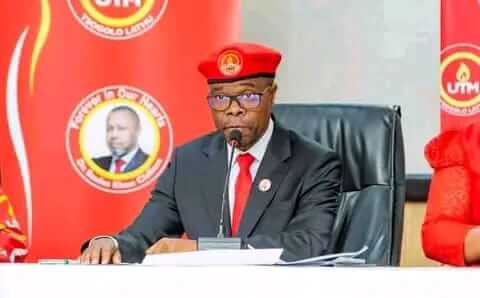
The United Transformation Movement (UTM) has come out strongly to refute reports that the Chilima family has repossessed the party’s headquarters building in Lilongwe.
The building, which was donated to the party by the late Vice President Saulos Klaus Chilima, has been at the center of controversy following reports that the Chilima family had taken back possession of the property.
However, according to the UTM publicity secretary,Felix Njawala, these reports are “totally false and misleading.” Njawala emphasized that the party is still in possession of the building and that there has been no communication from the Chilima family regarding the repossession of the property.
The UTM has also denied reports that the Chilima family refused to receive K10 million kwacha from the party towards the launch of the SKC Foundation.
The foundation, which was established in honor of the late Vice President Chilima, aims to promote his legacy and continue his work in empowering Malawians.
The controversy surrounding the UTM headquarters and the SKC Foundation funding has raised questions about the relationship between the party and the Chilima family.
The late Vice President Chilima was a key figure in the UTM, and his family has continued to play an important role in the party’s affairs.
However, the UTM has assured its members and supporters that it remains committed to its core values and principles.
The party has also emphasized its gratitude to the Chilima family for their continued support and generosity.
As the controversy continues to unfold, the UTM has called on its members and supporters to remain calm and to ignore the “false and misleading” reports that are being circulated.
The party has assured its members that it will continue to work tirelessly to promote its values and principles, and to provide leadership that is accountable and transparent.
In related news, the UTM has announced plans to hold a press conference to address the controversy surrounding its headquarters and the SKC Foundation funding.
The press conference, which is expected to take place later this week, will provide an opportunity for the party to clarify its position and to provide updates on its plans and activities.
As the UTM continues to navigate the challenges and controversies that have arisen in recent weeks, the party remains committed to its core values and principles.
The UTM’s leadership has assured its members and supporters that it will continue to work tirelessly to promote its values and principles, and to provide leadership that is accountable and transparent.
The UTM has refuted reports that the Chilima family has repossessed its headquarters building in Lilongwe.
The party has also denied reports that the Chilima family refused to receive K10 million kwacha from the party towards the launch of the SKC Foundation.
As the controversy continues to unfold, the UTM has called on its members and supporters to remain calm and to ignore the “false and misleading” reports that are being circulated.
The once-ubiquitous phrase “Boma ndilomweli sitikusintha” (this is the government we are not changing), which was proudly touted by the ruling Malawi Congress Party (MCP) as a symbol of its confidence in its leadership and policies, has undergone a drastic transformation.
In a scathing indictment of the MCP’s governance, Malawians have mockingly replaced the phrase with “Bodza ndilomweli” (this is the deception), primarily in response to President Chakwera’s recent State of the Nation Address (SONA), which many felt was deceptive and failed to address pressing national issues.
Furthermore, the party’s failure to deliver on its campaign promises has only added to the growing perception of deception, prompting Malawians to adopt the mocking phrase.
At the heart of the controversy lies President Chakwera’s recent state of the national address, which was widely anticipated to provide a roadmap for the country’s development.
A damning analysis of President Chakwera’s State of the Nation Address
Instead, many Malawians felt that the president’s speech was riddled with inaccuracies and failed to address pressing issues such as poverty, corruption, and unemployment.
“We were expecting the president to provide a clear vision for the country’s future, but what we got was a bunch of lies and empty promises,” said Emily Jere, a concerned citizen. “It’s no wonder that people are now saying ‘Bodza ndilomweli’ – the MCP has indeed deceived us.”
The MCP’s response to the criticism has been lukewarm, with party officials dismissing the allegations as “baseless” and “politically motivated.”
However, many Malawians remain unconvinced, citing the party’s failure to deliver on its campaign promises as evidence of its deception.
As the debate rages on, it remains to be seen how the MCP will respond to the growing discontent among Malawians.
One thing is certain, however – the party’s reputation has taken a hit, and it will require more than just rhetoric to restore public trust.
In the meantime, the phrase “Bodza ndilomweli” continues to gain traction, serving as a rallying cry for those who feel deceived by the MCP’s promises. As one social media user aptly put it, “The MCP’s deception has been exposed, and it’s time for them to take responsibility for their actions.”
The Malawi Congress Party’s leadership would do well to take heed of the growing discontent among Malawians.
By acknowledging the concerns of its citizens and taking concrete steps to address them, the party may yet be able to salvage its reputation and regain public trust.
However, until then, the phrase “Bodza ndilomweli” will continue to serve as a reminder of the MCP’s deception.
MZUZU-(MaraviPost)-The former ruling Democratic Progressive Party (DPP) Member of Parliament (MP) for Karonga North Constituency, Mungaswalu Mwambande has joined the ruling Malawi Congress Party (MCP).
Mwambande who also served as Deputy Minister of Natural Resources, Energy and Mining under the leadership of Peter Mutharika in 2019 comfimed the development in a phone interview.
According to Mwambande his decision follows his constituents demand as well as the development projects President Lazarus Chakwera’s government has done in his area as well as Karonga district as whole.
He said all DPP committee in his constituency joined MCP last year and the constituents have been pressuring him to follow suit.
“I am no longer with DPP but MCP. I have closed the DPP chapter because of the development projects that the current government has done in my area and Karonga as whole. Apart from that, my constituents have been asking me for the same,” said Mwambande who looked very happy with his decision.
Mwambande who was also a very senior member of DPP in the north disclosed that he will be officially welcomed this coming Saturday.
“This Saturday I will be welcomed by MCP officials in the district. It not a secret at all,” he disclosed.
DPP spokesperson Shadreck Namalomba was cutting our calls when contacted.
However, MCP Second Deputy Secretary General, Uchizi Mkandawire while confirming the development said Karonga is now MCP base and President Lazarus Chakwera’s territory.
Mkandawire described the development as a signal that Chakwera is the people’s choice.
According to him, his party will scoop all seats (MPs and ward councilors) in Karonga district as it did with the the by-elections.
“This should tell the nation especially those who claim that the district or the region is their bedroom that things are not the same on the ground. Believe me or not, MCP will get 99 percent of votes and seats,” he added.
Last week, MCP also welcomed Chitipa Wenya DPP MP, Welani Chilenga.
PARIS-(MaraviPost)-French footballer Paul Pogba’s elder brother Matthias Pogba is among six individuals sentenced by a French court to prison for extortion.
The group, including Matthias, received prison terms ranging from three to five years for coercing Paul into paying MK27 billion.
The court also ordered Matthias to pay fines for his involvement in the extortion ring, which reportedly included people Paul has known since childhood.
Matthias’ lawyer, Mbeko Tabula, criticized the sentence, describing it as excessively harsh and confirming plans to appeal.
“Matthias has always maintained his innocence. He was pressured and misled into participating. He would never deliberately harm his younger brother,” Tabula stated.
The extortion case gained attention in August 2022 when Matthias posted a video threatening to expose Paul’s private secrets.
Malawi breaking news and World News. News about Malawi, Malawi Business, Malawi Tourism, Malawi Politics, Malawi News, World and Africa Top News.