Prophet Patson Gondwe feeds thousands vulnerable Balaka communities

LILONGWE-(MaraviPost)-Malawi’s Prophet Patson Gondwe’s Good News Ministries on Thursday, April 7, 2022 reached out over 304 households with food items amid looming hunger due to floods.

The ministry donated maize floor and assorted items including soap, soya pieces, salt and cooking oil for relief.

Prophet Gondwe’s GNM outreach programs

The church targeted household with the elderly, persons with disabilities and the needy drawn from Traditional Authorities (T.As) Nsamala, Sawali, Matopa and Mbela in Balaka District.

Prophet Gondwe says the donation meant ease food shortages among households particularly the vulnerable.

The Man of God therefore encouraged believers to help the needy with the little available.

Prophet Gondwe carrying a bag maize floor

“This is part of the church farming proceeds designed to share with the needy. This should teach us all the spirit of giving the little we have to others.

“The Holy Spirit will always guide us to who the church must reach in times of need. Let every believer have a hand to any needy, ” urges Prophet Gondwe.

The man of Man also cherished a number hard to reach households with message of hope while offering with food items and cash.

Excited elderly after receiving food items

One of the beneficiaries, a 92 year old Robin Mzunga of Group Village Head (GVH) Saiwa in TA Msamala lauded Prophet Gondwe and the church for the timely support.

The Balaka charity initiative is pegged at MK4 million.

This is the second Prophet Gondwe’s ministries outreach program after carried similar exercise in Salima in March this year.

The maize flour is part of the proceeds from 70 hectares of land which the church cultivated to feed the elderly and the needy worthy MK50 million.

Prophet Gondwe started giving in 2014 after his return from SCOAN and he does it every year most of charity works that are not publicized.

GFF youth coalition dates Malawi Parliament on sexual reproduction promotion

LILONGWE-(MaraviPost)-Malawi youth under the banner Global Financing Facility (GFF) youth coalition the past week engaged Parliamentary committees on health, budget for support towards sexual reproduction health service particularly in rural areas.

The coalition drawn from youth groups including All for Youth (A4Y) Youth Initiative for Community Development (YICOD Malawi), and Phalombe Youth Arms Organization (PYAO) wants full participation and engagement in the GFF Processes, budget and policy processes locally and national levels.

GFF youth coalition meeting health chair Ngwale from far left

The coalition’s Project coordination Christina Chilimba observes that youths are not fully involvement in policy formulation towards sexual reproduction health.

Chilimba said the engagement with Parliamentary committees was to brief them on issues affecting young people as well as advocate for increased youth sensitive resource allocation using verified ground data.

“This project aims at advocating for increased resource allocation towards adolescent and youth SRHR + Nutrition in the National and District Budgets, National COVID 19 Response Plan and District Implementation Plans, through mobilizing and enhancing youth leaders’ capacity to hold government accountable.

“We are advancing resource allocation for youth friendly health services as well as sexual reproductive health and rights.Reason for our meeting with the parliamentarian committee chair was to present to him an advocacy brief,” says Chilimba.

GFF youth coalition pausing a photo with health committes chair Ngwaled

She added, “We have trained 15 youth leaders, 5 from Mzuzu, 5 from Dowa and 5 from Mwanza
We have trained them on how to utilize a score card as well as development of a score card just to enrich them with skills.

“We want representation of youths in important positions to add that youthful voice in decision making. Our expectations after meeting the chair person of health committee is to at least see the advocate issue which we have brought to their table”.

Matthews Ngwale Parliamentary Health Chair‎ lauded the youth coalition for engaging policy makers for quick intervention on issues raised towards advancement of sexual reproduction health services.

Ngwale therefore encouraged the coalition to reach out rural youth while assuring the grouping of total support towards sexual reproduction.

The Global Financing Facility (GFF) partnership has supported the government of Malawi to develop an investment case based on the country’s Health Sector Strategic Plan 2017-22 (HSSP-II).

Priorities include a focus to enhance governance and accountability, improve coordination, and strengthen access to and quality of primary care towards Universal Health Coverage.

The GFF is supporting the government to increase capacity for planning at sub-national level to improve governance, planning, and budget execution for health at district levels.

Earth tremor shakes Malawi’s southern region

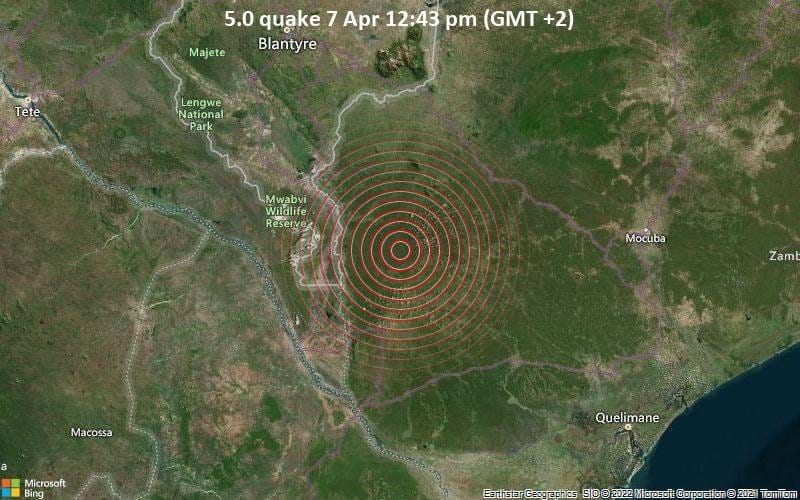
BLANTYRE-(Maravipost)-The German Research Centre for Geosciences (GFZ) on Thursday, April 7, 2022 reportedly that Malawi was shaken by a 5.0 magnitude earth tremor in southern region particularly Nsanje, Blantyre around 12:43 noon.

GFZ reported that the Nsanje tremor hit at a shallow depth of 10km beneath the epicenter, saying shallow earthquakes are felt more strongly than deeper ones as they are closer to the surface.

“The exact magnitude, epicenter, and depth of the quake might be revised within the next few hours or minutes as seismologists review data and refine their calculations, or as other agencies issue their report,” GFZ said.

A second report was later issued by France’s Réseau National de Surveillance Sismique (RéNaSS), which listed it as a magnitude 5.0 earthquake as well as as others who reported the same quake include the citizen-seismograph network of RaspberryShake at same magnitude 5.0 and the European-Mediterranean Seismological Centre (EMSC) at magnitude 5.1.

“Based on the preliminary seismic data, the quake should not have caused any significant damage, but was probably felt by many people as light vibration in the area of the epicenter.”

The report further said weak shaking might have been felt in rest of Nsanje 39km from the epicenter and Mlange 102 km away.

“Volcano Discovery will automatically update magnitude and depth if these change and follow up if other significant news about the quake become available,” said the report.

Department of Meteorological and Climate Change Services is yet to announce if the earth tremor caused some damages and loss of life.

In 2018, Nsanje was also hit with an earthquake whose magnitude was 5.6, reportedly the strongest since the sequence of earthquakes that struck Karonga District in 2009 that lasted for about 10 seconds.

According to information published by U.S. Geological Survey’s National Earthquake Information, the epicenter of that earthquake was in Mozambique, just 25 km from Nsanje, which lasted for about 15 seconds.

That quake’s tremor was also felt in different parts of the Southern Region reaching as far as Blantyre and Zomba which are located about 115km and 150km from the epicenter.

Malawi lies in the great East African Rift System (EARS), a 3000 km long Cenozoic age continental rift extending from the Afar Triple Junction between the horn of Africa and the Middle East, to western Mozambique.

The civilians fleeing M23 rebels in eastern DRC

After a week of relative calm, clashes between Kinshasa’s armed forces and the M23 movement in Estern DRC resumed on Wednesday. Since March, 28, many civilians have fled their villages to seek safety.

Ndamugabo ran from his village in north Kivu province and took refuge in a school in Rutshuru. He is now waiting for assistance. “It was Monday morning at 7am that we suddenly saw the M23 on the hill next to our houses and we fled, along the way I was wounded. I am being treated here at the camp in this school.”, recounts Ndamugabo Sebishimbo.

The M23, also known as the Congolese Revolutionationary Army, grew from a former Tutsi militia, once supported by Rwanda and Uganda. It was defeated by the national army in 2013 but resurfaced last November.

Patience Niyonzima was in hospital with her newborn when everyone hastily departed around her. A day she will not forget, “It was the end, we thought we were going to die. A man told me to stay in the nearest hospital otherwise I wasn’t going to survive, but I pushed through“. She now lives in Rushuru with her baby, but like many she left everthing behind and says there are no ressources to help her.

A few days ago, the government urged displaced people to return home but most of them are too afraid to go back despite their assurance. _”Let me tell you that we will leave the office in Kinshasa to come and die here because this is part of the national territory.”, _declared General Patient Mushidi Yav, Deputy Commissioner General in charge of the administrative police in Rutshuru on April, 4.

According to local sources, since Wednesday the national army has been pounding hills occupied by M23 rebels but hasn’t yet been able to dislodge them successfully.

Over 10,000 have already left the area towards Ugand and 36,000 within the DRC according to the UN.

Source: Africanews

Africa Road Builders: Tanzanian President Samia Suluhu Hassan wins the 2022 Babacar Ndiaye Trophy for transport success

Tanzanian President Samia Suluhu Hassan has been named the 2022 winner of the Africa Road Builders–Babacar Ndiaye Trophy. The prize is awarded to leading figures in Africa who have demonstrated their commitment to the development of transport infrastructure on the continent.

The selection committee for the award commended Hassan for her “personal leadership, huge investments and commitment” to extending roads and the railway network in Tanzania. “We send our warm congratulations to President Samia Hassan and the people of Tanzania,” the selection committee said.

The committee noted the $290 million provided by the African Development Bank to support the revitalization of road, rail and air transport in Tanzania. It also took into account the $172.2 million contract signed with the China Corporation Limited to supply the country with 1,430 modern freight wagons to implement the ambitious Tanzania Railways Corporation railway program. Finally, the committee noted the official start of construction on the historic project to build an outer ring road around the city of Dodoma. This project was launched by President Hassan on 11 February, in the presence of the President of the African Development Bank Group, Dr. Akinwumi A. Adesina.

Currently the only female head of state in Africa, Hassan came to power in March 2021, following the death of President John Magufuli, under whom she served as Vice-President.

Sponsored by the African Development Bank’s Adesina, the Africa Road Builders Babacar Ndiaye Trophy is organized by Acturoutes, an information platform on infrastructure and roads in Africa, and the organization Media for Infrastructure and Finance in Africa (MIFA), a network of African journalists specializing in road infrastructure. Nigerian President Muhammadu Buhari received the award in 2021.

The trophy was instituted in honour of Babacar Ndiaye, President of the African Development Bank Group from 1985 to 1995.The 2022 trophy will be awarded at the final conference of the Africa Road Builders, which is scheduled to take place alongside the African Development Bank’s next Annual Meetings in May in Accra, Ghana.
Source African Development Bank Group

Ukraine: UN relief chief joins call for probe after ‘horrifying’ visit to Bucha

Martin Griffiths was in Bucha and in Irpin, both located outside the capital, Kyiv, accompanied by the country’s Deputy Prime Minister, Olha Stefanishyna. 

Mass graves and destruction 

The relief chief described the visit as “horrifying”, said UN Spokesperson Stéphane Dujarric, speaking during his daily briefing in New York. 

“He saw a mass grave with bodies wrapped in plastic, dozens of apartment blocks and houses destroyed, and burned-out cars in the street,” said Mr. Dujarric. 

Recalling that the world is already deeply shocked by the images coming out of the area, Mr. Griffiths echoed the UN Secretary-General’s call for an immediate, independent investigation to guarantee accountability

<!–[if IE 9]><![endif]–> Graves of two victims in Bucha, Ukraine. © ICRC

Graves of two victims in Bucha, Ukraine.

Humanitarian pause needed 

From Bucha, Mr. Griffiths travelled to Kyiv, where he met with Prime Minster Denys Shmyhal and other senior officials, including the Defence Minister and the Vice-Minister for Foreign Affairs. 

He listened to their views and concerns, and also sought ideas for making progress with establishing a humanitarian pause, together with safe passage for aid deliveries and evacuations. 

Prior to visiting Ukraine, Mr. Griffiths was in Moscow where he had also discussed these topics with Government officials on Monday. 

The humanitarian affairs chief reaffirmed the UN’s core commitment to helping protect civilians and reaching all in need of aid, as quickly as possible. 

“He also said that, after its temporary relocation, the UN will reestablish its humanitarian presence and leadership in Kyiv, which Ukrainian authorities warmly welcomed,” Mr. Dujarric added. 

Scaling-up support 

UN agencies and humanitarian organizations have dramatically scaled up operations in Ukraine over the past six weeks.  Some 160 partners are now present in all 24 regions of the country, known as oblasts. 

Humanitarians have reached at least two million people with assistance, and convoys have been mobilized to reach thousands in some of the hardest-hit areas, including Sumy, Kharkiv and Sievieredonetsk.             

Additionally, a $1.1 billion appeal to support people inside Ukraine, launched last month, is now nearly 60 per cent funded. 

<!–[if IE 9]><![endif]–> The town of Irpin, in the Kyiv region, Ukraine. © ICRC

The town of Irpin, in the Kyiv region, Ukraine.

Peace is the remedy: WHO 

Meanwhile, the World Health Organization (WHO) has underlined commitment to support the country in addressing immediate challenges and future reconstruction needs. 

“The life-saving medicine Ukraine needs right now is peace,” said Dr. Hans Kluge, WHO Regional Director for Europe, speaking during a press conference from the western city of Lviv on Thursday – World Health Day. 

Health under attack 

WHO reported a grim milestone on Thursday, having verified more than 100 attacks against health care since the war began, killing 73 people and injuring 51 more.  

Of the 103 attacks so far, nearly 90 have impacted health facilities, while 13 affected transport, including ambulances. 

Due to the conflict, half of all pharmacies in Ukraine are also presumed closed, while some 1,000 health facilities are in proximity to conflict areas, or in changed areas of control. 

Standing in solidarity

Dr. Kluge expressed solidarity with Ukraine, and its health workers, who continue to deliver care in the face of immense suffering. 

“I stand with our Director-General, who on behalf of WHO, has consistently called on the Russian Federation for a humanitarian ceasefire immediately, which includes unhindered access to humanitarian assistance for those in need,” he said. 

WHO’s work in Ukraine is centred around three principles, starting with keeping health facilities operational.   

More aid on the way 

Teams have delivered more than 185 tonnes of medical supplies to the hardest hit areas, including besieged Sumy, reaching half a million people with materials to support trauma, surgery and primary health care. 

Another 125 tonnes are on the way, and items such as wheelchairs, communications aids for the blind, and other assistive products, are in transit. 

WHO is also working with neighbouring countries, and across the entire European region, to ensure millions fleeing the fighting can also receive care and that health systems can manage the influx. 

Conflict must end 

Prior to the war, Ukraine had been making “excellent progress” against challenges such as tuberculosis, HIV and moving towards universal health coverage. 

Dr. Kluge stressed the importance of not losing this momentum. 

WHO is preparing to redeploy teams throughout the country as access and security improves, he said, underlining commitment to being present during the current humanitarian response and in post-conflict rebuilding. 

“Health requires peace, well-being requires hope, and healing requires time,” said Dr, Kluge, adding “it is my deepest wish that this war comes to an end swiftly, without further loss of life. Tragically, this is not the reality we see.”
UN Health News
Rwanda commemorates the 28th anniversary of the 1994 Genocide against Tutsi

28 years ago, the civil war in Rwanda erupted. A conflict that caused the death of more than 800,000 Tutsis and moderate Hutus in just 100 days.

This year, the African Union chose the theme ‘Remember-Unite-Renew’ and reaffirmed its commitment to prevent and fight genocide on the Continent.

On April 7, the president of Rwanda Paul Kagame, lit the remembrance flame at the Kigali Genocide Memorial, where more than 250,000 victims rest. National mourning will last until April 13 while commemoration activities will go on until July 3. They will be lasting 100 days, the lenght of the conflict back in 1994.

This civil war started a day after a mysterious plane crash claimed the lives of the presidents of Rwanda and Burundi. For over two decades, historians, local and international judicial investigators worked on the conflict and nonethelsse, the extent and circumstances of this accident and the following massacres continue to raise questions.Especially among those who escaped and outlived the genocide.

Belgium and especially France have been singled out for their friendship with the Hutu extremist regime who butchered the Tutsis and moderate Hutus. In 2021, President Emmanuel Macron said France “had a role, a history and some political responsibility” a first among French leaders. However, Macron did not say France did not have an active role in what is considered one of the biggest killings of the twentieth century.

Source: Africanews

Malawi: Country strategy sparks transformation in agriculture

Some 250 young agricultural entrepreneurs were trained, 10,000 people gained access to agricultural loans and 12 small agricultural businesses have been created. In total, 8,000 new irrigation projects were launched.

Malawi has achieved significant progress in its agricultural sector, helped by a country strategy drafted by the African Development Bank. The 2018-2022 strategy also supported progress in the transport sector, according to the mid-term review approved on 4 April by the African Development Bank Group’s Boards of Executive Directors in Abidjan.

The Country Strategy Paper, approved by the African Development Bank Group’s Boards of Executive Directors in June 2018, is based on two pillars: investing in infrastructure development through energy and transport, and investing in economic transformation by added value in agriculture and developing water infrastructure.

With regard to the second pillar, the mid-term review of the strategy highlights the transformation of the Shire Valley, currently under way. By the halfway mark, some 250 young agricultural entrepreneurs had received training, 10,000 people had gained access to agricultural loans and 12 small agricultural businesses were created. In total, 8,000 new irrigation projects were launched. The Fisheries and Aquaculture Development Project and the Emergency Recovery and Resilience Programme following cyclones Idai and Kenneth should be completed this year.

In terms of economic diversification and improving the business climate, by 2020 the strategy had resulted in training for 1,000 small farmers and provided agricultural extension services. It has also allowed over 2.28 million transactions to be processed through a digital payment platform and secured three VISA and Mastercard certifications.

In terms of the first pillar and the improvement of transport infrastructure, the fourth phase of the Multinational Nacala Road Corridor Development Project is under way. The project aims to renovate the road between Nsipe and Liwonde (55 kilometres) and create a one-stop border post between Malawi and Zambia (completed in 2021), while a one-stop border post between Malawi and Mozambique is due to be completed by 2023. A significant achievement was the completion of two projects in the transport sector: the resurfacing of the road between Mzuzu and Nkhata Bay (47 kilometres) and the renovation of the road from Liwonde to Mangichi (75 kilometres).
Source African Development Bank Group

Standard Bank pumps MK46m in UNAYO regional football leagues

By Edwin Mbewe

LILONGWE-(MaraviPost)-Standard Bank on Thursday, April 7, 2022 unveiled MK46.1 million sponsorship towards UNAYO regional football leagues.

The sponsorship targets Bank three regions association including SRFA,CRFA and NRFA.

Each region is expected to get MK15,375,000 (MK15.3 million) as it’s share from the total amount per year to run the affairs of the division one league.

Standard bank launches UNAYO regional leagues

The league is expected to reach out to 29 districts in the country and over 64 teams are targeted to take part.

About 700 matches have been estimated to be played and has been given an eight months time frame for it to get completed.

Speaking to journalists at the function which took place at the Bank’s headquarters in the capital Lilongwe Walter Nyamilandu Manda, Football Association of Malawi (FAM} President hailed the bank for coming back into football sponsorship after years out of the system.

He described the gesture as timely saying it will help to unearth the hidden talents in the rural areas which will eventually play at highest level,like in Super League and National teams.

Nyamilandu added that the FA is working on training more coaches, officiating personnel who will patronise the leagues to produce well equipped players.

“For us as football governing body in the country it is a break through we have been looking for very long time because we had huge gap in the structure to promote the sport in rural areas,coming on board with UNAYO makes our programs to be complete as we have high chances now of grooming new players that can take Malawi football forward by qualifying to AFCON and other major tournaments,the leagues will also bring entertainment in the districts”, Manda Joyfully narrated.

Charity Mughogho, Standard Bank Head of Consumer and High Net Worth Clients said the deal comes as the UNAYO platform is set to reach 100,000 wallets milestone for financial inclusion.

“The sponsorship gives the bank the platform for engaging further with their clients spanning across the country, a good majority of whom are passionate about and support local football.

“The UNAYO National Regional Leagues will be played in all 29 districts and it will act as ideal touch point for our digital financial solution and its customers. During the period of the leagues our UNAYO team will be active throughout to support local communities and help them enter into digital economy”, says Mughogho.

Raphael Humba, Southern Region Football Association Chairman, who spoke on behalf of the three regions was extremely happy about the news saying they had problems to run the affairs of division one as they only had the Sponsorship for Premier Division.

He further hailed the bank for the gesture saying it will ease the problems they have been facing in running division one affairs.

Humba added that the league will definitely play a great role in unearthing talent and promised to run the leagues in a professional way to safeguard the deal.

The MK46 million UNAYO sponsorship will cater for the winners’ prizes for top 4 teams in each region leagues, specifically providing support towards Trophies, medals and match balls.

UNAYO has also pledged support for the administration of the league and match officials.

UNAYO as a platform allows wallet holders to run various transactions including sending and receiving money.

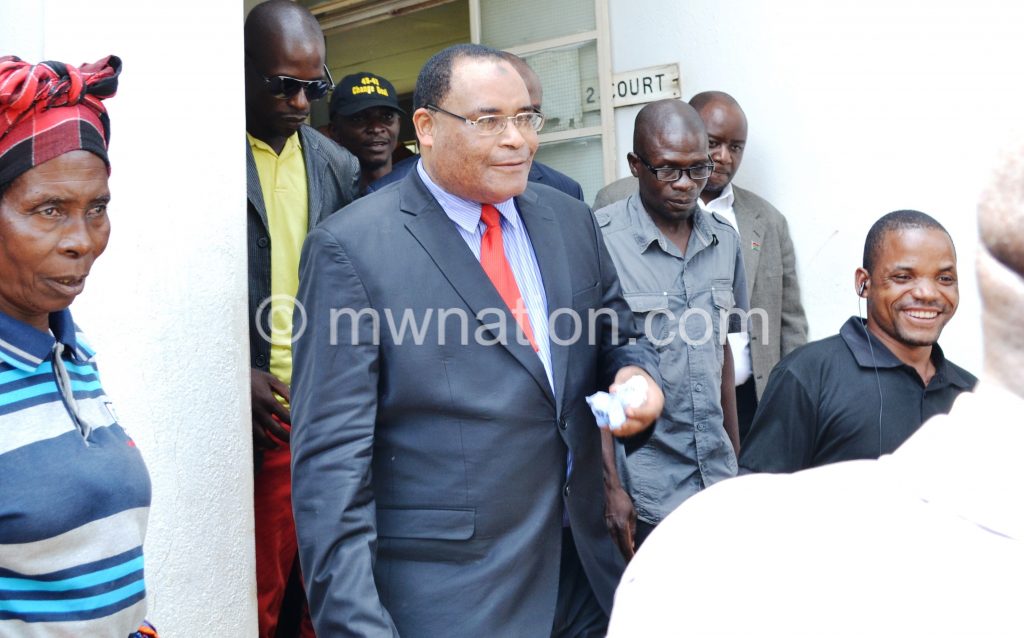
Malawi Supreme Court snubs Uladi Mussa’s bail

BLANTYRE-(MaraviPost)-Malawi Supreme Court of Appeal has dismissed convicted former Minister of Homeland Security Uladi Mussa’s application for bail pending hearing and determination of his appeal in the abuse of office case.

In his application, Mussa through lawyer Chancy Gondwe cited the possibility of his appeal succeeding and delays in processing the appeal due to lack of a court quoram, as factors to justify his application.

Mussa pictured during his previous court appearance

But in his ruling in Blantyre on Friday, Justice of Appeal Lovemore Chikopa noted that the application did not show what interest of justice would be served if he was granted bail pending appeal.

He said the court looked into Mussa’s file and found that it was clear that he needs to do some more work before the appeal is ready for hearing.

The judge said: “To that extent we would think that the sufficiency or otherwise of judges in this court is perhaps an irrelevance. The application for bail pending appeal is therefore not granted.

“When we talk of instances where bail pending appeal has been granted we are really talking of cases where the applicants were able to show to the satisfaction of the court that it was in the interests of justice that the convicts be admitted to bail pending appeal,” adds the ruling.”

In the application, Mussa further argued that he has all along the trial been compliant of the bail conditions and is a citizen of substantial standing in the society.

But Anti-Corruption Bureau director of legal and prosecution Chrispin Khunga objected Mussa’s grounds of appeal, saying they do not disclose anything untenable that would make a court grant him bail pending appeal.

Mussa was in 2020 sentenced to five years imprisonment alongside former regional immigration officer David Kwanjana and businessperson Peter Katasya.

In the appeal, Mussa and his co-convicts argue that High Court Judge Chifundo Kachale erred in finding them with a case to answer when there was no sufficient evidence to prove the case of neglect of duty or abuse of office.

Mussa and Kwanjana were each handed prison sentences of 12 months for neglecting public duties and five years for abuse of public office.

Source: Nation online

Exit mobile version