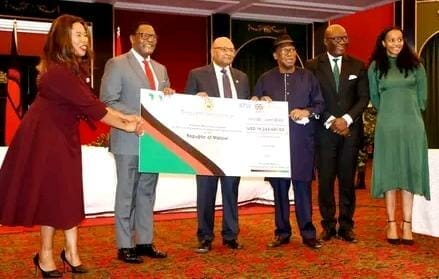
BLANTYRE-(MaraviPost)-The Malawi Government has received a drought insurance payout of US$14.2million (MK14.2 billion) from the African Development Bank through the Risk Capacity Limited to support drought affected households in the country.
Receiving the amount at a ceremony held at Kamuzu Palace in Lilongwe on Tuesday June 28, 2022, President Lazarus Chakwera assured Malawians that his government will continue to put Malawi first, and will cushion few whose crops did not do well.
Chakwera smiles on drought insurance payout
He said the payout will therefore, assist the Agricultural Development Divisions (ADDs) of Karonga, Salima, Mzuzu, Salima, Lilongwe, Blantyre, Machinga and Shire Valley which were heavily affected by drought this year.
” I would like to thank the ARC group for honouring the payout of MK14.2 billion towards providing resilience to disaster affected victims and those whose crops did not do well.
” I would like to further assure that the country has enough food and even those whose crops did not do well, will be provided for, said Chakwera.
He added ” we intend to scale up an already existing social cash transfer to programme to improve the level of disposable income in affected homes and boost their spending power.”
Chakwera pledged that his government will continue collaborating with international stakeholders to achieve resilience against climate change effects on farmers and help them adapt to weather-related shocks.
ARC Group Board Chairperson Mothae Anthony Maruping, asked the government to consolidate its membership with ARC so as they become full members and benefit more.
Deputy Minister of Agriculture Madalitso Kambauwa said the payout has come at the right time and will address the climate shocks experienced this year.
Malawi signed a drought insurance policy with ARC Group through African Development Bank to provide a resilience to various climatic risks.
Keynote Speech delivered by Dr. Akinwumi A. Adesina at the UK-Africa Investment Summit, “Sustainable Infrastructure Forum”
Adesina received an honorary Doctor of Humane Letters in recognition of his career achievements in agriculture, and the innovative High 5 development priorities for Africa Access Multimedia Content
DURHAM, United States of America, May 9, 2022/ — America’s Duke University (https://bit.ly/3KXZEnZ) yesterday conferred honorary doctorate degrees on four recipients during its 2022 Commencement ceremonies in Durham, North Carolina.
The honorees were African Development Bank Group President and World Food Prize recipient Dr. Akinwumi Adesina; rocket scientist, businesswoman and former non-profit leader Sylvia Acevedo, who currently serves on the board of Qualcomm, a global leader in semiconductors and wireless technology; Patrick Brown, founder and Chief Visionary Officer of Impossible Foods, a leading producer of meat and dairy products from plants; and Tom Catena, the medical director and sole surgeon at Mother of Mercy Hospital in the Nuba Mountains of central Sudan.
Adesina received an honorary Doctor of Humane Letters in recognition of his career achievements in agriculture, and the innovative High 5 development priorities for Africa, which he conceived shortly after his election as President of the continent’s premier development finance institution in 2015.
The university’s academic council unanimously recommended Adesina as a recipient. Duke University President Vincent E. Price said of Adesina: “Yours has been a truly extraordinary career—you have fought to eradicate poverty and improve living conditions in Africa, and your bravery and commitment have inspired countless people around the globe. I know that your example will also inspire our graduates to careers of equal purpose and principle.”
Adesina said he felt deeply humbled by Duke University’s recognition. “To be awarded an honorary degree is always a privilege beyond measure. I regard this recognition as a reward for all who work tirelessly to accelerate Africa’s development and to ensure millions of Africans thrive and reach their fullest potential.”
Founded in 1838, Duke University is ranked among the top universities in the United States.
Video (https://bit.ly/3KWXMvZ) Distributed by APO Group on behalf of African Development Bank Group (AfDB).
LILONGWE-(MaraviPost)-The African Development Bank (ADB) on Wednesday, January 6, 2021 appointed Malawian economist Kennedy K. Mbekeani as a Deputy Director General for Southern Africa Region.
Mbekeani is among five deputy directors and three directors ADB appointed for the East, Central and Southern Africa regions and Deputy Directors General for the East, Central, Northern, Southern and West Africa regions.
Kennedy is a seasoned development economist with over 20 years of senior level country and regional experience in development finance, project management, policy advisory services, and knowledge generation.
Mbekeani joined the Bank in 2009 as Chief Trade and Regional Integration Officer.
He provided leadership in formulating the Bank’s trade assistance strategy to regional economic communities and on policy research on international trade, economic integration and development.
Three directors and eight deputy directors appointed by ADB
Kennedy was Lead Regional Economist (2012-2014) at the South African Resource Centre.
He later served as Officer in Charge and Acting Regional Director of the Bank’s South African Resource Centre in South Africa (2014-2016) where he led the largest syndicated A/B Loan arranged in Africa to-date.
He was appointed Officer in Charge of the African Development Bank’s Ghana Country Office in February 2017.
In September 2017, African Development Bank President, Dr. Akinwumi A. Adesina, appointed him as Country Manager, Uganda Country Office where he grew the portfolio to over US$2 billion.
Before joining the Bank, Kennedy worked for the UNDP as a Trade, Debt and Globalisation Advisor for East and Southern Africa.
Prior to that he worked as a Senior Research Fellow at the Botswana Institute for Development Policy Analysis, and as Senior Economist at the National Institute for Economic Policy in South Africa.
Commenting on his appointment, Mbekeani said: “I am pleased to work with President Adesina to support execution of his vision for the Bank and the continent and accelerate delivery on the High 5s”.
Kennedy holds a Bachelor of Social Science degree from the University of Malawi, MPhil (Monetary Economics) from the University of Glasgow, MA and a PhD in International Economics from the University of California.
He has published on trade, regional integration, and infrastructure development in Africa.
Commenting on the appointment, Dr. Adesina said: “Kennedy is a rounded professional, with broad experience in international development. His capacity to deliver in various areas will help to build strong partnerships in the region and to promote both private and public sectors operations.”
Kennedy’s boss is a Tunisian national, Leïla Farah Mokadem as Director General for Southern Africa Region.
AfDB interested in transformational agro value chain industrialization projects which add value to competitively-produced commodities in Africa – VP Quaynor
ABIDJAN, Ivory Coast, October 9, 2020/ — At a webinar held Thursday by the Nordic-African Business Association (NABA), African Development Bank https://www.afdb.org/en) Vice President Solomon Quaynor made a powerful case for strategic investment opportunities in Africa.
The digital webcast, organized by NABA, the Norwegian Ministry of Foreign Affairs, Scatec Solar and Africa Finance Corporation (AFC), was part of a day-long event aimed at reconnecting Nordic businesses with the continent. The Nordic-African Business Summit has been hosted for nine consecutive years in Oslo – with more than 3,000 guests and 300 speakers from over 40 countries taking part so far.
Quaynor, Vice President for Private Sector, Infrastructure and Industrialization, who was joined by Paal Bjornestad, the Bank’s Executive Director for the Nordic countries, Ireland and India, addressed a virtual audience made up of Nordic business representatives, government and private sector and interested individuals.
The Bank’s mandate to spur sustainable economic development and social progress on the African continent, saw $9 billion in commercial and concessionary lending in 2019, Quaynor outlined, during his presentation on the Bank’s activities and priority areas, which was followed by a question and answer session.
This lending went towards its priority High5s, across its key cross-cutting themes – that is mainstreaming gender, support to fragile markets, and climate-friendly projects. Twenty five percent was to the private sector.
One example of this is the Boko Mine and Port in Guinea, described as a “truly transformative project.” The $1.4 billion integrated mining and related transport infrastructure project has benefitted from a 14-year senior loan of up to $100m from the African Development Bank, with up to a 3-year grace period. The project is expected to add $400 million to Guinea’s GDP, $300 million to the country’s trade balance annually during the operational phase. Additionally, over 4,000 jobs will be created during its construction phase, as well as 700 permanent and 1,500 temporary jobs during the operational phase.
Agro-industrialization projects for which the Bank is seeking support from Nordic country partners, would include those that add value addition to the competitive production of commodities such as cocoa, livestock and cotton, and would leverage the African Continental Free Trade Agreement, adding value and “allowing African production to participate more in these value chains and also to increase jobs and increase incomes to private sector and also the African economy,” Quaynor said. One good example of this is AFC and AP Moller Capital’s Arise Group of Companies, in partnership with Olam of Singapore.
Addressing the challenges in financing projects, bankability
The panel heard that there is a question of bankability which includes market and profitability / cashflow risk, lack of a conducive enabling environment, properly conducted Environmental and Social Impact Assessment (ESIA), and challenges of integrity of sponsors and contractors.
Other questions focused on project financing available for investors, trade finance, and whether the Bank has invested in tourism projects. The response was that the Bank supports “all projects which support economic development, but we have decided to be selective and focus on areas of our comparative advantage.”
The Bank is being more selective and targeting larger transformational industrialization projects. “We also support financial institutions to indirectly support smaller projects. We will also be pivoting more from maximizing our direct loans to using guarantees to crowd in other private investors,” Quaynor said.
On the criteria for Bank support in smaller projects:
“In areas where the opportunities are small but very important, such as off-grid renewable energy, we support through platforms such as SEFA (the Sustainable Energy Fund for Africa)… Overall we need bankable projects, credible business plans…and we need to be sure that ESG and compliance work has been done,” said Quaynor.
Distributed by APO Group on behalf of African Development Bank Group (AfDB).
The winners of the GobalCapital Bond Awards 2020 were announced on 30 September at a ceremony held virtually for the first time in 12 years
ABIDJAN, Ivory Coast, October 2, 2020/ — The African Development Bank https://www.afdb.org/en) was selected in a poll of bond market players as the best issuer in 2020 of a COVID-19 bond for its $3 billion dollar-denominated Fight COVID-19 social bond issued on March 27, 2020.
The winners of the GobalCapital Bond Awards 2020 were announced on 30 September at a ceremony held virtually for the first time in 12 years. GlobalCapital is a leading source of information on global capital markets with coverage of all market segments.
“We are grateful for the market’s recognition of the Bank’s effort in responding quickly to the needs of the continent with its Fight COVID-19 Social Bond which is an important instrument in alleviating the impact of the COVID-19 pandemic on African economies and lives. Thanks to the very strong support received by investors, we were able to provide an efficient response at a very challenging time while also catering to the needs of socially responsible investors looking for impactful investments,” said Ms. Bajabulile Swazi Tshabalala, the Bank’s Senior Vice President and Chief Finance Officer.
The Fight COVID-19 bond, floated on the Luxembourg Stock Exchange and significantly oversubscribed, was the world’s largest social bond at time of issuance. The Bank has since listed the bond on both the London Stock Exchange and Nasdaq. Bond proceeds, with a three-year maturity, will go to alleviate the impact of the pandemic on livelihoods and Africa’s economies.
“The primary debt capital markets’ response to the coronavirus crisis has been resilient and robust. Institutions all over the world from governments and multilateral development banks, to domestic lenders, to companies have raised vital financing to see them through this extraordinary period,” GlobalCapital noted in its winners’ announcement release.
The bond issue is part of a suite of interventions the Bank has rolled out to strengthen African countries’ responses to the health and economic impacts of the COVID-19 pandemic. This includes a COVID-19 Response Facility of up to $10 billion to provide flexible and emergency assistance to the Bank’s members to shore up their national budget, economies and livelihoods of their citizens.
“The African Development Bank is proud of the success of its landmark “Fight COVID-19 Social Bond”, launched to help alleviate the impact of the pandemic on people’s lives and livelihood. This transaction, the largest social bond at the time of issuance, reflects investors’ confidence in the Bank’s Social Bond framework, and its capacity to deliver. We were among the pioneers in the Social Bond market, and would like to thank all our partners, including the arrangers and investors, for their continued trust and support and share this award and success with them,” said Hassatou N’Sele, Treasurer of the Bank.
The Bank is a recognized pioneer in the social bond sphere. In March 2020, it received the Environmental Finance’s 2020 bond of the year award—SSA category— for a successful one billion Norwegian krone (NOK) social bond issued in 2019. It was the first social bond ever launched in the Norwegian market, and the Bank’s first transaction in Norwegian Krone.
In 2018, the Bank was recognized as “Second most impressive social or sustainability bond issuer” at the Global Capital Socially Responsible Investments Awards. Since 2017, the Bank has launched nearly $5 billion worth of such instruments denominated in US dollars, euros and Norwegian krone.
The Bank is rated AAA by all the major rating agencies. In late 2019, the Board of Governors of the Bank Group approved a 125% increase in the General Capital of the Bank, raising its capital from $93 billion to $208 billion, the largest increase in the institution’s history.
Distributed by APO Group on behalf of African Development Bank Group (AfDB).
ABC News: Mauritius scrambles to counter oil spill from grounded ship
Funding, to be sourced from the Special Relief Fund, will complement ongoing activities by the government of Mauritius, development partners, and other actors
ABIDJAN, Ivory Coast, September 18, 2020/ — The Board of Directors of the African Development Bank (www.AfDB.org) on Wednesday approved a $500,000 emergency assistance grant to support international recovery efforts after a significant oil spill earlier this year off the coast of Mauritius.
The funding, to be sourced from the Special Relief Fund, will complement ongoing activities by the government of Mauritius, development partners, and other actors to undertake salvaging and cleaning operations, conduct damage and loss assessments, along with other socio-economic evaluations. The United Nations has assumed a lead role in coordinating the response.
“The $500,000 emergency assistance grant from the African Development Bank to Mauritius is an important contribution to the International Recovery effort towards restoring the pristine marine ecology, so important for livelihoods in the blue economy and tourism sectors, which is now threatened by the unfortunate oil spill,” said Martin Fregene, Bank Director for Agriculture & Agro-industry.
More than 1,000 tons of oil have leaked into the Indian Ocean since a carrier vessel ran aground off the Mauritius coast on 25 July. Rescue teams successfully pumped out about 3,800 tons of oil and the government declared a state of emergency and has ordered fishermen and citizens to stay away from the beaches and lagoons around the communities of Blue Bay, Pointe d’Esny and Mahebourg.
The oil spill has resulted in health, conservation and economic challenges. The country relies heavily on the blue economy, particularly food and tourism, and its coastline has some of the world’s most pristine coral reefs. The general population remains at ongoing risk of severe illness from petroleum and its associated pollutants.
The country had hoped to reopen its borders to tourists following a successful response to the COVID-19 pandemic. However, the spill has delayed those plans.
In May 2020, the Bank approved €188 million euros in loans to bolster the country’s national budget as it mounted a response to the pandemic.
As of 1 August 2020, the Bank had four ongoing operations in its country portfolio with a valuation of $458.8 million.
Distributed by APO Group on behalf of African Development Bank Group (AfDB).
In several news reports, World Bank President David Malpass was recently quoted as saying some Multilateral Development Banks, including the African Development Bank, have a tendency to lend too quickly and in the process, add to the continent’s debt problems.
This statement is inaccurate and not fact based. It impugns the integrity of the African Development Bank, undermines our governance systems, and incorrectly insinuates that we operate under different standards from the World Bank. The very notion goes against the spirit of multilateralism and our collaborative work.
For the record, the African Development Bank maintains a very high global standard of transparency. In the 2018 Publish What You Fund report, our institution was ranked the 4th most transparent institution, globally.
The African Development Bank provides a strong governance program for our regional member countries that focuses on public financial management, better and transparent natural resources management, sustainable and transparent debt management and domestic resource mobilization. We have spearheaded the issuance of local currency financing to several countries to mitigate the impacts of foreign exchange risks, while supporting countries to improve tax collection and tax administration, and leveraging pension funds and sovereign wealth funds to direct more monies into financing development programs, especially infrastructure.
The African Development Bank’s Africa Legal Support Facility (ALSF) supports countries to negotiate terms of their royalties and taxes to international companies, and terms of their non-concessional loans to some bilateral financiers. We have been highly successful in doing so.
These are the facts:
The World Bank, with a more substantial balance sheet, has significantly larger operations in Africa than the African Development Bank. The World Bank’s operations approved for Africa in the 2018 fiscal year amounted to US $20.2 billion, compared to US $10.1 billion by the African Development Bank.
With regard to Nigeria and South Africa, the World Bank’s outstanding loans for the 2018 fiscal year to both countries stood at US $8.3 billion and US $2.4 billion, respectively. In contrast, the outstanding amounts for the African Development Bank Group to Nigeria and South Africa were US $2.1 billion and US $2.0 billion, respectively, for the same fiscal year.
With reference to the countries described as “heavily indebted,” our Bank recognizes and closely monitors the upward debt trend. However, there is no systemic risk of debt distress.
According to the 2020 African Economic Outlook, at the end of June 2019, total public debt in Nigeria amounted to $83.9 billion, 14.6% higher than the year before. That debt represented 20.1% of GDP, up from 17.5% in 2018. Of the total public debt, domestic public debt amounted to $56.7 billion while external public debt was $27.2 billion (representing 32.4% of total public debt). South Africa’s national government debt was estimated at 55.6% of GDP in 2019, up from 52.7% in 2018. South Africa raises most of its funding domestically, with external public debt accounting for only 6.3% of the country’s GDP.
Development Banks continue to play critical roles in development efforts and in the aspirations of developing countries, most especially in Africa.
Given substantial financing needs on the African continent, the development assistance of the African Development Bank, the World Bank and other development partners remain vitally important, with increasing calls for such institutions to do even more.
The lending, policy, and advisory services of these development institutions in their respective regions are often coordinated and provide substantially better value-for-money to developing nations, compared to other sources of financing. As a result of the African Development Bank’s AAA-rated status, we source funding on highly competitive terms and pass on favorable terms to our regional member countries. Combined with other measures to ensure funds are used for intended purposes, it helps regional member countries finance debt and development in the most responsible and sustainable way.
With regard to the need for better lending coordination and the maintenance of high standards of transparency, the African Development Bank coordinates lending activities, especially its public sector policy-based loans, closely with sister International Financial Institutions (notably the World Bank and the IMF). This includes reliance on the IMF and World Bank’s Debt Sustainability Analyses (DSA) to determine the composition of our financial assistance to low-income countries; and joint institutional approaches for addressing debt vulnerabilities in the African Development Fund (ADF) and International Development Association (IDA) countries.
In addition, country economists of the African Development Bank fully participate in regional and country level IMF Article 4 missions. Contrary to suggestions, these are just a few concrete examples of historic and ongoing coordination between sister Multilateral Development Banks, IFIs, and development partners. The African Development Bank is committed to the development of the African continent. It has a vested interest in closely monitoring debt drivers and trends in African countries as it supports them in their efforts to improve the lives of the people of Africa.
We are of the view that the World Bank could have explored other available platforms to discuss debt concerns among Multilateral Development Banks. The general statement by the President of the World Bank Group insinuating that the African Development Bank contributes to Africa’s debt problem and that it has lower standards of lending is simply put: misleading and inaccurate.
Tanzania President Magufuli rejects calls to extend rule beyond two-term limit
Support from the Bank’s African Development Fund will bolster ongoing reforms being undertaken by the government of Tanzania
ABIDJAN, Ivory Coast, December 23, 2019/ — The African Development Bank (AfDB.org) has approved a $55 million facility to strengthen implementation of reforms to enhance Tanzania’s economic competitiveness and private sector participation in the country’s growth.
These critical reforms will lead to a more vibrant economy, which will improve the living conditions of Tanzanians, particularly the poor and vulnerable, and including women and youth.
“Tanzania’s private sector is dominated by small enterprises mostly in smallholder agriculture and small informal non-farm businesses,” said Abdoulaye Coulibaly, the Bank’s Director of Governance and Public Financial Management Department.
“By strengthening the regulatory framework, the country’s private sector will have the required incentives to fully participate in the economy, particularly in cross sector growth-enhancing and transformational investment opportunities.”
Constraints to doing business in Tanzania include high compliance costs, lengthy pre-approval procedures, multiple and duplicate processes for business registration, loopholes in some laws and regulations applied by regulators during inspections, and high regulatory costs at the national and local levels.
Support from the Bank’s African Development Fund will bolster ongoing reforms being undertaken by the government of Tanzania that have been identified as critical for the participation of local and foreign investors across different sectors of the economy.
Tanzania’s main development challenge has been to make economic growth more inclusive and broad-based – to create employment and equal opportunities across age, geography and gender.
The Bank’s support will finance the second phase of the Good Governance and Private Sector Development Program (GGPSDP) that will help close the 2019/20 financing gap and make key government agencies more effective.
GGPSDP II will build on strong results from GGPSDP I and support ongoing efforts to reduce the cost of doing business, reduce fees on permits, licenses and registration certificates in key institutions (Prior action), phase rollout of the online Business Registration and Licensing Agency registration portal (BRELA).
The reform program aligns with Tanzania’s Vision 2025 and its second five-year development plan (2016/17 – 2020/21). It is also consistent with pillar II of the Tanzania Country Strategy Paper (2016-2020) – Strengthening Governance and Accountability, as well as two African Development Bank High5 Priorities: Industrialize Africa and Improve the quality of life of the people of Africa.
Distributed by APO Group on behalf of African Development Bank Group (AfDB).
DoDMA`s Director for responsible and recovery, Harris Kachali leads ADB officials during the tour of the affected irrigation scheme areas in Chikwawa
Blantyre, May 08, 2019: Department of Disaster Management Affair’s (DoDMA) Director of Recovery, Harris Kachale on Monday announced that Chikwawa district council will receive $27 million from the African Development Bank for recovery process.
Kachale said this at Chilenga Irrigation Scheme in the area of Traditional Authority Makhwila at the end of an inspection exercise of irrigation schemes that were damaged in the district during the recent flooding.
“We are here with officials from African Development Bank and Chikwawa district council to assess the impact of the floods especially on infrastructure damage. And having moved around the districts, it is quite evident that these floods caused a lot of damage on infrastructure.
“To this effect, the Africa Development Bank is pumping in resources to the tune of $27 million mainly for recovery and resilience so we will be looking at infrastructure that was damaged such as roads, irrigation schemes, and schools,” said Kachale.
However, the director was quick to warn Chikwawa district council to award contracts to credible contractors who will build infrastructures that will be able to withstand disasters.
“This is a lot of money as such we would want this time around to have infrastructures that will withstand, so we will work closely with the council to ensure that this is done,” said Kachale.
He added that the recovery program will kick-start end June this year upon completion of assessment and identification of contractors.
Earlier, Chairperson for Chilenga Irrigation Scheme, Montfort Kandiado appealed for assistance from well-wishers to assist them in rehabilitating the scheme.
“The floods damaged the weir at the intake and pipes that transport the water to the scheme resulting in very few farmers receiving water as of now.
“Normally we plant three times a year in the scheme and if our problems are not rectified in good time, a lot of farmers will not be able to cultivate in the scheme,” lamented Kandiado.
African immigrants passing by a poster advertising international money transfer services in Brussels, Belgium.?Photo: Panos/Mark Henley
African diaspora remittances can reduce poverty
By: Jocelyne Sambira
In a small and stuffy room in midtown Manhattan, some people are filling in forms while others wait patiently in line to submit them. It is spring in New York City but the sweltering heat and the poor ventilation is reminiscent of summer. The teller shielded by a glass window barks orders through a round hole. With one hand on his suitcase, Omar tugs at his collar to loosen the red and blue striped tie around his neck. Pearls of sweat are visible on his forehead. “I am sending money to a person,” he speaks deliberately. Seemingly satisfied with his answer, the teller continues to punch her keyboard and shouts the next question, “How much?” He knows the drill. And like most migrant workers in the city, the trek to this hole in the wall is part of his routine on pay days.
Billion dollar industry
It’s hard to believe that this grimy cubicle is the face of a billion dollar industry. The global money-transfer industry, having escaped the financial crisis unscathed, is making huge profits. Not only do the companies charge a fee to transfer money to another country, they also make profits off the exchange rates. Like when Omar sends his monthly $200 contribution to his family in Ghana, he pays up to 8% in remittance or transfer fees. Remittance is money sent to someone as an allowance.
Egypt and Nigeria are among the top recipients of migrant remittances, says the African Development Bank’s latest report, the African Economic Outlook 2013. According to the report, the two countries received 64% of total remittances to Africa in 2012 – US$18 billion transferred to Egypt and US$21 billion to Nigeria.
The World Bank estimates that there are 140 million Africans living outside the continent. Scores of young Africans, like Omar, move to the West in search of better jobs every year. Omar settled on driving a yellow cab in New York City after holding various odd jobs, he told Africa Renewal. He bragged about how he made US$1,000 some days after pulling an all-nighter. A portion of his money goes to pay for his parents’ rent and school fees for his siblings in Ghana.
As a green card holder, which gives him permanent residency in the United States, Omar can use walk-in payment facilities like the one in midtown Manhattan without fuss. Wire transfer companies have recently been under greater scrutiny and tighter regulations put in place requiring them to “know their customers.” To send money abroad, the sender’s identity and that of the receiver must be disclosed. Often tellers will ask for proper identification. But for illegal migrants, this is not an option. They often work and get paid under the table and therefore prefer to use informal channels. These unrecorded flows are believed to be at least 50% larger than recorded flows, says Dilip Ratha, a World Bank senior economist in charge of migration and remittances. Globalisation has created a demand for a cheap and mobile labour force, notes Rob McCusker in his article on underground banking written for the Australian Institute of Criminology. There is often the cultural expectation, he says, that migrant workers will send a proportion of their earnings to families back home.
Hawala
A lot of the moneysent informally is hard to track. For example, money carried by visiting friends or acquaintances.
A lot of the moneysent informally is hard to track. For example, money carried by visiting friends or acquaintances. But there are informal banking systems like the hawala (which means “trust” in Arabic) networks that serve people who want to remain anonymous because they require no identification. The fees are much lower, between 3% and 5%. The term hawala is now often used to mean “transfer,” explains Ibrahim Farah, a Somali-American who operates a money transfer business in Nashville, Tennessee. Speaking to Nashville Public Television’s series, Next Door Neighbours, Farah says it’s an age-old practice that was used by Arabic traders in the past to protect themselves against highway robbers. Hawala was later used in the Middle East, Asia and Africa to move money quickly and safely.
With the collapse of the banking system in Somalia following civil war in the 1990s, hawalas were used by refugees and internally by businesses and non-governmental agencies to pay employees. Backed by the World Bank and the UN and fuelled by the Somali diaspora community, the Somalia remittance network channels about US$1.5 billion a year. The money has helped keep Somali families afloat over the years, especially during the 2011 famine. However, because of fears that these alternative banking systems could become vessels for money launderers and terrorists, many countries have introduced new legislation and tighter controls, which has forced some hawalas to close.
Redefining remittances
Somalia is not the only African country where migrant remittances have become an important source of external funding. Officially recorded remittance flows to Africa by the World Bank are estimated to have increased from US$ 9.1 billion in 1990 to nearly US$40 billion in 2010. These remittances equalled 2.6% of sub-Saharan Africa’s gross domestic product in 2009, or almost 60% of official aid flows to the region.
African countries rely heavily on external funding for development. But foreign direct investments and official development aid have declined over the years, notes the African Development Bank (AfDB). Development experts believe remittance flows can help reduce poverty and grow economies. However, a big chunk of the remittances go to pay hefty bank fees. “High transaction fees are cutting into remittances, which are a lifeline for millions of Africans,” states Gaiv Tata, the World Bank’s director for finance and private sector for Africa.
Ghana, South Africa and Tanzania are the most expensive countries in Africa to send money, with fees averaging 20%, according to the Send Money Africa database funded by the African Institute for Remittances. One reason is the limited market competition for cross-border payments. The database shows Africans pay higher fees to send money home than any other migrant group. Opening up the remittance market to competition and better information to consumers could bring remittance prices down, says Massimo Cirasino, another senior World Bank economist.
The world’s eight most industrialized countries known as the G8, and the group of finance ministers and central bank governors from the G20, plan to bring remittance fees down to 5% by 2014 from the current average of 12.4%. This would put US$4 billion back in the pockets of Africa’s migrants and their families. The plan will involve increasing competition and banning exclusivity agreements, providing consumers with more information on prices and conditions through innovation and improved efficiency. For example, an overhaul of the Rwandan payment system has helped reduce the cost of sending money to that country from 19% to 15% over the past two years.
Remittances are an important share of foreign reserves for countries, but their impact on development and economic growth are minimal if they are only spent on consumption. Cash-strapped African governments are trying to get migrants to invest part of their wealth in their homeland in the form of diaspora bonds. The capital raised could be earmarked for big development projects. The initiative is not new. The governments of India and Israel have raised about US$40 billion since the 1950s using these bonds, noted Suhas L. Ketkar and Dilip Ratha in a 2007 World Bank research paper on diaspora bonds.
Sub-Saharan Africa is the most expensive region to send money to with an average of 12.4% compared to the global average cost which is around 9%.?Photo:?Africa Renewal/Bo Li
In Africa, Ethiopia was the first country to issue diaspora bonds to finance a hydroelectric power dam. The so-called Millennium Corporate Bonds, issued in 2009, failed to sell. Analysts cited lack of trust in the government as a guarantor and political risks as some of the reasons for the flop. In 2011, the government re-advertised the bonds as the Renaissance Dam Bonds, lowering the minimum denomination to an affordable US$50 and offering to pay yields or interest to the buyers every six months. Waiving remittance fees associated with the purchase of the bonds was another new feature added.
Meanwhile, Rwanda had a more successful outcome. When Rwanda’s major donors suspended aid after the UN accused its government of backing rebels in the Democratic Republic of the Congo – a charge it denied, Rwandans living internally and abroad, as well as “friends” of Rwanda, were called upon to donate to a “solidarity fund” named Agaciro Development Fund, which means “dignity” in Kinyarwanda. By August 2012, the fund had attracted pledges of about US$31 million, according to The Guardian, a UK newspaper.
Issuing Diaspora bonds and turning remittance flows into bonds or instruments that can be sold to investors are good alternatives to borrowing from the international capital market, says the AfDB. According the bank’s research, Africa could potentially raise $17 billion annually using future flows of exports or remittances as collateral. The arguments in favour of enlisting migrants as investors are that migrants are often interested in housing, infrastructure, health and education projects and they are thought to be more loyal than financial investors in times of stress.
Selling the bonds in small denominations is also a plus for low-wage earners. However, as Ethiopia learned, patriotism alone cannot drive investment – people have to make a financial return. Trust is another important factor in marketing bonds to the diaspora. Transparency in the use of funds could ease concerns. If done right, experts believe these bonds could be a promising financial vehicle for African countries to attract resources, and for the diaspora t
Malawi breaking news and World News. News about Malawi, Malawi Business, Malawi Tourism, Malawi Politics, Malawi News, World and Africa Top News.