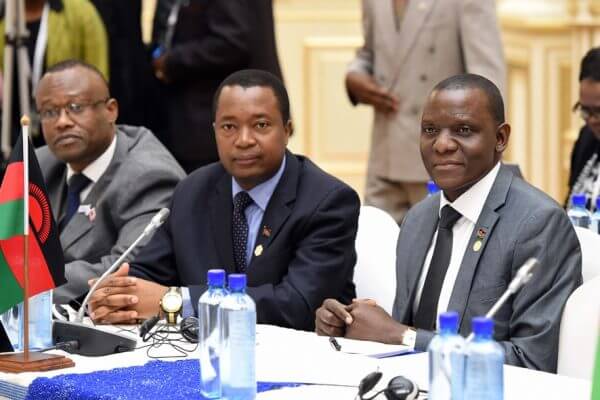
BLANTYRE-(MaraviPost)-Former Reserve Bank of Malawi (RBM) Governor Dr. Dalitso Kabambe says President Lazarus Chakwera’s Tonse Alliance administration is running an “impotent monetary policy”.
Dr Kabambe therefore hinted that correcting all of Malawi’s economic cancers is not a small boys’ job! It’s a big man’s job
He however dared that “unfortunately, Tonse Alliance is in the category of ‘small boys’
Dr. Kabambe was speaking at an opposition Democratic Progressive Party (DPP) press conference on Monday, August 28, 2023, in Blantyre.
Kabambe observes that the impotence of the monetary policy is manifested in the misalignment between the dollar and the kwacha and the rising inflation rate.
The former RBM governor added that solving the economic problems of this country is “a boy’s job” and cannot take long if the government has people who know what they are doing.
“The Malawi economy is now completely run down. Since 2020 when the Tonse Alliance Government came into power, inflation has soared from a single digit of 7 percent to 29 percent; the Malawi kwacha has depreciated from MK732 per US dollar to MK1,090 on the official market and MK1,900 at the parallel market.
“Interest rates have jumped from 13 percent to 24 percent; official reserves have gone down from 6 months of import cover to 1 month; and public debts have soared from MK4.1 trillion to MK9.2 trillion”, observes Dr. Kabambe.
He adds, “Put simply, the macroeconomic environment has become hostile and unbearable to everyone and as a result, economic growth has remained subdued at an average of 2 percent compared to 4 percent for the past 5 decades. The Malawi economy can now best be described as in ICU.
“While the Government heaps all the blame on external forces such as the Ukraine war, COVID-19, and natural disasters, the truth is that the economy is also frantically bleeding”.
Dr. Kabambe is one of the potential DPP’s Presidential aspirants.
The party therefore says the poor economic policies have led to high levels of unemployment, loss of jobs, and fuel scarcity, among others.
Chakwera Tonse Government is yet to comment on the matter.
Malawi a country blessed with natural beauty a lot of natural resources and a rich cultural heritage finds itself in a midst of a severe economic crisis.
The country is grappling with numerous challenges, with its economy in the blink of collapse. However, amidst these trying times, a beacon of hope emerges in the form of Dr. Dalitso Kabambe, an experienced economist with the expertise and track record to transform the fate of this nation.
Kabambe as former Reserve Bank of Malawi (RBM) Governor achieved several prudent monetary policies direction including;
Achieved single-digit inflation within one year of work from 24% in January down to 7.1% by December 2017 and maintained single-digit average inflation throughout the tenure.
2. Maintained a stable exchange rate for the Malawi kwacha at MK732 to a dollar throughout the tenure
3. Raised the country’s foreign exchange reserves from less than 2 months of import cover of US$389 million to over 6 months of US$1.4 billion.
4. Reduced the policy rate from 24% down to 13.5% within 2 years.
5. Reduced Non-Performing Loans (NPL’s) for Banks from 19% to 4% within two years.
6. Improved private sector lending from negative to 19% across the board from Banks, MFI’s and Saccos.
7. Improved RBM profitability from a projected K4 billion loss in 2017 to a surplus of MK21 billion by year-end and a further surge in profits to a record of MK57 billion in 2019, a record no other RBM Governor has ever achieved.
8. Pushed up the country’s remittances from US$36 million in 2017 to US$250 million in 2019.
9. Successfully implemented the ECF program with the IMF throughout the period.
10. Improved the performance of the Malawi Stock Exchange in all its indicators.
Three years after being removed from RBM, Malawi’s inflation is pegged at 29.% while the policy rate is 24% coupled with a scarcity of forex worsening purchasing power of fuel, essential medical supplies, and among others.
Now, Dr. Kabambe is vindicated while still standing as one of the country’s successful Malawi Central Bank governors, the nation has ever had with credible monetary policy.
Malawi needs the caliber of Dr. Kabambe with sound monetary policy skills to turn fortunes at the central bank without a political eye.
But the only sin Kabambe committed to being removed from RBM was being a Lhomwe, gentile amongst Jews. Surely if Kabambe had a chance, he would have changed, but that is an unreachable aspiration for any mortal.
Unfortunately, we don’t choose where to be born.
Unfortunately, God doesn’t look at our background when he wants to bless us. Love him or loathe him, Dr. Kabambe can’t miss the top 10 finest economists of the land.
Kabambe is such a blessing to a country of fools. Men who die of thirst with their feet in the water. We are nothing but a sad tale.
We, from independent media, wish Kabambe the very best of life. Man can despise him out of hate but God has always plans for every man.
We will always miss you, Dr. Kabambe at the Reserve Bank of Malawi.
Your contributions to the Bank are priceless, indeed, quality is expensive.
Disclaimer: The views expressed in the article are those of the author and not necessarily of The Maravi Post or Editor
LILONGWE-(MaraviPost)-The central bank plays a crucial role in guarding the nation on monetary policy that cushions inflation, and forex shortages for buying power without injuring a common man in the village.
The central bank works closely with Ministry of Finance, particularly Treasury on fiscal discipline; prudent public funds expenditures.
Currently, the duo; Central Bank, Reserve Bank of Malawi (RBM), and Ministry of Finance are not in a healthy relationship where the other preaches something, and one does the contrary.
This is where Malawi’s ailing economy fails to get back on track as both sides are on receiving end.
For instance, In the 2023/2024 national budget, Finance Minister Sosten Gwengwe projected that the GDP growth rate will be at 2.8% but currently on the ground is 1.9%.
On inflation, Gwengwe assumed 17.9% but now is rated 29.8%. Not only that but also the policy rate was projected at 18%, currently pegged at 24%.
Was the Minister of Finance Gwengwe real when making projections in consultation with the central bank, particularly the Monetary Policy Committee (MPC) of RBM on inflation and policy rate?
Is RBM Governor Wilson Banda sensible in hiking the policy rate amid economic volatile Malawi is going through?
Revered economist, Chifipa Mhango observes that Policy lending rate hikes by RBM will add more pressure on borrowers.
He said, “In an economic environment where the currency is under continuous devaluation, that alone adds more inflationary pressures”.
“Much as the latest inflation rate eased to 27.3% in June 2023 from a high of 29.2% in May 2023, the level is well above the RBM target of 5%. That alone is concerning on how this will be contained using monetary policy instruments such as lending rates when especially food inflation rate remains elevated at 37.2%.
He further said RBM has since April 2022 hiked rates by 12%, from the 12% to 24%, thus representing 1,200 basis points.
“It is also concerning that Malawi Government is still not able to manage the fiscal challenges, as the deficit widens, thus implying revenue generation is weak and limited while spending appetite remains high.
“It is, therefore, imperative that Malawi Government plays its role in creating a conducive environment for economic expansion while also defining its policy clearly with actionable items around expenditure management.
“What RBM is doing to raise interest rates is a normal and predictable policy reaction, guided by the inflation rate outlook. However, if the other inflation pressures are a result of mismanagement of the economy on the fiscal front, then that needs urgent reflection on the part of the Malawi Government.
“Otherwise the country’s consumers and businesses alike are heading for a tough time on borrowing costs,” said Mhango, who is Chief Economist for Don Consultancy Group of South Africa.
All this is a result of a lack of insightful leadership both at central bank and Ministry of Finance to oversee economic trends for the common man in the village who tends to suffer when basic needs items including sugar, soap, cooking oil, and fuel prices go up due to inflation, local currency devaluation.
President Lazarus Chakwera’s Tonse Alliance government has failed to contain Malawi’s ailing economy since took reign of power in June 2020.
When the former governing Democratic Progressive Party (DPP) was leaving office, the policy rate was at 13.5% while inflation had single digits with a projection of economic growth of 5%.
Addressing the news conference at that time in Mzuzu former MPC chair Dr. Dalitso Kabambe added that Malawi had for the first time managed to anchor nonfood inflation to a single digit and also projected that it will remain low supported by relatively tight monetary policy as well as continued stability of the exchange rate.
“But we project that Malawi will maintain a single-digit inflation at least for the next 36 months as emerging risks the effects of Cyclone Idai and the elevated prices of maize are deemed temporary,” he said.
Dr. Kabambe as RBM governor was working closely with Finance Minister Joseph Mwanamveka, both economists.
The duo managed the economy despite the volatile political situations Malawi was going through after 2019 disputed elections through 2020.
Dr. Kabambe’s RBM managed to give waivers of taxes on lending and borrowing rates when COVID-19 hit hard in early 2020 and fuel prices were reduced. This is a quality of insightful leadership.
But the current Tonse Alliance government RBM’s Monetary Policy Committee (MPC) on July 26, 2023, noted that “the performance of the economy remained weak on account of adverse weather shocks; lingering effects of the Russia-Ukraine war; prolonged foreign exchange shortages and the associated exchange rate depreciation; as well as fiscal deficits”.
“The Committee resolved that a monetary policy response is required to contain demand and reduce inflation towards the medium-term target.
“Therefore, the MPC decided to increase the policy rate by 200 basis points to 24.0%, and the Liquidity Reserve Requirement Ratio (LRR) ratio on domestic deposits by 200 basis points to 7.75%.
But, Chakwera’s Tonse leadership lacks common measures that are used are the raising of the interest rates for borrowing money, introduction of new tax measures, and the reduction of government spending.
These measures are crafted in such a way that people should not have too much disposable income to push prices upwards. But the case is different with Chakwera Tonse Alliance leadership.
However, instead of the government and the Reserve Bank of Malawi implementing the list of measures that will stimulate the economy and get it back on track what is happening is that most of the policies that are being implemented are taking the economy deeper into trouble.
Kabambe with relief items to Cyclone Freddy survivors
Amid the high cost of living and dwindling disposable income, the government has been introducing taxes that are further eroding the remaining consumer demand.
One would wonder how businesses, production, and manufacturing would grow when there is no domestic demand for the same. As a result, economic activities will continue to dwindle, companies will lay off staff as they will be making fewer sales, and overall economic growth with continue to slump.
The government talking about mega-farms and the much-touted ATM strategy which will promote investments in Agriculture, Tourism, and Mining. All these are good initiatives that can change the fortunes of this country.
But how can investors venture into such initiatives when our interest rates are among the highest in SADC? Investments need cheaper and easily accessible money.
Good economic policies are measured by how the welfare of ordinary citizenry is improved. How easy is it for ordinary Malawians to access basic needs?
LILONGWE-(MaraviPost)-Malawi is currently breeding in sourcing forex for import cover including fuel, medical suppliers, and farm inputs and among others.
The country needs to export more goods and services than it imports to generate foreign exchange for the importation of essential goods and services such as pharmaceuticals, fuel, construction materials, industrial and motor vehicle spare parts as well as luxuries, notably consumer goods.
Reserve Bank of Malawi (RBM) director of financial markets Kisu Simwaka is on record as having said that the foreign exchange the country generates is only enough to cover 33 percent or one-third of the import needs. In his presentation in 2021, he asked the question: Where does the 67 percent come from?
Each month, Malawi spends an average of US$250 million on imports. Thus, at US$197.1 million last year, annual revenue from tobacco, the country’s major foreign exchange earner, was not even enough to cover a month’s import bill.
For any country to have enough forex on import cover there is a need for sound monetary, fiscal, and diaspora remittance policies.
The central bank and foreign affairs play a big role in forex regeneration through capable and skillful individuals.
Dr. Dalitso Kabambe as former Principal Secretary in the Ministry of Foreign Affairs from 2015 to 2017 helped the nation forex cover before another excellent performance at the Reserve Bank of Malawi (RBM) as governor from 2017 to 2020.
During his office term both at Foreign Affairs and Central Bank, Malawi did not suffer from any forex shocks as it’s being witnessed now under Reverend Lazarus Chakwera’s
Key achievements at Foreign Affairs
1. Revised the Country’s Foreign Policy and Diaspora Engagement Policy to them more development-oriented
2. Rationalized the country’s embassies abroad to make them more results-oriented and focussed
3. Natured all Development Cooperation frameworks to make sure that the country gets more foreign aid, gets good markets for its products, and that DFI’ and tourism numbers in the country increase
4. Revamped bilateral, regional, and multilateral agreements to the benefit of the country
5. Refurbished Malawi’s foreign offices abroad and within the country
2015 – 2017: Principal Secretary for Ministry of Foreign Affairs and International Cooperation Responsibilities.
Controlling Officer for the Ministry of Foreign Affairs and International Cooperation, responsible for budget planning, execution, expenditure control management, and reporting to both the Executive and Legislature;
Technical Head of the Ministry of Foreign Affairs and International Cooperation responsible for defining strategic direction and vision of the Ministry, defining work plans for all Departments and ensuring that they effectively execute them, ensuring availability of financial and human resources for all work of the Ministry and undertake performance appraisals for all members of staff of the Ministry;
Technical advisor to the Government on the country’s Foreign policy, its formulation, and implementation; v Responsible for Managing and proper functioning of Malawi Missions abroad including their strategic directions, work plans, financial and human resources, and performance appraisals;
Act as Technical Head for Malawi delegations to all Technical Level bilateral, regional, and international negotiations including those of SADC, COMESA, AU, LDC, LLDC, WTO, and Commonwealth;
Technical Advisor to Government on Malawi’s positions in negotiations at bilateral, regional, and multilateral levels on economic, financial, and political matters;
Participate in Malawi’s efforts aimed at mobilizing aid and technical assistance from bilateral and multilateral partners;
Facilitate efforts aimed at promoting peace and security regionally and internationally.
Coordinate Joint Permanent Commissions of Cooperation (JPCC) meetings and follow up on the execution of agreements; Undertake several other duties as defined and directed by the Appointing Authority from time to time.
Currently, diplomats in various embassies for Malawi have gone months without pay due to forex shortages.
LILONGWE-(MaraviPost)-Former Reserve Bank of Malawi (RBM) Governor Dr. Dalitso Kabambe has come out to clear the allegation that he has been receiving salary as Principal Secretary (PS) in the Office of President and Cabinet (OPC) for the last three years.
Kabambe on several occasions wrote Malawi Government to stop paying him salaries and instead retire him from the Civil Service and pay him his gratuity and monthly pensions.
Instead, President Lazarus Chakwera’s Tonse Alliance government continued to pay him salaries.
In one letter dated April this year, The Maravi Post has seen, Kabambe referred to previous other letters as he pleaded with the government to stop paying him salaries.
In a letter dated April 20, 2023, addressed to the Secretary to the President and Cabinet (SPC), Kabambe expressed his displeasure to the government for continuing to pay him through his Standard Bank account which he says “Should the government continue to pay me those salaries into this account, I will be forced to either close the account entirely or put a stop order to it.”
This is the third letter, which was written to the Secretary to President and Cabinet, raising the same position. On 10th November 2020, Kabambe’s attorneys T. F. & Partners wrote the first letter and Kabambe himself wrote another letter dated 8th January 2021.
However, despite the letter, the government is still paying him salaries, a move that one labor relations expert said could be “a ploy by the government that it wants to use this as an argument in court where Kabambe is suing for termination of his contract as RBM governor unceremoniously.”
Weekend Nation has also quoted RBM spokesperson at the time Onlie Nkuna that Kabambe’s contract at RBM entitles him to payment of salary and other benefits if fired for reasons that are not his own making.
In contrast, the government opted to “redeploy” Kabambe to Capitol Hill as Principal Secretary, forcing Kabambe to challenge the move at the Industrial Relations Court where he is also asking for his terminal benefits.
The development comes as the Tonse Alliance government’s efforts to run away from paying Kabambe’s benefits as per the Industrial Relations Court determination.
This according to political analysts is a trap set against Kabambe on his political path.
Kabambe is the opposition Democratic Progressive Party (DPP) Presidential aspirant ahead of the 2025 polls.
Opposition Democratic Progressive Party (DPP) will soon go for elective convention to choose presidential candidate for Malawi’s 2025 general polls.
Therefore one of DPP presidential aspirants is Dr. Dalitso Kabambe, former Reserve Bank of Malawi (RBM).
Dr. Kabambe has a lot to offer for the country if he given chance to rule Malawi.
Below is full academic and work accomplishments:
ACADEMIC ACCOMPLISHMENTS
2008 PhD in Development Economics: Imperial College London, University of London, United Kingdom. 2001 Msc in Development Economics: Imperial College, University of London, United Kingdom.
1998 BSc in Agricultural Economics: University of Malawi.
PROFESSIONAL ACCOMPLISHMENT 2017 – 2020: Governor, Reserve Bank of Malawi Responsibilities
Trebled as Chairperson of the Board of Directors of the Reserve Bank of Malawi, Chairperson of the Monetary Policy Committee (MPC) and Registrar of Financial Institutions in Malawi; As Chairperson of the Board of Directors of the Reserve Bank of Malawi, I guided the Board in formulating and directing the execution and oversight of all policies of the Bank including Administrative and Management in exercise of the powers and functions conferred on the Bank by the Constitution and all other relevant laws; As Chairperson of the Monetary Policy Committee, I was responsible for the Monetary Policy decisions and Exchange Rate Policy decisions for Malawi and oversee its implementation; As Governor of the Reserve Bank of Malawi, I was responsible for the day to day running, management and administration of the Bank. Specifics include; managing the country’s foreign reserves, issuing and managing the country’s legal tender, act as fiscal agent, banker and advisor to Government, promote and ensure a sound, safe and efficient payment system, promote the development of the capital market, formulate and implement macro prudential policies, collect economic data and undertake research and manage human and financial resources of the Bank; As Registrar of Financial Institutions, I was responsible for regulating, licencing, registering and supervising all financial services providers in Malawi in accordance with the applicable laws with a view to have a safe, sound, robust, stable, fair and efficient financial system which operates on a highest standard of code of conduct and order of business;
2015 – 2017: Principal Secretary for Ministry of Foreign Affairs and International Cooperation Responsibilities
Controlling Officer for the Ministry of Foreign Affairs and International Cooperation, responsible for budget planning, execution, expenditure control management, and reporting to both the Executive and Legislature; Technical Head of the Ministry of Foreign Affairs andInternational Cooperation responsible for defining strategic direction and vision of the Ministry, defining work plans for all Departments and ensure that they effectively executethem, ensure availability of financial and human resources for all work of the Ministry and undertake performance appraisals for all members of staff of the Ministry; Technical advisor to Government on the country’s Foreign policy, its formulation and implementation; Responsible for Managing and proper functioning of Malawi Missions abroad including their strategic directions, work plans, financial and human resources and performance appraisals; Act as Technical Head for Malawi delegations to all Technical Level bilateral, regional and international negotiations including those of SADC, COMESA, AU, LDC, LLDC, WTO and Commonwealth; Technical Advisor to Government on Malawi’s positions to negotiations at bilateral, regional and multilateral level on economic, financial and political matters; Participate in Malawi’s efforts aimed at mobilizing aid and technical assistance from bilateral and multilateral partners; Facilitate efforts aimed at promoting peace and security regionally and internationally. Coordinate Joint Permanent Commissions of Cooperation (JPCC) meetings and follow up on execution of agreements; Undertake several other duties as defined and directed by the Appointing Authority from time to time.
Dr Dalitso Kabambe DPP Presidential hopeful
2013 – 2015: DIRECTOR OF PLANNING AND POLICY–Ministry of Health Responsibilities
Direct, Coordinate and control activities of the Planning and Policy Development Department; Coordinate all donor investments in the Health Sector including their prioritization, execution, monitoring and evaluation of their programs; Conduct Policy Analysis and Policy Briefs for the Health Sector; Coordinate all Health Sector wide Planning activities including Drafting of Sector Strategic Plans, Multi Year Implementation Plans at District level and Medium Term Expenditures Frameworks for the Sector; Provide leadership in Preparation, Appraisal, Execution and Monitoring and Evaluation of all Health Sector wide Programs and Projects; Provide leadership in Monitoring and Evaluation of all Policies, Plans, Programs and Output Targets for the sector including those of MDG’s and National Strategies such as the MGDS; Lead the Management of Data Collection Systems such as HMIS and DHIS and publish for circulation; Coordinate Nationwide Planning Systems for the Health Sector that links Local, Regional and National Level Health Planning Systems; and Coordinate Health Sector wide Investment Activities under the SWAP Arrangement; and Prepare necessary Cabinet Papers and Policy Briefs on various matters affecting the Health sector.
2010 – 2013: BUDGET DIRECTOR– Ministry of Finance, Economic Planning and Development Responsibilities.
Direct, Coordinate and control activities of Budget Division; Monitor the implementation of the National Budget; Review Budget Policy practices, taxation and all elements of Government Revenues and Expenditures; Monitor the performance of Treasury Funds, Trust Funds, Sub Vented Organisations and Parastatal Institutions; Vetting annual and supplementary estimates before submitting to Authorities; Approve funding to Ministries and Departments; Provide professional advice on both Fiscal and Monetary policy matters; Undertake research and provide advice on Fiscal reform measures and other social and real sectors of the economy; Monitor Government financial position at the Reserve Bankon regular basis; Draw budget estimates for programs and projects; and Carryout any other duties as assigned by Government from time to time.
2008 – 2010: DEPUTY DIRECTOR FOR ECONOMIC PLANNING – Ministry of Development Planning and Cooperation Responsibilities.
Define responsibilities of Chief Economists, Principal Economists, Economists and Support Staffs under my supervision and subsequently follow-up implementation of their activities on daily basis; Carryout macroeconomic analysis forecasting/modelling and preparation of the National Accounts and Balance of Payment (BOP); Conduct macroeconomic research including Business Interviews and prepare periodic reports on the performance of the Malawi economy, including economic reports; Participate in all discussions/meetings on macroeconomic issues in fiscal, monetary, external, Public Financial and Economic Management (PFEM), national accounts and IMF; Initiate and coordinate formulation of medium to long term sectoral and national development strategies and policies; Analyze potential impacts of economic and development policies including bilateral and multilateral policy decisions; Coordinate the preparation and execution of budgets including Public Sector Investment Projects (PSIP) and ensure effective and efficient delivery of public services; Conduct reviews of the country’s development strategies, policies, projects and programs to ensure that they are in line with the medium to long term development priorities; Analyse both domestic and international socioeconomic policies, programs and projects as well as shocks on the economy and formulate appropriate policy recommendations;
2006 – 2008: CHIEF ECONOMIST – Ministry of Development Planning and Cooperation.Responsibilities Define responsibilities of Principal Economists, Economists and Support Staff and supervise their activities on daily basis; Actively participate in formulation of medium to long term sectoral and national development goals, policies and plans; Analyze potential impacts of national economic policies on the economy and on different groups of stakeholders; Prepare sectional workplans and budgets and actively participate in their excursion; Carryout macroeconomic analysis forecasting and preparation of the national accounts balance of payment; Analyse both domestic and international socioeconomic policies, programs and projects as well as shocks on the economy and formulate appropriate policy recommendations; Coordinate the implementation of socio economic programs; Conduct sectoral policy analysis and reviews and recommend for strategies that brings growth.
1998–2006: PRINCIPAL ECONOMIST – Planning Department,
Ministry of Agriculture and Food Security: Responsibilities Supervise and coordinate activities of Senior Economists, Economists and Support staff; Conceptualize, prepare, appraise and coordinate the implementation of rural development projects and programs; Monitoring and evaluation of development projects and programs and make recommendations on the directions of implementation of project/program; Prepare agricultural negotiating proposals for Malawi’s bilateral, regional and multilateral trade negotiations and subsequent participation in these meetings; Drafting sectoral policies, strategies and programs for Malawi’s rural and agrarian development sector; Managing the Agricultural Market Information System and other national programs and projects; Coordinate the preparation of departmental budgets and work plans for the Planning Department and the Ministry of Agriculture as a whole together with their follow up Reviews, Monitoring and Evaluation of the budget and work plans; Participate in donor negotiations on publicly funded projects.
RESEARCH PAPERS
2007 Published a PhD thesis entitled ‘An economic analysis of the impact of international policy reforms on export supply systems in Malawi’ 2002 One of the authors of a book entitled ‘Economic Impacts of Natural Disasters in Malawi’. The study was funded by the World Bank and undertaken in collaboration with the Oversees Development Institute (ODI). 2001 Wrote an MSc dissertation on ‘Impacts of economic reforms on the performance of the agriculture sector in Malawi’ 1997 Co-author of the research paper entitled ‘The impact of liberalizing the input and output market for theagriculture sector in Malawi’. 1996 One of the authors of the first State of Environment Report for Malawi. Specifically responsible for chapters six and seven subtitled; Biodiversity and Climate Change respectively. Key achievements:
Governor
Achieved single digit inflation within one year of work from 24% in January down to 7.1% by December 2017 and maintained single digit average inflation throughout the tenure;
Maintained stable exchange rate for the Malawi kwacha at K732 to a dollar throughout the tenure
Raised the country’s foreign exchange reserves from less than 2 months of import cover or US$389 million to over 6 months US$1.4 billion
Reduced the policy rate from 24% down to 13.5% within 2 years
Reduced Non Performing Loans (NPL’s) for Banks from 19% to 4% within 2 years.
Improved private sector lending from negative to 19% accross the board from Banks, MFI’s and Saccos
Improved RBM profitability from a projected K4 billion loss in 2017 to a surplus of K21 billion by year end and a further surge in profits to a record of K57 billion in 2019, a record no other RBM Governor has ever achieved
Pushed up the country’s remmittances from US$36 million in 2017 to US$250 million in 2019
Successfully implemented the ECF program with the IMF throughout the period
Improved the performance of the Malawi Stock Exchange in all its indicators.
LILONGWE-(MaraviPost)-The former Reserve Bank of Malawi (RBM) Governor Dr. Dalitso Kabambe on Friday, June 16, 2023 challenged 2023 DMI at St. John Baptist University finales to be agents of change in economic governance amid Malawi’s social-economic ills experiencing currently.
Dr. Kabambe who is also opposition Democratic Progressive Party (DPP) Presidential aspirant told finales dinner in the capital Lilongwe that graduates should be proactive, particularly in creating employment opportunities in their areas of interest.
He was invited to be a guest honor for key address during the finale dinner.
The former RBM Governor observes that the world needs individuals who can think critically to address complex challenges at all levels of society.
“Graduates must be willing to identify and seize opportunities that arise in their fields of work to help drive economy and social progress in Malawi,” said Dr Kabambe.
The former Governor pointed out his extensive experience in various government departments, using himself as an example to demonstrate the importance of perseverance, hard working spirit, and dedication to achieve success.
He encouraged students to work extra-hard and pursue their dreams regardless of hurdles they are encountering.
Dr. Kabambe was grateful to be granted this opportunity to address the students and staff from DMI St. John Baptist University at their Finale Dinner as the guest of honor.
He applauded the institution for its efforts to produce capable graduates who possess innovative skills, that give them the capacity to revive this country’s economy and social development.
Dr Kabambe therefore lauded the University for remaining vigilant and showing efforts to produce graduates who are well equipped to identify economic challenges and be able to alleviate them.
BLANTYRE-(MaraviPost)-Good wine needs no bush always! That’s quality one opposition Democratic Progressive Party (DPP) presidential hopefuls Dr. Dalitso Kabambe is carrying all the way ahead of the party’s elective convention in July or later this year.
Dr. Kabambe carries hopes for Malawi if given chance to govern as he has all quality leadership skills on economy and governance.
Apart from skills in managing developing economies, Dr. Kabambe is also very experienced in formulating excellent working conditions for staff. The Civil Service stands to be a motivated one under him.
The former Reserve Bank of Malawi (RBM) governor, he’s also results oriented and knows how to enforce performance among staff members.
To sum it all, he’s a man of integrity and trustworthy both at home and in his congregation. These are the values he will inculcate in all members.
Now, after realising Dr. Kabambe’s capabilities while repositioning himself with clean campaign ahead of DPP convention, other DPP presidential hopefuls and Malawi Congress Party (MCP) leadership have joined forces with smear campaign against Kabambe.
Since Dr. Kabambe came out to the public in joining politics, different narratives have also emerged to shut him from helping Malawi to reclaim its real socio-economic agenda.
Both Chakwera’s MCP and other DPP aspirants have come with numerous narratives to dent his image to the public as they know he is the man Malawi needs now.
Since Dr. Kabambe joined DPP presidential race, he has never attacked personally other presidential aspirants including Chakwera.
For instance this week, MCP operatives with other DPP presidential aspirants came up with another narratives that Dr. Kabambe has dragged DPP leader Peter Mutharika to court for firing his campaign managers.
The smear campaign against Kabambe came after fired former DPP Northern Regional Governor Ackim Mwanza, Director of Women Joyce Chikukula and Regional Youth Director Kelvin Chirambo sought court redress over the matter.
MCP operatives were all over in the social media on Friday with smear campaign against Kabambe on the matter he did not take part.
Smear campaign is a waste of time against someone who doesn’t believe in smear campaigns or dividing the DPP party.
Kabambe is a new blood in DPP who has come to unite and revive Malawi’s lost economic prowess.
For Malawi for reclaim its developmental agenda which the late Bingu wa Mutharika left in 2012, the country needs an experienced and accomplished economist not accountant, pastor, human rights activist, lawyers, judges.
This is the reason Dr. Kabambe joined DPP presidential race to revive Bingu’s vision for Malawi and completely turn around the fortunes of the country on to a prosperous trajectory.
Dr. Kabambe is an accomplished economist who has contributed greatly to Malawi’s positive economic pathways with numerous roles played before joining DPP presidential race.
Disclaimer: The views expressed in the article are those of the author not necessarily of The Maravi Post or Editor
BLANTYRE-(MaraviPost)-Malawi’s economy is bleeding now without hope for a quick recovery since 2020 coupled with disasters. But this should not be perennial excuses when the nation entrusts individuals to run the shows of the state.
With the current Malawi’s debt as shown in the proposed 2023-2024 national budget, there will be less development to that effect.
“As at end- December 2022, Total Public Debt reached MK7.90 trillion or 69.93 percent of GDP. Out of this stock, MK4.43 trillion is domestic debt while MK3.47 trillion is external debt.
“Compared to end-March 2022, total Public Debt Stock amounted to MK6.38 trillion, representing an increase of 23.8 percent; mostly out of issuance of treasury securities to finance budget deficits and refinancing of old maturing debts”, admits Finance Minister Sosten Gwengwe.
The debts is beyond Malawi’s economic recovery that expenditure surpasses what the nation generates through taxes, aids among others.
The former Malawi leader late Bingu wa Mutharika managed to put the nation’s economic growth on track that Malawians were smiling between 2004 to 2010. But now the story in different. Malawi needs the caliber of Bingu with economic sound policy direction.
In his write up, former Reserve Bank of Malawi (RBM) Dr. Dalitso Kabambe talk tough on development economics needed for underdeveloped nations including Malawi.
Kabambe with relief items to Cyclone Freddy survivors
Kabambe puts to light on how Malawi leadership can do to achieve meaningful economic growth while reducing poverty levels.
“A branch of economics called “development economics” is concerned with the economic and social elements of development, especially in underdeveloped nations.
“In order to plan and implement policies that can hasten development, it aims to comprehend the elements that contribute to economic growth and poverty reduction in low- and middle-income nations,” says Kabambe.
He adds, “development economics looks at a variety of topics including economic expansion: How can nations achieve steady, inclusive economic expansion? What are the growth-promoting factors, and how can governments help these factors?
“Poverty reduction: What are its causes and methods of eradication? Which laws and initiatives are most successful at eradicating poverty and fostering economic inclusion?”.
The former budget director explains, “Human development: What can nations do to enhance human development in terms of health, education, and other areas? What part do private investments and state policies play in enhancing the results of human development?
“Income inequality: What factors contribute to it and how can it be lessened? What part do laws and regulations play in alleviating inequality? Global trade: How might developing nations profit from global trade? What laws and regulations can encourage trade and economic integration?”
“Microeconomics, macroeconomics, and econometrics are only a few of the theoretical and empirical frameworks that development economics draws from. Additionally, it frequently draws on ideas from other fields, including political science, sociology, and anthropology.
“Work environments for development economists include universities, research facilities, international organizations, and governmental organizations,” concludes Kabambe former Director of Planning and Policy at Ministry of health.
But what exactly did Kabambe achieve at Ministry of Health as central role player?
Kabambe helped in sourcing funds for completing Nkhatabay District Hospital, sourcing funds for the construction of Phalombe District Hospital, Cancer Center, several health centres and rehabilitations of Theatres, HDU and ICU units at KCH and Queens.
He was also a member of the Malawi negotiating team for global fund resources for the fight of the three killer diseases, namely, HIV/AIDs, Malaria and TB.
Malawi needs the likes of Kabambe on leadership pinnacle towards meaningful economic recovery not political lip services while the rest of the nation is suffering.
BLANTYRE-(MaraviPost)-Opposition Democratic Progressive Party (DPP) Presidential aspirant, Dr Dalitso Kabambe has emphasised the need for empowering rural communities economically.
This is one way of building a resilient nation that would be able to mitigate the impact of some of the natural disasters that affect Malawi time and again.
Kabambe who is visiting cyclone Freddy victims in Phalombe, was speaking at Chisawa camp in the area of GVH Namangale where over 5, 000 people most of whom are women and children have been displaced and are being housed in one of the local churches in the area.
“If the rural communities are empowered economically, they will be able to afford decent housing some of which will be able to withstand some of the natural disasters. Economic transformation of Malawi as a whole is key to a better life for all”, Kabambe said.
The former Reserve Bank of Malawi (RBM) Governor who has been touted for sound fiscal and monetary policies during his time at the central bank, has embarked on a humanitarian support initiative where he is donating food packs to over one thousand households that have been affected by cyclone Freddy that hit most parts of the southern region.
About 250 people have lost lives while 18,000 households displaced due to Tropical Cyclone Freddy impact in the southern region of Malawi.
Malawi breaking news and World News. News about Malawi, Malawi Business, Malawi Tourism, Malawi Politics, Malawi News, World and Africa Top News.