Tag Archives: Plants

Cape Town’s New Green Café Is Serving Sustainability With Style

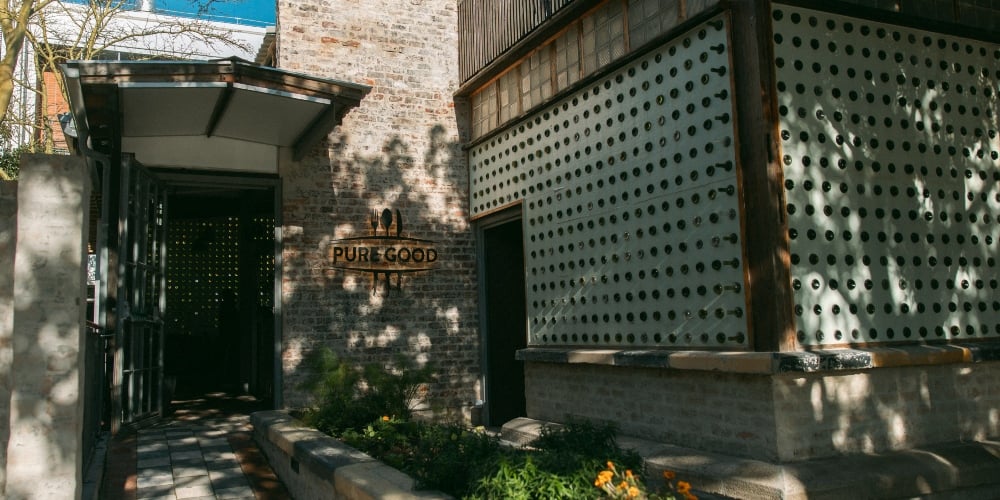
If you think sustainable dining means dull salads in a boring setting, think again! The V&A Waterfront’s newest eatery, Pure Good Café, located on Marina Road and adjacent to Africa Padel, is shaking things up with an aesthetic you’ve probably never seen before.

Pure Good, founded by Shannon Smuts, has already made a name for itself, supplying corporates, schools, and events with sustainable food solutions designed to promote a healthy lifestyle. Now, they’re bringing all that good stuff into their new café, serving up wholesome food with a side of eco-friendly flair.

The cafe aims to continue the Pure Good legacy, building a strong foundation on sustainability, community empowerment and accessible wellness.

The Vision

The story began in 2023 when the V&A Waterfront asked Pure Good to take over an eco-structure that was built almost entirely from salvaged and repurposed materials.

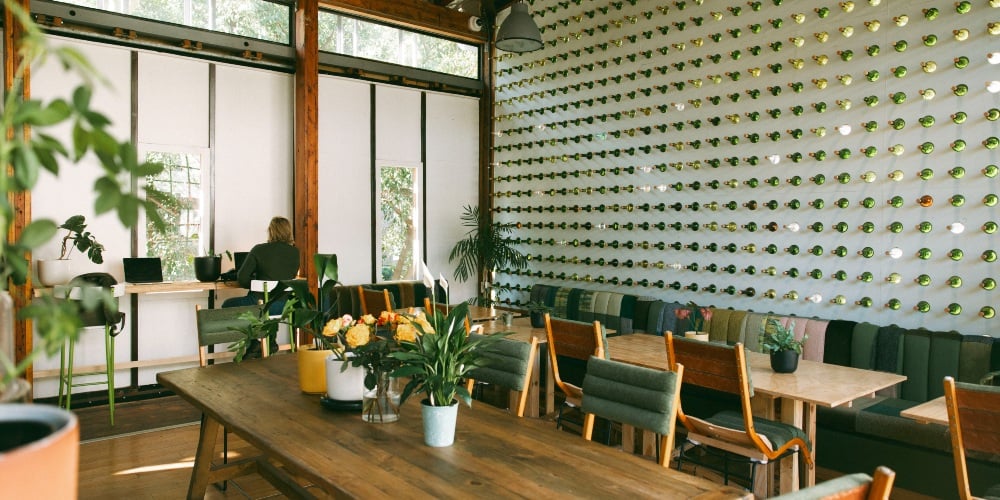
When Shannon and her team visited the site, they immediately felt a connection. While the space needed serious work, their ideas began to flow as they explored every corner. The café has designed the space using only upcycled, second-hand, or landfill-bound items, all reimagined in a way that feels both clever and modern.

“We wanted the café to be practical and functional but still look fresh and modern.”

Two years on, the café is open, celebrating sustainability in every way, from its design and furnishings to its seasonal menu and educational initiatives.

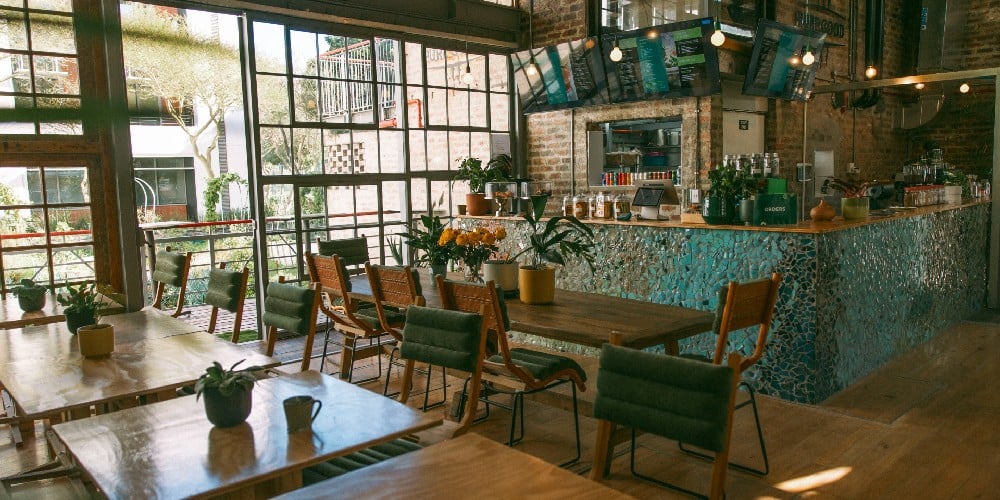
Over 98% of the café is built using salvaged materials, making sustainability part of every detail. The striking mosaic counter, made from broken ceramics by local artist Mervin Gers, was created just days before launch during a hands-on session with friends and family. The furniture, designed by Wunders using office waste, and the ‘orphaned’ plants from Plantify, which would have otherwise been discarded, breathe new life into the space. Other thoughtful touches include floorboards reclaimed from the Old Clock Tower, an outdoor deck made from salvaged wood from Quay Four, and crockery sourced from Mervin Gers’ factory seconds.
Wellness and Cuisine

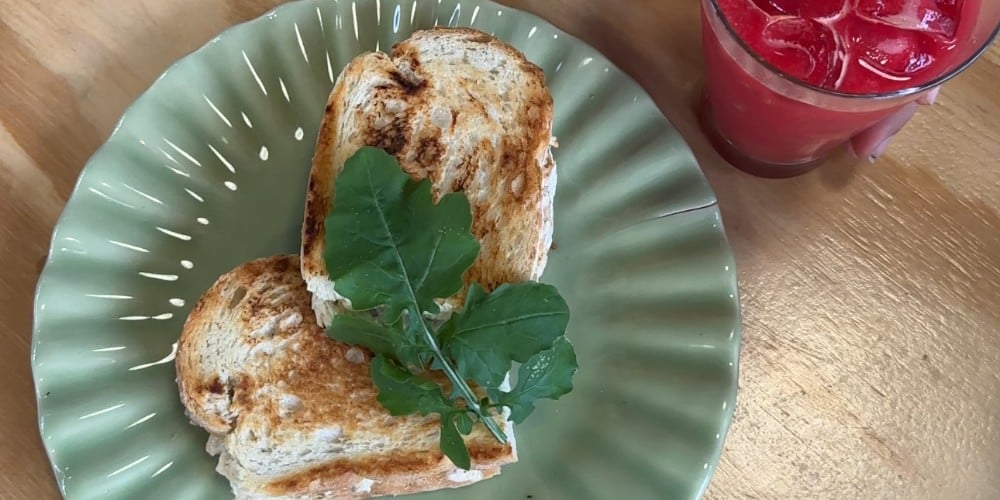
The café serves wholesome, affordable meals created from scratch using fresh produce sourced directly from Pure Good’s organic, regenerative farming partners. Enjoy everything from build-your-own protein-rich bowls, wraps and sandwiches. Sweet tooth lovers can tuck into guilt-free treats, coffee, and smoothies. Dishes are available in both full and half portions.

“From the structure to the menu to the food waste streams, we’re leading the charge on circular design, proving that sustainability and great food can go hand in hand,” Smuts explains.

The café’s kitchen also provides a training hub for young people from disadvantaged communities. The surrounding garden, nurtured in partnership with the non-profit organisation Grow SA and supported by the V&A Waterfront, feeds directly into the seasonal menu.

“Every cup of coffee and every bite of food supports a bigger mission for us. Whether it’s training the next generation of food entrepreneurs or reducing waste, we want every part of the experience to matter.

“We want people to walk in curious and walk out inspired,” adds Smuts.

Related Content

The post Cape Town’s New Green Café Is Serving Sustainability With Style appeared first on Cape Town Tourism.

Public Opinion on Immigration, New Power Plant Rules, College Cost Sharing

As the Trump administration carries out its campaign promises on immigration, Americans respond to rising tension over how they’re put in place. The Environmental Protection Agency plans to repeal limits on greenhouse gas pollution from the country’s fossil fuel power plants. And, a proposal in the Republican’s mega bill aims to have colleges assume some financial responsibility for their student’s loans.

Want more comprehensive analysis of the most important news of the day, plus a little fun? Subscribe to the Up First newsletter.

Today’s episode of Up First was edited by Dana Farrington, Neela Banerjee, Nicole Cohen, Lisa Thomson and Alice Woefle. It was produced by Ziad Buchh, Nia Dumas and Christopher Thomas. We get engineering support from Neisha Heinis and our technical director is Carleigh Strange

Learn more about sponsor message choices: podcastchoices.com/adchoices

NPR Privacy Policy

How Ugandan women are taking control of the coffee business

Meridah Nandudu envisioned a coffee sisterhood in Uganda, and the strategy for expanding it was simple: Pay a higher price per kilogram when a female grower took the beans to a collection point. It worked. More and more men who typically made the deliveries allowed their wives to go instead. Nandudu’s business group now includes more than 600 women, up from dozens in 2022. That’s about 75% of her Bayaaya Specialty Coffee’s pool of registered farmers in this mountainous area of eastern Uganda that produces prized arabica beans and sells to exporters.

Nandudu says traditionally women have done the hard work, but have not had control of the money. “Initially, women had been so discouraged about coffee in a way that when you look at coffee value chain, it’s the women who do the donkey work. It is the women that are planting, when it comes to weeding, harvesting, pulping, fermentation, washing and our fathers come at the point when this coffee is ready for selling,” she explains. Nandudu’s goal is to reverse that imbalance in labour and financial control in a business which can’t run without women. According to the US Department of Agriculture, Uganda is the second highest coffee producer in Africa, after Ethiopia.

The east African country exported more than 6 million bags of coffee between September 2023 and August 2024, accounting for $1.3 billion in earnings, according to the Uganda Coffee Development Authority. The earnings have been rising as production has been dwindling in Brazil, which is the world’s top coffee producer, due to unfavourable drought conditions. Nandudu grew up in In Sironko district, a remote village near the Kenya border where coffee is the community’s lifeblood. As a child, when she was not at school, she helped her mother and other women look after acres of coffee plants, weeding and labouring with the pulping, fermenting, washing and drying the coffee.

According to Nandudu, the harvest season was known to coincide with a surge in cases of domestic violence, as couples fought over how much of the earnings men brought home from sales — and how much they didn’t. “We came up with an idea where a woman’s coffee was fetching a slightly higher price than that one of a man. It was particularly 200 shillings, if a woman delivered coffee, it would earn that family 200 shillings plus on a kilo, so that motivated the men to trust their women to sell the coffee.

So, when the women sell the coffee, she has a hand in it, she knows how much we have sold this coffee, and when they come back at home they are able to sit and are able to discuss. So, through this we have witnessed low reduction levels of gender based violence in our communities and then the women have been empowered,” says Nandudu. Nandudu earned her degree in the social sciences from Uganda’s top public university in 2015, with her father funding her education from coffee earnings. She wanted to launch a company that would prioritize the needs of coffee-producing women in the country’s conservative society. She thought of her project as a kind of sisterhood and chose “Bayaaya” — which translates as brotherhood or sisterhood in the Lumasaba language — for her company’s name.

It launched in 2018, operating like others that buy coffee directly from farmers and process it for export. But Bayaaya is unique in Mbale, the largest city in eastern Uganda, for focusing on women and for initiatives such as a cooperative saving society that members can contribute to and borrow from. For small-holder Ugandan farmers in remote areas, a small movement in the price of a kilogram of coffee is a major event. The decision to sell to one or another middleman often hinges on small price differences.

A decade ago, the price of coffee bought by a middleman from a Ugandan farmer was roughly 8,000 Uganda shillings, or just over $2 at today’s exchange rate. Now the price is roughly $5. Nandudu adds an extra 200 shillings to the price of every kilogram she buys from a woman. It’s enough of an incentive for more women to join the company. Another benefit is a small bonus payment during the off-season from February to August.

Nandudu says: “It is important for us as women to be engaged in the coffee value chain. One is, as we all know traditionally we woman are like caretakers, we are managers it’s us basically to manage whatever activities are happening at home, always our husbands are always not at home so we are the ones that go to the farm, we are planting, we are the ones that are doing the weeding, we harvest the coffee with our children, we are able to pulp this coffee, and then we are able to ferment, we are washing the coffee so we are providing a support system to our husbands – so a woman is very important in the coffee value chain.”

That motivates many local men to trust their women to sell coffee Nandudu believes. Nandudu’s group has many collection points across eastern Uganda, and women trek to them at least twice a week. Men are not turned away. Juliet Kwaga, is one of the women who believes the coffee production is changing her life around. Kwaga, remembers her father was always in control. She says: “A lot of things have changed. I can talk about my story, when I grew up by then mum was not participating in this coffee things, her work was only to be at home as you know those are those days, but now these days things have changed because of sensitizing. We receive a lot of people who come talk to us, talk to families and in that process, we have seen a lot of changes, changes in families.”

Now, Kwaga’s husband, with a bit of encouragement, is comfortable sending her. “ She rejoices at the independence she now has to take care of her children. “I can buy food in a home as a woman, I can take my children to school as a woman and still I also have some money as a woman in the home. It is not like I am depending on my husband for everything, I want a book for my child or I am sick, such things, such easy easy things that I have to provide for myself,” she says. In Sironko district, home to more than 200,000 people, coffee trees dot the hilly terrain. Much of the farming is on plots of one or two acres, although some families have larger tracts.

Many farmers don’t usually drink coffee, and some have never tasted it. But things are slowly changing. Routine coffee drinkers are emerging among younger women in the coffee business in urban areas, including at a roasting place in Mbale where most employees are women. For Nandudu, who aims to start exporting beans, that’s progress. Now there are more women in “coffee as a business,” she says.

Source: Africanews

New pipeline project transforms Kibera’s water access

Eunice Akinyi needs water. She’s come to this kiosk to collect a supply. In Kibera, one of Africa’s largest informal settlements, finding a clean, affordable water source can be difficult. But this new system provided by Shining Hope for Communities (SHOFCO) has offered people like Akinyi peace of mind. She can drink what she has collected today and wash clothes for her son without worrying. “I was using water from private water vendors, but since I have a young child, he suffered from rashes and diarrhoea and we used to go to hospital many times. When I drink it, it used to affect me.

When I washed clothes with water, my child got rashes and pimples on his body and had to keep rushing to the hospital which requires a lot of money. But since I started using SHOFCO’s water, I have noticed positive changes,” she says. SHOFCO uses a network of aerial pipes to supply water. It is significantly cheaper than private vendors, who charge between 10 Kenya shilling ($0.077) and 20 Kenya shilling ($0.15) for a 20-litre jerry can depending on the season, while SHOFCO’s kiosks offer the same amount for just three Kenya shilling ($0.023). Women, who bear the primary responsibility for fetching water, often face coercion, including sex-for-water exchanges, due to the scarcity and exploitation by cartels.

But since launching in 2016, SHOFCO has built 52 water kiosks fitted with automated pre-paid key card systems, eliminating the need for sellers and reducing opportunities for exploitation. “Earlier on when we relied on private water vendors, we had a problem especially when it was a man selling water. Some of them would want to have an affair with you so that you do not have to queue in long lines to get water. Sometimes as women we were forced to go fetch water at night but it was dangerous because you did not know who you would encounter,” recalls Ivine Juma, another Kibera resident. Water pipes in Kibera are often laid on the ground and are unsafe due to widespread illegal connections and vandalism by water cartels, combined with poor government infrastructure and weak enforcement. Additionally, frequent flooding and inadequate sanitation leads to contamination of exposed pipes, increasing the risk of waterborne diseases.

The aerial design of SHOCO’s system minimises tampering and contamination, allowing for rapid leak detection and repair. “Our system, we use aerial pipelines, simply because we don’t want our water to be contaminated and also to have that ease of repairing the system. Because when you use the conventional system of trenching or laying pipes, when you have a leakage underground, you cannot really detect where the leakage is coming from and when the leakage happened. So our system is different because you are able to see,” says Felix Nyauma, acting head of WASH at Shining Hope For Communities (SHOFCO). SHOFCO currently operates six boreholes and five water treatment plants. The aerial water pipe network now stretches 18 kilometres, serving 40,000 residents and dispensing 300,000 litres of water each day.

According to the 2009 census, around 170,000 people lived within Kibera’s 2.5 square kilometres. Since then, urbanisation and rapid population growth have likely increased the number of residents, further straining housing, sanitation and access to basic services. “People are always moving to the urban centres,” says Aidah Binale, WASH programme coordinator at WASH alliance Kenya. “When you look at the master plans, some of them were laid in the1980s or 70s or 60s. And with the population now, it can’t handle that. So we have to embrace some of these innovations that are in the settlements so that we able to make sure the residents we are working with have a good life, have better health.” Pipes in the air is a solution to that problem.

Source: Africanews

Lampedusa: Honouring the migrants who died at sea

In a quiet corner of Lampedusa cemetery retired professor, Fabio Giovanetti waters plants and tidies rubbish from the graves of migrants of who have died crossing the Mediterranean Sea. “We have never seen or met these people, none of them have given us their name or their story. We don’t know anything, but they are still human beings who had the misfortune to encounter a shipwreck,” he says.

Lampedusa is the gateway to Europe for the thousands of migrants who cross the Mediterranean every year. This small island in the middle of the sea has for decades welcomed anyone who arrives, alive or dead, after the long journey to the European coasts. In 2024 the Italian Red Cross welcomed over 45,000 people. More than 9,000 people have already arrived in Lampedusa in 2025. Some of those who don’t survive the sea journey and whose story ends here in Lampedusa, are buried in the local cemetery. Often little is known about them, sometimes their name is known, sometimes not even that. Giovanetti, is a member of the Forum Lampedusa Solidale, a group of citizens who help those in need on the island, local and migrant alike.

Every migrant grave in this small cemetery tells a story. The Forum volunteers decided to decorate them with writings and drawings that restore dignity to people, but at the same time the tombstones tell the drama of those who die without an identity. On the tombs, the sea is often drawn wrapped in barbed wire, like in a prison. Over the years the Forum has managed to reconstruct fragments of stories, a form of respect towards these victims of the sea. One grave is for a man the group have named ‘Yassin’ from Eritera. “We don’t actually know what his name was. Yassin arrived dead in Lampedusa, but we wrote Yassin because a shipwrecked survivor said that someone near him was shouting this name” explains Giovanetti. Giovanetti tells the story of Ester Ada who died in 2009. “A Turkish merchant ship, the Pinar, rescued 153 migrants, including a dead woman. A dispute opens between Italy and Malta and despite being in Maltese waters, Malta refuses to welcome the merchant ship. The standoff lasts four days and in the end Italy welcomes the migrants together with the body of Ester Ada, this young woman who died during the crossing.”

Another young woman known as Welela is one of the very migrants buried in Lampedusa whose name and story we know says Giovanetti : “She was an Eritrean girl who was trying to reunite with her brother and during the journey she suffered a very serious accident that left her with burns all over her body.” “Once she arrived on the island (dead) she was taken to the mortuary and a lady from Lampedusa temporarily donated her tomb, so we were able to bury her here. Trying to reconstruct the history and identity of this person, our research intersected with that of her brother who lives in a city in Northern Europe and it was he who told us the whole story of this unfortunate girl,” he adds.

A few kilometres from the cemetery, on the Favaloro pier, patrol boats continue to disembark people rescued at sea. On April 21, 85 people were rescued by the coast guard in the stormy sea, along with the body of a young man, according to the Italian Red Cross. The latest confirmed victim of over 30,000 deaths in the Mediterranean in the last ten years, according to the International Organization for Migration.

Imad Dalil runs the migrants hotspot in Lampedusa for the Italian Red Cross. He says: “We are here to welcome people, alive as you said, inside the hotspot and guarantee them, with the multidisciplinary team, all the services both material and health and psychiatric support. Also dead people arrive at the dock and we are here for them too.”

Valeria Passeri, an aid worker for Mediterranean Hope, a refugee and migrant programme of the Federation of Protestant Churches in Italy says Lampedusa is a place where migrants pass through, but those who die enroute remain and the cemetery is a place where they can be remembered and belong. “The cemetery is a very important place because today it is the place where the people of Lampedusa and the people on the move meet. The only place where they are together. It is a place where it is possible to remember and taking care of that space means dedicating attention, honouring and welcoming people even if they did not make it.”

Source: Africanews

Fear and uncertainty grip Haitian workers in Texas meatpacking plants amid immigration crackdown

In the quiet town of Cactus, Texas, Haitian migrants like Nicole and Idaneau Mintor are facing a new wave of fear and uncertainty. Both work long hours at the JBS meatpacking plant—home to 3,700 workers, many of them immigrants—debating whether the American dream they chased is now slipping away.

Nicole, who arrived through the CBP One program last November, says she was drawn to the region for its job opportunities and higher wages. She earns more than $20 an hour deboning cattle—money she could never have hoped to make in Haiti. But earlier this month, she received a message warning her to leave the U.S. within seven days or face deportation or fines.

“They would consider going back to Haiti,” she said in Haitian Creole. “But the country is in a bad situation right now. You can’t make a decision. You have no idea what to do.”

The Biden-era immigration parole program allowed hundreds of thousands from Haiti, Cuba, Nicaragua, and Venezuela to enter legally. But recent actions under Donald Trump’s renewed crackdown have thrown those protections into question. Although a federal judge has temporarily blocked enforcement of deportation notices, many like Nicole still live in fear of losing their jobs, homes, and work permits.

“I don’t steal. I pay my bills. I respect the laws,” said Mintor. “But they are planning to take away my work permit.”

For these workers, the uncertainty is not just legal—it’s existential. With no clear path forward and no safe way back, their futures hang in limbo.

Source: Africanews

Israel Vows To Intensify War, India Deepens Ties With Russia, 2024 Union Lookahead

Despite U.S. calls to protect Palestinian civilians, Israeli Prime Minister Benjamin Netanyahu vowed to intensify attacks on Gaza until Hamas is defeated. India’s external affairs minister is meeting with his counterpart in Moscow to strengthen relations between the longtime allies. And, after some big wins in 2023, the United Auto Workers union is setting its sights on foreign automakers with plants in the south.

Today’s episode of Up First was edited by Dana Farrington, Michael Sullivan, Pallavi Gogoi and Mohamad ElBardicy.
It was produced by Julie Depenbrock, Mansee Khurana and Lisa Weiner. We get engineering support from Phil Edfors. And our technical director is Zac Coleman.

Learn more about sponsor message choices: podcastchoices.com/adchoices

NPR Privacy Policy

Plants on Lunar Soil

Scientists have for the first-time grown plants on lunar surface material known as regolith which had been collected 50 years before by Apollo astronauts.

Researchers used three of those samples to experiment. This comes just at the beginning of the Artemis era and the return of astronauts to the moon.

During the research, scientists grew Arabidopsis thaliana, a plant in the mustard greens family. Just like every player prefers a darmowa kasa za rejestrację bez depozytu when gaming, so do scientists prefer using the arabidopsis plant as a model organism in all plant biology studies since it’s small in size and it grows with ease.

As a result, they are already aware of its genes and how it responds when growing in different environments.

The team worked with teaspoon-sized samples collected from the Apollos 11, 12, and 17 missions. They used wells in plastic trays as pots and each well was filled with a gram of lunar soil. They then added water and a few seeds to the samples.

– –

The trays were put in a room and a nutrients solution was added daily. Seeds planted on volcanic ash and controlled earth soil were also part of the samples.

To the surprise of the scientists, they all sprouted after two days. They all looked the same until day six when they began growing differently depending on the type of sample they were in.

Plants grown on control earth soil and volcanic ash grew more robust than those on lunar soil and it was now clear that the regolith was not as hospitable for growing plants although it did not interrupt the signals and hormones involved in seed germination.

Some of the plants grown on Lunar soil grew more slowly, they had stunted roots, and some had reddish-black pigments on their leaves, a revelation of just how difficult it is for plants to grow on lunar soil.

Plants growing on Apollo 11 samples struggled the most as they turned purple, a sign that the soil had already been exposed to the harsh space environment but plants growing on Apollo 12 and 17 were doing well.

The plants were however harvested after 20 days just before they started to flower for RNA study. The study revealed that indeed the plants were stressed, and their reaction was like how Arabidopsis thaliana responds to growth in other harsh conditions such as when the soil has heavy metals or excess salt. Through this study, the researchers could also determine efficient ways of avoiding stressors for plants grown on lunar soil.

NASA, the body that conducted the study termed it a breakthrough in their long-term human exploration objectives. They aim at utilizing the available resources on the moon and other planets to create food resources for future astronauts operating and living in deep space.

The research is also a proof of how NASA is putting efforts into unlocking agricultural innovations which can clarify how plants grown in areas with food scarcity here on earth can overcome stressful conditions.
Source: Africa Feeds