Category Archives: Politics

Malawi has a multi-party system with over 40 registered political parties.The political process in Malawi is such that parties are voted into power. Parties participate in an electoral process. The parties with the most representation in the National Assembly are the People’s Party (PP), Malawi Congress Party (MCP), United Democratic Front (UDF), and Democratic Progressive Party (DPP).

President of Malawi 

Under the country’s 1966, 1994 and 1995 constitutions, the President is executive head of state. The first President was elected by the National Assembly, but later presidents were elected in direct popular elections for a five-year term. In the event of a vacancy, the Vice-President becomes President.

  Denotes Vice-President acting as President
? President
(Birth–Death)
Portrait Tenure Elected Political affiliation
(at time of appointment)
Took office Left office Time in Office
1 Hastings Banda
(1899–1997) [1]
Dr HK Banda, first president of Malawi.jpg 6 July 1966 24 May 1994 27 years,319 days Malawi Congress Party
2 Bakili Muluzi
(1942–)
Muluzi.png 24 May 1994 24 May 2004 10 years,3 days 1994
1999
United Democratic Front
3 Bingu wa Mutharika
(1934–2012)
Mutharika at Met.jpg 24 May 2004 5 April 2012
(died in office.)
7 years,316 days 2004 United Democratic Front
2009 Democratic Progressive Party [2]
4 Joyce Banda
(1949–)
Joyce Banda August 2012.jpg 7 April 2012 31 May 2014 2 years,54 days People’s Party
5 Peter Mutharika
(1939–)
Peter Mutharika 2011 (cropped).jpg 31 May 2014 Incumbent 4 years,103 days 2014 Democratic Progressive Party

Standards

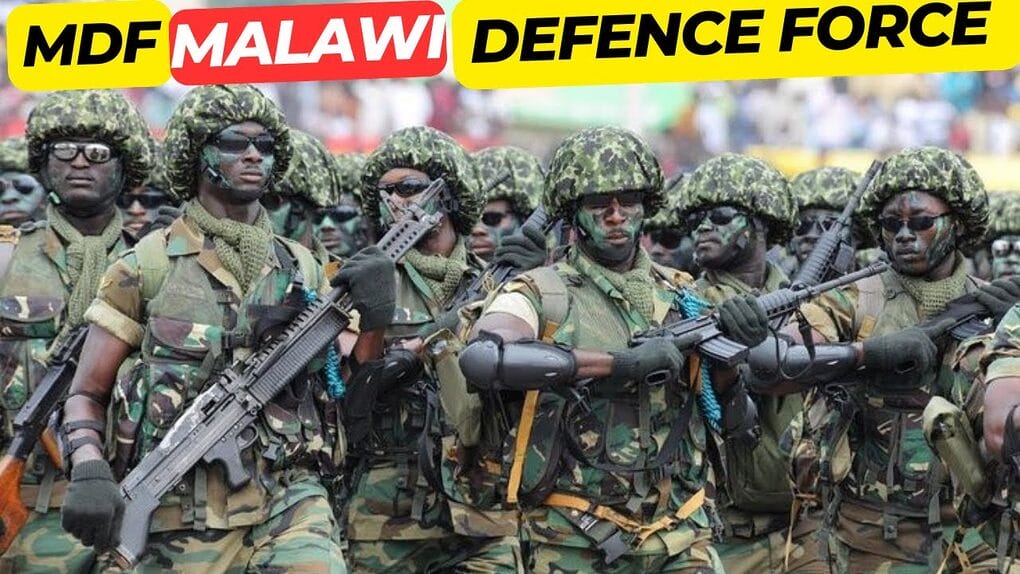
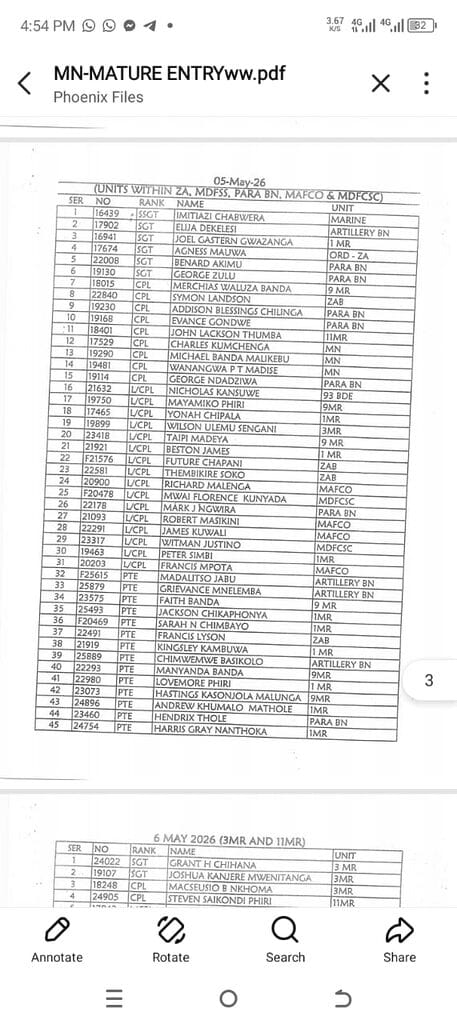
Malawi Defence Force (MDF): Concern Regarding Mature Entry Recruitment Criteria

I write to bring to your attention concerns regarding the current recruitment process within the Malawi Defence Force (MDF), particularly in relation to officer cadet entry pathways.
As you are aware, the MDF provides two routes for commissioned officer entry: direct entry (for civilians) and mature entry (for serving personnel). The minimum requirements for both pathways include possession of at least a degree, with age limits of 28 years for direct entry and 35 years for mature entry.

It has recently come to our attention that, under the leadership of Jaffu, the mature entry advertisement has been restricted to personnel holding the rank of Sergeant and below. This limitation appears inconsistent with established provisions and is perceived as unfair to many deserving serving members.
There are several personnel above the rank of Sergeant ranging from Staff Sergeant to Warrant Officer Class I who possess qualifications beyond a first degree and fall within the stipulated age limit of 35 years. Excluding such individuals introduces a parallel structure that departs from established practice and undermines merit-based progression within the MDF. It is particularly concerning that highly qualified individuals, including those holding Master’s and PhD degrees, may be excluded solely due to rank considerations rather than merit and eligibility.

In light of this, we respectfully request that this matter be brought to the attention of the Commander-in-Chief, Peter Mutharika, as it raises serious concerns regarding fairness, transparency, and adherence to the MDF Act. Promotion and career advancement should be guided by merit and eligibility, not restricted in a manner that disadvantages qualified personnel.

At present, many deserving soldiers feel discouraged and concerned about the direction this process is taking. We believe that corrective action is necessary to restore confidence and ensure that recruitment procedures remain just, transparent, and inclusive.

We therefore kindly urge that the ongoing recruitment process, including the interviews scheduled to commence on Monday, 4 May 2026, be suspended until these concerns are fully addressed and aligned with the provisions of the MDF Act.

We trust in your leadership and judgment, Maravi, and hope that you will escalate this matter to the appropriate authorities for timely resolution.

Yours sincerely,
Deserving Concerned Soldiers

Isn’t this disrespectful for Edgar Lungu’s remains reportedly missing amid court battle against burial in Zambia

LILONGWE-(MaraviPost)-What began as a drawn-out and controversial delay in giving former Zambian president Edgar Lungu a dignified burial has taken a chilling turn, transforming from a national unease into an international shock after his remains reportedly vanished overnight under mysterious circumstances.

The remains of Zambia’s former president, Edgar Lungu, have reportedly been stolen under unclear circumstances, marking a deeply troubling chapter in what was already a sensitive and widely criticized situation.

For nearly a year, the former leader’s body had not been buried, with the family citing unresolved issues surrounding funeral arrangements and other undisclosed concerns.

That delay had drawn growing scrutiny from citizens, leaders, and international voices alike.

Now, the unthinkable has happened.
Family representatives confirmed earlier this week that the body is missing.

According to their statement, they have no knowledge of who might have taken it or why.

Authorities have yet to provide concrete leads, and investigations are said to be ongoing.

“This is not just a family matter anymore it is a national and moral crisis,” said one local political analyst.

“The failure to bring closure has opened the door to something far more disturbing.”

Across Zambia and beyond, reactions have been swift and emotional. Many have expressed outrage over both the initial delay in burial and the subsequent disappearance.

Cultural and traditional leaders have also weighed in, emphasizing the importance of timely and dignified funerals, especially for figures of national significance.

Social commentators argue that the situation reflects deeper tensions possibly involving political disagreements, family disputes, or state-level complications that were never fully addressed.

Others warn that the incident risks eroding public trust and tarnishing the legacy of a man who once held the highest office in the land.

Meanwhile, calls are mounting for a transparent investigation and swift action to recover the remains.

Religious leaders have urged calm and unity, while stressing the need for respect for the deceased.

As the mystery deepens, one thing is certain what should have been a solemn and respectful farewell has instead become a haunting story of delay, controversy, and now, disappearance.

Lungu died on 5th June 2025.

Mutharika won’t be intimidated: MCP must answer for crisis they created

By Dickson Kashoti

President Professor Arthur Peter Mutharika is not a man who governs by ultimatums, threats, or political blackmail.

He remains unshaken, resolute, and firmly in control—despite a hollow 48-hour ultimatum issued by officials from the Malawi Congress Party yesterday.

Let it be stated without apology: Malawi is in crisis. But this crisis is not new—and it did not fall from the sky.

It is the direct consequence of reckless governance, economic vandalism, and systemic looting under the MCP administration.

The same Malawi Congress Party that is today pretending to be a voice of concern is the very architect of the collapse they now seek to politicise.

Malawians are not fools.
They remember the fuel queues.
They remember the darkness from endless blackouts.
They remember dry taps.
They remember the empty shelves, the suffocating cost of living, and the humiliation of a nation brought to its knees—not by external forces, but by its own leaders.

Nothing captures this betrayal more brutally than the scandal of the missing 27 million litres of fuel donated by the Democratic Republic of the Congo.

Thirty million litres were given to Malawi as a lifeline. Only 2.3 million litres can be accounted for. The rest—27 million litres—disappeared into thin air.

This was not incompetence. This was not mismanagement. This was organised plunder.

This was theft on an industrial scale—an unforgivable act of economic sabotage carried out while ordinary Malawians slept in fuel queues for days.
While citizens suffered, a cartel of politically connected elites allegedly turned humanitarian aid into a private cash machine.

And today, those same individuals—or their political sponsors—have the audacity to issue ultimatums?
They should be answering questions—not issuing threats.

On foreign exchange, the situation is equally damning. President Mutharika inherited an economy on life support, with depleted reserves at the central bank—a problem worsened catastrophically under Lazarus Chakwera.

Instead of stabilising the economy, the Chakwera administration drove it deeper into crisis through incompetence, poor judgment, and reckless experimentation.

The appointment of an unqualified and incompetent Finance Minister was not just an error—it was an act of economic negligence.

The disastrous 44 percent devaluation of the Kwacha—undertaken under the watch of the International Monetary Fund programme—crippled households overnight, sending prices soaring and crushing already struggling families.

And when the IMF walked away, citing fiscal indiscipline and uncontrolled spending, the truth became undeniable: the government had completely lost control.
Let us be clear—this is not leadership. This is failure.
Total failure.

Now, having presided over one of the most painful economic declines in recent history, the MCP wants to posture as saviours?
They want to shout from the rooftops and pretend they have answers?
Malawi deserves better than this hypocrisy.

If the MCP has solutions, let them present them.
If they have ideas, let them debate them.
But they must stop insulting the intelligence of Malawians with empty ultimatums and recycled rhetoric.
Leadership is not noise. Leadership is responsibility.

In contrast, President Mutharika is doing the real work—quietly, deliberately, and decisively.
No theatrics. No empty slogans. No desperate attempts to score political points.

His administration has already moved into action—tightening fiscal discipline, restructuring debt, and implementing pragmatic economic measures to stabilise the Kwacha and restore confidence.

These are not campaign slogans. These are hard decisions.
This is leadership.

Even in opposition, voices such as Dalitso Kabambe and Atupele Muluzi have demonstrated maturity—criticising where necessary, but also offering alternatives.
That is what responsible politics looks like.
Not threats. Not ultimatums. Not propaganda.

Malawi stands at a critical crossroads.
This is not a time for political games.
This is not a time for those who broke the system to pretend they can fix it.
This is a time for steady leadership, difficult decisions, and national unity.
President Mutharika will not be distracted.
He will not be intimidated.
And he will not be lectured by those who drove this country into the ground.

Malawi will recover—not through noise, but through discipline, leadership, and accountability.

And history will judge—very harshly—those who chose greed over country when Malawi needed them most.

Ndiope ndani?

Mozambique’s fuel crisis: A nation at a standstill

MAPUTO-(MaraviPost)-Mozambique is grappling with a severe fuel shortage, particularly in Maputo and Matola, with long queues, closed stations, and rationing reported.

The government initially denied a crisis but later attributed the situation to liquidity issues, foreign exchange shortages, and logistical delays rather than a lack of fuel at terminals.

The fuel shortage has persisted for over five days, with some stations closing or operating under police supervision.

Drivers are struggling to fill up, with some limited to 1,000 meticais (approximately 12 liters) per vehicle.

The situation is dire, with transport services suspending operations and prices expected to rise.

The root causes of the crisis are multifaceted. Fuel distributors are struggling to secure bank guarantees in US dollars to release fuel from port terminals, citing liquidity problems.

International logistical bottlenecks have increased fuel import costs and created delays, with transport times increasing from 15 to 25 days.

Panic buying and hoarding have exacerbated the situation.

The government has initiated inspections on stocks and sales, urging calm and claiming fuel is available at ports.

However, the shortage has affected transport, with some cross-border services suspending operations.

While southern areas face severe shortages, some provincial authorities, such as Zambezia, have reported stable, though tight, supplies.

The situation is characterized as a “liquidity crisis” for importers rather than a total lack of inventory, though the result at the pump is similar to a supply failure.

The government has announced emergency measures to secure liquid fuels, triggering immediate price hikes in Maputo.

Former Zambia leader Edgar Lungu’s remains gone missing from RSA mortuary

JOHANNESBURG-(MaraviPost)-News coming in shows that the body of the late former President Edgar Chagwa Lungu has gone missing from a South African mortuary.

A family source has confirmed with KBN TV that they can not find the body at the mortuary.

“It is true, they have stollen the body of ECL,” he said, warning that the family is curious to know who has stollen the body.

Lungu died last year and is yet to be buried after disagreements ensured between his family and government over the burial process.

Source: KBN TV

Two vessels fired upon near Strait of Hormuz as Gulf tensions mount

TEHRAN-(MaraviPost)-Two commercial vessels have come under fire near the Strait of Hormuz within hours of each other, escalating maritime tensions in the strategic waterway as regional states urge de-escalation.

A vessel located 8 nautical miles west of Iran reported being fired upon within the last 30 minutes, according to initial maritime alerts.

All crew members are accounted for and safe. Details on the ship’s identity, flag state, and extent of damage have not yet been released.

Hours earlier, a cargo ship sustained severe damage to its bridge after being fired upon 15 nautical miles northeast of Oman.

That vessel is believed to be the MSC Francesca, a Panama-flagged ship that departed the Saudi port of Dammam en route to Singapore. The condition of its crew has not been confirmed.

Iran’s state-affiliated Tasnim news agency said Iranian forces were enforcing maritime law and claimed the vessel had failed to heed defined warnings.

Tasnim did not specify which incident it was referring to or provide evidence of the alleged violations.

The attacks follow reports that Iran is planning a new regulatory mechanism for the Strait of Hormuz, a move Gulf states have already described as “completely unacceptable.”

The Strait is a critical chokepoint for global oil shipments, handling roughly one-fifth of the world’s petroleum.

Gulf countries have repeatedly called for de-escalation and a return to secure navigation through the waterway.

Regional officials are also pressing for the US naval blockade to be called off and for the Strait to remain open to international shipping.

Iran has proven increasingly assertive in the waterway amid broader regional friction and disagreements over sanctions, security arrangements, and ceasefire terms.

The latest incidents raise concerns over the safety of commercial traffic and the risk of miscalculation between naval forces operating in close proximity.

Maritime security firms have advised vessels transiting the area to exercise extreme caution, maintain maximum distance from Iranian territorial waters where possible, and report suspicious activity immediately.

No group has claimed responsibility for the attacks beyond the Tasnim statement. Investigations into both incidents are ongoing.

Outrage over Israeli soldier’s act of desecration in Lebanon

DEBEL-(MaraviPost)-Widespread condemnation has followed the emergence of a disturbing image showing an Israeli soldier apparently hitting a statue of Jesus with a sledgehammer in southern Lebanon.

The incident has sparked outrage among Christians and human rights groups, with many calling for accountability.

The image, which was taken in the Christian village of Debel, shows the soldier using a sledgehammer to strike the head of a statue of a crucified Jesus that had fallen off a cross.

The Israeli military has confirmed the authenticity of the image and has launched an investigation into the incident.

Israeli Prime Minister Benjamin Netanyahu has condemned the act, saying it was “stunned and saddened” by the destruction of the Catholic religious icon.

“I condemn the act in the strongest terms,” Netanyahu said in a statement on X. “Military authorities are conducting a criminal probe of the matter and will take appropriately harsh disciplinary action against the offender”.

The Israeli military has also apologized for the incident, saying it was “wholly inconsistent with the values expected of its troops”. “The IDF views the incident with great severity and emphasizes that the soldier’s conduct is wholly inconsistent with the values expected of its troops,” the military said in a statement.

The incident has sparked concerns about the treatment of Christians in the region, with some pointing out that Israel is one of the few safe havens for Christians in the Middle East.

However, others have criticized the Israeli military’s actions, saying they are inconsistent with the country’s claims of respecting religious freedom.

The incident comes amid ongoing tensions between Israel and Lebanon, with a ceasefire agreement brokered by the US having been implemented last week.

The Israeli military has said it is working with the local community to restore the statue to its place.

The incident of an Israeli soldier smashing a Jesus statue in Lebanon has sparked widespread condemnation. Israeli Prime Minister Benjamin Netanyahu has vowed “harsh action” against the soldier, saying the act was “wholly inconsistent with the values expected of its troops”.

Foreign Minister Gideon Sa’ar also condemned the incident, labeling it “grave and disgraceful” and apologizing to Christians who felt hurt.

The international community has also reacted strongly, with the US Ambassador to Israel, Mike Huckabee, calling for “swift, severe, & public consequences”.

The Assembly of Catholic Ordinaries of the Holy Land has expressed “profound indignation and unreserved condemnation” of the act, calling for immediate disciplinary action and accountability.

The incident has also sparked concerns about the treatment of Christians in the region, with some pointing out that Israel is one of the few safe havens for Christians in the Middle East.

However, others have criticized the Israeli military’s actions, saying they are inconsistent with the country’s claims of respecting religious freedom.

The current situation in Lebanon remains tense, with a ceasefire agreement brokered by the US having been implemented.

The Israeli military has said it is working with the local community to restore the statue to its place.

Tensions rise between Trump, Starmer over Iran war

LONDON-(MaraviPost)-UK Prime Minister Sir Keir Starmer and US President Donald Trump are at odds over the war in Iran, with Starmer refusing to yield to pressure from Trump to join the conflict.

The disagreement comes after Trump told Sky News that the UK was not supportive when the US asked for help, sparking tensions between the two leaders.

Trump also hinted that the tariff agreement with the UK, reached last year, could be renegotiated.

The rift between the two leaders highlights the growing divide between the US and UK over the Iran war, with Starmer emphasizing the need for international law to be upheld.

Iran’s actions have also raised concerns about food shortages in the UK, with prices potentially being affected by the conflict.

The situation remains fluid, with the UK government warning that the conflict in the Middle East could continue for some time.

The tensions between US President Donald Trump and UK Prime Minister Keir Starmer are heating up, especially regarding the Iran war.

Starmer has made it clear that the UK won’t be drawn into military action against Iran, despite pressure from Trump.

In fact, Starmer stated, “I’m not going to change my mind, I’m not going to yield, it is not in our national interest to join this war and we will not do so”.

Trump has warned of economic consequences for the UK’s non-participation, referencing the tariff agreement made last year.

The US and Iran are in talks to end the conflict, with Trump indicating a deal might be near.

However, Iran’s supreme leader has warned that the Strait of Hormuz will remain closed if the US blockade continues.

The situation is fluid, with reports of Iranian gunboats firing on tankers and the US enforcing a blockade on Iranian ports.

When sabotage is disguised as justice: The hard truth behind Malawi’s power struggles, presidential leadership

The hard truth is that Malawi is currently facing a silent war within its own governance structures, a war that threatens to derail progress and cripple the visionary leadership of President Peter Mutharika.

The recent loss of power supply due to a system shutdown at ESCOM on Friday at 10:03 a.m, an unusual and deeply troubling incident—cannot be dismissed as mere technical failure.

It is an evident symptom of a broader sabotage campaign aimed at discrediting the DPP-led government and casting it as incompetent and ineffective.

This is not just about electricity; it is about the very fabric of governance and the ability of a democratically elected leader to implement his mandate for the people of Malawi.

The hard truth is that President Mutharika must now seriously reconsider the weight he gives to the judiciary’s rulings, especially those that appear to be more obstructive than just.

The judiciary, which is supposed to be an impartial arbiter of justice, is increasingly becoming a tool used by remnants of the ousted MCP regime and other detractors to frustrate government efforts.

When the president’s administration tries to redeploy executives in key parastatals like ESCOM or MDF to inject fresh energy and accountability, the courts rush in with injunctions that halt these moves—not on the merits of governance, but on technicalities that serve sabotage.

The hard truth is that this judicial interference is not neutral; it is partisan obstruction that threatens to paralyze the executive’s ability to govern effectively.

The hard truth is that the judiciary’s unwarranted stay orders and injunctions are a direct attack on the president’s development agenda.

These legal obstacles have gone beyond neutral checks and balances; they have become instruments wielded by a network of saboteurs embedded within government departments and institutions.

This clandestine resistance is intent on making the government appear as a failure, thereby weakening public confidence and destabilizing the political landscape.

The disruption at ESCOM is a clear example of how these forces operate—creating crises and blaming the government, while secretly undermining its operations.

The hard truth is that if President Mutharika continues to heed all these judicial roadblocks without decisive action, the Democratic Progressive Party (DPP) risks collapse.

The party’s admirable manifesto, which promises development, stability, and prosperity for Malawi, will remain unfulfilled if the president’s hands are tied by continuous judicial sabotage.

The government’s inability to execute even basic administrative reshuffles or infrastructural reforms due to court injunctions is not just frustrating; it is catastrophic for national progress.

The hard truth is that Malawi’s leadership cannot afford to be passive in the face of such sabotage.

President Mutharika must exercise his constitutional powers with seriousness and resolve. He must pay a deaf ear to those who use legal maneuvers to block development initiatives.

This is not about undermining the judiciary’s independence but about recognizing when that independence is being exploited to serve political sabotage rather than justice.

The president must work with a trusted team—people who are aligned with the DPP’s vision and not secretly working to undermine it.

Pruning these saboteurs, regardless of their previous affiliations or positions, is critical if the government’s development manifesto is to be realized.

The hard truth is that the president’s leadership is not a personal endeavor but a national responsibility. His actions are aimed at improving the lives of Malawians, and any obstruction to this goal is betrayal to the people.

The judiciary’s role should be to protect the constitution and support legitimate governance, not to obstruct executive orders that have clear developmental purposes.

The fact that multiple injunctions have been granted to individuals resisting redeployments within government institutions shows a pattern of judicial overreach that serves narrow interests rather than the nation.

The hard truth is that Malawi needs a leader who can rise above these internal conflicts and assert his authority in the interest of national development.

President Mutharika must lead with a firm hand, ensuring that those who sabotage progress are held accountable and removed from positions where they can do harm.

This is not a call for authoritarianism but a plea for responsible governance where the executive’s legitimate actions are respected and supported, not blocked by hidden political agendas.

The hard truth is that the stakes are high. Malawi’s future hinges on the government’s ability to implement policies and reforms without being shackled by internal sabotage.

The power outages, the stalled redeployments, and the court injunctions are all interconnected symptoms of the same problem—a political sabotage that threatens to undo years of progress and good intentions.

President Mutharika’s response to this challenge will define his legacy and the trajectory of Malawi’s development.

The hard truth is that the time for patience is over. President Mutharika must now take decisive steps to ensure that his governance is not undermined by judicial sabotage or political remnants that seek to destabilize the nation.

He must build a loyal and effective team, prune those who sabotage, and govern Malawi with the seriousness and determination that the country deserves.

Only then can the promise of a better Malawi become a reality, free from the shadows of sabotage and obstruction.

Feedback:+265992082424
Email: jonesgadama@gmail.coml

US warns of renewed civil war in South Sudan as tensions escalate

The United States has sharply criticized South Sudan’s leadership, warning that President Salva Kiir’s actions are pushing the country toward renewed civil war.

Speaking before the U.N. Security Council, U.S. Ambassador Jennifer Locetta accused the government of forced displacement, violence against civilians, and obstruction of U.N. peacekeepers.

Recent operations, including mass evacuations in parts of the country such as around Akobo, have led to the displacement of hundreds of thousands of people and destruction of civilian property.

The situation is dire, with the U.S. stating that President Kiir’s actions are prioritizing unilateral control over peace, protection of civilians, and national stability.

The U.S. also accused South Sudanese authorities of restricting UNMISS operations, citing repeated violations of the Status of Forces Agreement, limits on patrol movements, and closure of peacekeeping bases.

This has hindered the ability of peacekeepers to protect civilians and facilitate humanitarian aid.

Washington said it would not support continuation of the UNMISS mandate in its current form and called for major reforms focused on civilian protection, humanitarian access, and accountability.

The statement comes as the U.N. Security Council prepares to renew the mandate of the U.N. Mission in South Sudan (UNMISS).

The situation in South Sudan remains fragile, with ongoing tensions between President Kiir and opposition leader Riek Machar threatening to derail the 2018 peace agreement.

The international community is urging South Sudanese leaders to prioritize dialogue and cooperation to prevent a return to full-scale conflict.

The U.N. Security Council has extended the UNMISS mandate until April 2026, emphasizing the need for political inclusivity, accountability, and dialogue to prevent a relapse into conflict.