LILONGWE-(MaraviPost)-Billy Kaunda is not just a name in Malawi’s music circles.
He is a living story, a voice that has echoed through generations, carrying with it the rhythm, struggles, and spirit of the people.
In a time when the nation is still coming to terms with the loss of musical giants like Lucius Banda, Kaunda’s presence feels even more significant.
With 13 albums and numerous singles, released between 1997 and 2025, Billy Kaunda stands as a bridge between the past and the present, a reminder of what Malawian music has been and what it continues to be.
What sets Billy Kaunda apart is not only his longevity in the industry, but the depth of his artistry.
His music speaks not just in melody, but in meaning. Through his lyrics, he has consistently captured the socio-political realities of Malawian life, telling stories that resonate with both the young and the old.
He is, in many ways, a custodian of culture, preserving our identity and history through his music.
There is something powerful about a musician who remains relevant across decades.
While trends come and go, Kaunda’s authenticity has never faded even a bit.
He has not chased the noise of modern fame, but instead allowed his work to stand on its own merit timeless, honest, and deeply rooted in tradition.
In today’s fast-changing music landscape, where new artists emerge almost daily, Billy Kaunda represents stability and surety.
He reminds the industry that greatness is not just about popularity, but about impact, consistency, and truth.
As Malawi reflects on the legends it has lost over the years, perhaps the greater responsibility now lies in celebrating those still with us.
Billy Kaunda is more than a survivor of an era as he is a symbol of resilience and artistic integrity.
And while history will always remember those who have passed, it is equally important to honor the voices that are still singing.
In Billy Kaunda, Malawi does not just have a musician, it has a living legend still writing his story for the many generations to come.
WASHINGTON-(MaraviPost)-US President Donald Trump has announced a two-week suspension of bombing and attacks on Iran, just hours before his self-imposed deadline was set to expire.
The move comes after Pakistan’s Prime Minister Shehbaz Sharif appealed to Trump to extend the deadline, allowing diplomacy to run its course.
Trump’s decision is conditional on Iran agreeing to reopen the Strait of Hormuz, a vital waterway for global oil shipments.
The US President had threatened to “decimate” Iran if the strait wasn’t reopened, warning that “a whole civilization will die tonight” if a deal wasn’t reached.
The announcement has been met with cautious optimism, with the international community breathing a sigh of relief.
The United Nations has welcomed the development, urging all parties to seize the opportunity for peace.
“There is no military objective that justifies the wholesale destruction of a society’s infrastructure or the deliberate infliction of suffering on civilian populations,” UN Secretary-General Antonio Guterres’ spokesman said.
Iran has responded positively to the proposal, with a senior official saying the country is reviewing Pakistan’s request for a two-week ceasefire.
The Iranian government has also called on young people to form human chains around critical infrastructure, including power plants, to protect against potential US strikes.
The situation remains volatile, with both sides engaged in heated negotiations.
Vice President JD Vance has expressed confidence that a deal can be reached, saying the US has “largely accomplished” its military objectives and is seeking a peaceful resolution.
As the world waits to see if the ceasefire holds, one thing is clear: the next two weeks will be crucial in determining the future of US-Iran relations and the stability of the Middle East.
LILONGWE-(MaraviPost)-Pyramid Group Limited has unveiled a MK120 million sponsorship package for district football leagues in the Central Region, in a move aimed at strengthening grassroots football development.
The unveiling ceremony took place at Bingu National Stadium on Tuesday, April 7, 2026, and was attended by representatives from various district football associations across the region.
The sponsorship will benefit 10 districts, with each district set to receive K4 million annually over a three-year period.
The initiative is expected to boost football activities at grassroots level and provide a structured platform for talent development.
Speaking during the event, Abel Chiumia, Managing Director of Pyramid Group Limited and Vice Chairperson of the Central Region Football Association, said the sponsorship aligns with efforts to transform football in Malawi.
Chiumia emphasized that investing in district leagues is key to nurturing young talent and strengthening the football pipeline.
He also urged district football associations to manage the leagues professionally to ensure the success of the initiative.
He further noted that the sponsorship package could be reviewed annually to match the rising cost of living, signaling the company’s commitment to sustaining the program.
Meanwhile, Ian Kapondera, Chairperson of Ntchisi District Football Association, commended Pyramid Group Limited for what he described as a timely intervention.
Kapondera said many districts have struggled to run competitive leagues due to financial constraints and pledged that beneficiary districts will ensure the funds are used responsibly.
The sponsorship is expected to revitalize district football leagues and create more opportunities for emerging players across the Central Region.
The leagues will be expected to be launched soon to align with the national calendar.
BLANTYRE-(MaraviPost)-Two healthcare workers at Mwanza District Hospital have been arrested in connection with the death of an unborn baby, allegedly due to a demand for a K100,000 bribe.
The suspects, Hary Moyo, 41, and Agness Phaka, 56, are accused of telling a pregnant woman to pay the bribe before receiving assistance, leading to the baby’s death.
Police spokesperson Hope Kasakula confirmed the arrests, saying the pair are being held for questioning.
The incident has sparked outrage, with Health Minister Madalitso Baloyi visiting the hospital last week to investigate.
Maranvipost has been following this case since the tragedy occurred, and our investigation reveals the hospital staff’s actions were a gross dereliction of duty.
The mother, whose identity is being protected, had gone to the hospital seeking urgent care, but was allegedly told to pay the bribe first.
The incident highlights the scourge of corruption in Malawi’s healthcare system, where patients are often forced to pay bribes for basic services.
MBABANE-(MaraviPost)-What began as a triumphant chapter for Eritrean football has taken a dramatic and troubling turn, after seven national team players reportedly disappeared following a recent trip to Eswatini.
The players had travelled to Eswatini to take part in the preliminary round of the 2027 Africa Cup of Nations (AFCON), where Eritrea delivered a stunning performance that reignited hope among their supporters.
In a match that will be remembered for years, Eritrea defeated Eswatini 4-1, securing a crucial step toward qualification and marking their return to continental relevance after 19 years in the shadows.
However, the celebrations were short lived as reports soon emerged that several members of the squad had gone missing shortly after the team’s assignment.
Out of the 10 Eritrea based players who made the trip, only three returned home, leaving seven unaccounted for and sparking widespread concern.
Unconfirmed reports suggest that the missing players may have crossed into South Africa, a country that has long been linked to similar incidents involving Eritrean athletes seeking better opportunities.
This is not the first time Eritrea has faced such a situation, as players have previously used international assignments as an opportunity to defect, citing difficult conditions back home.
The recurring nature of these incidents has, in the past, forced Eritrea to withdraw from various international competitions, raising questions about the sustainability of their football development.
Despite the growing speculation, the Eritrea Football Federation has remained silent on the matter, offering no official statement regarding the whereabouts of the players.
The silence has only deepened the mystery, leaving fans and observers wondering whether this is another case of defection or something more complex.
ZOMBA-(MaraviPost)-Zomba Stadium reopened its gates about a year ago after undergoing long awaited renovations but it is still yet to receive approval from the Football Association of Malawi (FAM) to host official matches.
The delay has raised concern among stakeholders, including Zomba Central Member of Parliament Bester Awali, who is pushing for the stadium to be fully certified for competitive football.
Awali said his vision remains clear to see the stadium actively hosting matches and other sporting activities that can benefit the youth and revive sports in the district.
He stressed that reopening the facility alone is not enough if it cannot be used for official competitions, which are key to developing talent and attracting fans.
The lawmaker said he will engage with FAM, urging the association to inspect the stadium and provide guidance on what is required for approval and he believes that once certified, the stadium will play a major role in boosting football standards in the Eastern Region.
Despite being structurally improved, the stadium has continued to operate below its full potential due to the absence of top level matches.
Zomba City Council Chief Executive Officer Archangel Bakolo confirmed that progress on the renovation has been steady, particularly under phase two of the project.
Bakolo noted that about 85 percent of the second phase has been completed, with only a few critical areas such as dressing room left unfinished.
According to Bakolo, the council has been working closely with the contractor to ensure that the outstanding tasks are completed as soon as possible.
He expressed optimism that the remaining works would be finalized by the end of April, which could strengthen the case for FAM approval.
Zomba Stadium had been closed for ten years while undergoing reconstruction before former president Lazarus Chakwera officially reopened it.
LILONGWE- (MaraviPost)-In a shocking display of insensitivity and irresponsibility, former President Lazarus Chakwera has once again proven himself to be a master of divisive rhetoric, sowing seeds of discord and discontent among Malawians.
His latest outburst, delivered at a funeral ceremony in Malembo village on April 6, 2026, is a clear indication that he is more interested in stirring up emotions and creating divisions than in promoting unity and peace.
“We are not like others, it’s not a privilege we should be doing this,” Chakwera said, referencing those who fought for Malawi’s liberation.
His statement, laden with innuendo and veiled threats, is a blatant attempt to whip up emotions and create divisions among Malawians.
It’s a cheap political trick that has been used by many a failed leader before, but it’s astonishing that someone of Chakwera’s stature and experience would stoop so low.
The implications of Chakwera’s statement are clear: he is suggesting that those who fought for Malawi’s independence are somehow less worthy or less deserving of respect than those who came after them.
It’s a narrative that is not only divisive but also ahistorical.
The men and women who fought for Malawi’s freedom did so at great personal cost, and it’s an insult to their memory to have their sacrifices reduced to mere political rhetoric.
But Chakwera’s statement is not just an insult to the nation’s founding fathers; it’s also a clear indication that he has not accepted the outcome of the September 16 elections.
He seems to be suggesting that the people of Malawi made a mistake by voting for his successor, and that he is still the rightful leader of the country.
This is a dangerous and reckless narrative that has the potential to create unrest and instability in the country.
Citizens for Credible Elections (CFCE), a group representing Malawian citizens, has rightly condemned Chakwera’s statement, describing it as “divisive, inflammatory, and having the potential to create unrest among Malawians.”
The group has called on Chakwera to refrain from making statements that could be divisive and instead promote unity and peace among Malawians.
But Chakwera is not just a liability to himself; he is a liability to the country as a whole.
His actions and statements have the potential to undo the progress that Malawi has made in recent years, and it’s time that he is held accountable for his actions.
The people of Malawi deserve better than a former president who is more interested in stirring up divisions than in promoting unity and peace.
They deserve a leader who is committed to healing the nation’s wounds, not deepening them.
As a leader, Chakwera has a responsibility to foster healing and reconciliation, not sow discord.
But he has failed to live up to this responsibility, and it’s time that he is called out for his actions.
In conclusion, Chakwera’s statement is a recipe for disaster in Malawi.
It’s a divisive and inflammatory rhetoric that has the potential to create unrest and instability in the country.
The people of Malawi must reject this kind of politics and demand better from their leaders.
LILONGWE-(MaraviPost)-A Malawian lawyer, Alexious Kamangira, has petitioned the Anti-Corruption Bureau (ACB) to investigate Steve Baba Malondera, Chairperson of the Public Accounts Committee (PAC), over allegations of bribery linked to the Amaryllis Hotel deal.
Kamangira claims Malondera received K65 million to influence the committee’s findings, with only K1 million allegedly distributed to each member.
The allegations have sparked concerns about transparency and accountability in public financial management, with Kamangira calling for Malondera’s resignation and an independent investigation.
Malondera has denied the allegations, stating he hasn’t received any money related to the inquiry.
The Amaryllis Hotel deal has attracted significant public interest, with the PAC inquiry already facing criticism for proceeding without key witness Colleen Zamba’s testimony.
The government has questioned the inquiry’s completeness, citing Zamba’s absence and lack of testimony from the hotel’s seller, Yusuf Investments Limited.
Washington, USA, 07 April 2026 -/African Media Agency (AMA)/- Nigeria has made meaningful progress in restoring macroeconomic stability, but inclusive growth must accelerate substantially to improve livelihoods—this partly depends on how effectively it invests in its people, create jobs, and starting in early life, according to the April 2026 Nigeria Development Update (NDU).
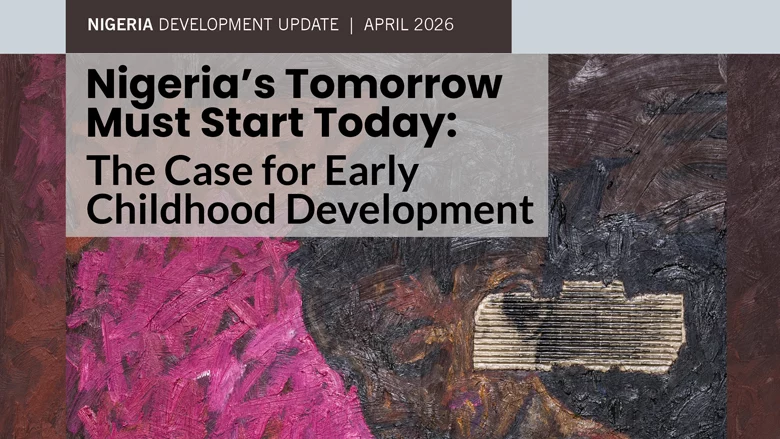
Titled Nigeria’s Tomorrow Must Start Today: The Case for Early Childhood Development, the report notes that while recent bold reforms have strengthened macroeconomic fundamentals, enhancing Nigerians’ productive capabilities will be critical to translating these gains into better living standards and jobs.
Nigeria’s economy grew by 4.0% in 2025, similar to 2024, driven mainly by services such as ICT, financial services, and real estate, with mild expansion in other sectors. Inflation has eased notably, falling to 15.1% year‑on‑year in February 2026, down from 26.3% a year earlier, supported by tight monetary policy, reduced exchange rate volatility, and improved food supply. Despite these gains, household incomes have yet to recover fully and poverty remains high, highlighting the need to lower inflation further and complement stabilization with investments that expand economic opportunity and jobs.
Nigeria’s external position remained positive in 2025, supported by stronger non‑oil exports, resilient remittances, and renewed portfolio inflows. The current account surplus reached 4.8% of GDP, while gross external reserves rose to $45.5 billion, equivalent to 8.7 months of imports. On the fiscal side, stronger non‑oil revenues lifted Federation Account receipts to 8.5% of GDP, although spending pressures widened the consolidated fiscal deficit modestly to 3.1% of GDP.
The Middle East conflict is expected to have mixed but manageable effects on Nigeria. Higher oil prices will boost revenues and exports, but higher energy, fertilizer, and shipping costs, alongside second-round effects, will add to inflation. Global risk aversion could tighten financial conditions and pressure the exchange rate, which should remain flexible to cushion shocks. Fiscal policy should leverage the windfall to rebuild buffers and provide targeted support to vulnerable households, avoiding blanket subsidies. Monetary policy should remain tight, supported by lower import barriers on inputs and food. Clear, consistent policy communication will help anchor expectations. Deepening macro and structural reforms will increase resilience going forward.
However, macroeconomic stability alone is not sufficient. The NDU underscores that human capital development is a key channel through which macroeconomic gains can translate into improved living standards and jobs—and that channel begins early. Investments during pregnancy and early childhood shape long-term productivity and shared prosperity. Yet outcomes in Nigeria remain weak and unequal: about 110 out of every 1,000 children die before age five, 40% are stunted, and more than half are not developmentally on track before entering school.
“Nigeria has made efforts to stabilize its economy, but welfare gains are still modest. Moreover, the conflict in the Middle East adds pressures. Sustaining and deepening macroeconomic stabilization, as well as addressing structural constraints, will be critical to translating reform dividends into faster, more inclusive growth, jobs and improved living standards,” said Mathew Verghis, World Bank Country Director for Nigeria. “Investing early in nutrition, health, caregiving, safety and early learning is one of the most powerful ways Nigeria can convert today’s reform gains into higher productivity, better jobs, and lasting poverty reduction.”
Improving early childhood outcomes requires a more integrated approach—bringing together nutrition, health, responsive caregiving, early learning, and children’s living environments, including access to water and sanitation, into a coherent and continuous package of support. This includes defining a basic package of services from pregnancy to age five, improving targeting and delivery, engaging private sector and community providers, and aligning financing and coordination with measurable outcomes.
“The outlook for Nigeria’s economy remains cautiously optimistic. Growth is projected at 4.2% over 2026-2028, supported by continued macroeconomic stabilization, ongoing structural reforms, and increased investment. Inflation, which is still high, is expected to fall gradually, albeit more slowly than previously expected due to pressures from the Middle East conflict”, said Fiseha Haile, World Bank’s Lead Economist for Nigeria.
Washington, USA, 07 April 2026 -/African Media Agency (AMA)/- Nigeria has made meaningful progress in restoring macroeconomic stability, but inclusive growth must accelerate substantially to improve livelihoods—this partly depends on how effectively it invests in its people, create jobs, and starting in early life, according to the April 2026 Nigeria Development Update (NDU).
Titled Nigeria’s Tomorrow Must Start Today: The Case for Early Childhood Development, the report notes that while recent bold reforms have strengthened macroeconomic fundamentals, enhancing Nigerians’ productive capabilities will be critical to translating these gains into better living standards and jobs.
Nigeria’s economy grew by 4.0% in 2025, similar to 2024, driven mainly by services such as ICT, financial services, and real estate, with mild expansion in other sectors. Inflation has eased notably, falling to 15.1% year‑on‑year in February 2026, down from 26.3% a year earlier, supported by tight monetary policy, reduced exchange rate volatility, and improved food supply. Despite these gains, household incomes have yet to recover fully and poverty remains high, highlighting the need to lower inflation further and complement stabilization with investments that expand economic opportunity and jobs.
Nigeria’s external position remained positive in 2025, supported by stronger non‑oil exports, resilient remittances, and renewed portfolio inflows. The current account surplus reached 4.8% of GDP, while gross external reserves rose to $45.5 billion, equivalent to 8.7 months of imports. On the fiscal side, stronger non‑oil revenues lifted Federation Account receipts to 8.5% of GDP, although spending pressures widened the consolidated fiscal deficit modestly to 3.1% of GDP.
The Middle East conflict is expected to have mixed but manageable effects on Nigeria. Higher oil prices will boost revenues and exports, but higher energy, fertilizer, and shipping costs, alongside second-round effects, will add to inflation. Global risk aversion could tighten financial conditions and pressure the exchange rate, which should remain flexible to cushion shocks. Fiscal policy should leverage the windfall to rebuild buffers and provide targeted support to vulnerable households, avoiding blanket subsidies. Monetary policy should remain tight, supported by lower import barriers on inputs and food. Clear, consistent policy communication will help anchor expectations. Deepening macro and structural reforms will increase resilience going forward.
However, macroeconomic stability alone is not sufficient. The NDU underscores that human capital development is a key channel through which macroeconomic gains can translate into improved living standards and jobs—and that channel begins early. Investments during pregnancy and early childhood shape long-term productivity and shared prosperity. Yet outcomes in Nigeria remain weak and unequal: about 110 out of every 1,000 children die before age five, 40% are stunted, and more than half are not developmentally on track before entering school.
“Nigeria has made efforts to stabilize its economy, but welfare gains are still modest. Moreover, the conflict in the Middle East adds pressures. Sustaining and deepening macroeconomic stabilization, as well as addressing structural constraints, will be critical to translating reform dividends into faster, more inclusive growth, jobs and improved living standards,” said Mathew Verghis, World Bank Country Director for Nigeria. “Investing early in nutrition, health, caregiving, safety and early learning is one of the most powerful ways Nigeria can convert today’s reform gains into higher productivity, better jobs, and lasting poverty reduction.”
Improving early childhood outcomes requires a more integrated approach—bringing together nutrition, health, responsive caregiving, early learning, and children’s living environments, including access to water and sanitation, into a coherent and continuous package of support. This includes defining a basic package of services from pregnancy to age five, improving targeting and delivery, engaging private sector and community providers, and aligning financing and coordination with measurable outcomes.
“The outlook for Nigeria’s economy remains cautiously optimistic. Growth is projected at 4.2% over 2026-2028, supported by continued macroeconomic stabilization, ongoing structural reforms, and increased investment. Inflation, which is still high, is expected to fall gradually, albeit more slowly than previously expected due to pressures from the Middle East conflict”, said Fiseha Haile, World Bank’s Lead Economist for Nigeria.