Almost the entire global population (99%) breathes air that exceeds WHO air quality limits, and threatens their health. A record number of over 6000 cities in 117 countries are now monitoring air quality, but the people living in them are still
breathing unhealthy levels of fine particulate matter and nitrogen dioxide, with people in low and middle-income countries suffering the highest exposures.
The findings have prompted the World Health Organization to highlight the importance of curbing fossil fuel use and taking other tangible steps to reduce air pollution levels.
Released in the lead-up to World Health Day, which this year celebrates the theme Our planet, our health, the 2022 update of the World Health Organization’s air quality database introduces, for the first time, ground measurements of annual mean
concentrations of nitrogen dioxide (NO2), a common urban pollutant and precursor of particulate matter and ozone. It also includes measurements of particulate matter with diameters equal or smaller than 10 μm (PM10) or 2.5
μm (PM2.5). Both groups of pollutants originate mainly from human activities related to fossil fuel combustion.
The new air quality database is the most extensive yet in its coverage of air pollution exposure on the ground. Some 2,000 more cities/human settlements are now recording ground monitoring data for particulate matter, PM10 and/or PM2.5,
than the last update. This marks an almost 6-fold rise in reporting since the database was launched in 2011.
Meanwhile, the evidence base for the damage air pollution does to the human body has been growing rapidly and points to significant harm caused by even low levels of many air pollutants.
Particulate matter, especially PM2.5, is capable of penetrating deep into the lungs and entering the bloodstream, causing cardiovascular, cerebrovascular (stroke) and respiratory impacts. There is emerging evidence that particulate matter impacts
other organs and causes other diseases as well.
NO2 is associated with respiratory diseases, particularly asthma, leading to respiratory symptoms (such as coughing, wheezing or difficulty breathing), hospital admissions and visits to emergency rooms
WHO last year revised its Air Quality Guidelines, making them more stringent in an effort to help countries better evaluate the healthiness of their own air.
“Current energy concerns highlight the importance of speeding up the transition to cleaner, healthier energy systems,” said Dr Tedros Adhanom Ghebreyesus, WHO Director-General. “High fossil fuel prices, energy security, and the urgency
of addressing the twin health challenges of air pollution and climate change, underscore the pressing need to move faster towards a world that is much less dependent on fossil fuels.”
Steps governments can take to improve air quality and health
A number of governments are taking steps to improve air quality, but WHO is calling for a rapid intensification of actions to:
Adopt or revise and implement national air quality standards according to the latest WHO Air Quality Guidelines
Monitor air quality and identify sources of air pollution
Support the transition to exclusive use of clean household energy for cooking, heating and lighting
Build safe and affordable public transport systems and pedestrian- and cycle-friendly networks
Implement stricter vehicle emissions and efficiency standards; and enforce mandatory inspection and maintenance for vehicle
Invest in energy-efficient housing and power generation
Improve industry and municipal waste management
Reduce agricultural waste incineration, forest fires and certain agro-forestry activities (e.g. charcoal production)
Include air pollution in curricula for health professionals and providing tools for the health sector to engage.
Higher income countries see lower particulate pollution, but most cities have trouble with nitrogen dioxide
In the 117 countries monitoring air quality, the air in 17% of cities in high-income countries fall below the WHO’s Air Quality Guidelines for PM2.5 or PM 10. In low- and middle-income countries, air quality in less than 1% of the cities complies with WHO recommended thresholds.
Globally, low- and middle-income countries still experience greater exposure to unhealthy levels of PMcompared to the global average, but NO2 patterns are different, showing less difference between the high- and low- and middle-income
countries.
About 4000 cities/human settlements in 74 countries collect NO2 data at ground level. Aggregated, their measurements show that only 23% of people in these places breathe annual average concentrations of NO2 that meet levels in the
recently updated version of WHO’s Air Quality Guidelines.
“After surviving a pandemic, it is unacceptable to still have 7 million preventable deaths and countless preventable lost years of good health due to air pollution. That’s what we’re saying when we look at the mountain of air pollution
data, evidence, and solutions available. Yet too many investments are still being sunk into a polluted environment rather than in clean, healthy air,” said Dr Maria Neira, WHO Director, Department of Environment, Climate Change and Health.
Improvement in monitoring needed
People living in lower and middle-income countries are the most exposed to air pollution. They are also the least covered in terms of air quality measurement — but the situation is improving.
Europe and, to some extent, North America, remain the regions with the most comprehensive data on air quality. In many low- and middle-income countries, while PM2.5 measurements are still not available, they have seen large improvements for
measurements between the last database update in 2018 and this one, with an additional 1500 human settlements in these countries monitoring air quality.
WHO’s Air Quality Guidelines
The evidence base for the harm caused by air pollution has been growing rapidly and points to significant harm caused by even low levels of many air pollutants. Last year, the WHO responded by revising its Air Quality Guidelines to reflect the evidence,
making them more stringent, especially for PM and NO2, a move strongly supported by the health community, medical associations and patient organizations.
The 2022 database aims to monitor the state of the world’s air and feeds into progress tracking of the Sustainable Development Goals.
World Health Day 2022
World Health Day, marked on 7 April, will focus global attention on urgent actions needed to keep humans and the planet healthy and foster a movement to create societies focused on well-being. WHO estimates that more than 13 million deaths around the
world each year are due to avoidable environmental causes.
As part of a unique global partnership to promote health, the senior leadership of the World Health Organization (WHO), the State of Qatar and FIFA today agreed a range of measures that will be implemented at this year’s FIFA World Cup Qatar 2022™ to protect and encourage health; and take lessons learned from the first tournament in the
Middle East and Arab world to share with future mega sporting events.
The heads of WHO, Qatar Ministry of Public Health, FIFA and the Supreme Committee for Delivery & Legacy (SC) met together for the first Steering Committee meeting of the “Healthy FIFA World Cup Qatar 2022™ – Creating Legacy for Sport and
Health” partnership. Launched in late 2021, the partnership is committed to:
protecting the health of all those involved in the FIFA World Cup Qatar 2022™: FIFA, WHO and Qatar have teamed up to ensure the FIFA World Cup Qatar 2022™ is a healthy and safe event from the implementation of precautions
to prevent the spread of COVID-19 to the provision of healthy menu options;
using the FIFA World Cup Qatar 2022™ as a platform to promote healthy lifestyles: The tournament will inspire millions around the world to play more football and be more active including a global campaign to raise awareness of the
health benefits of physical activity. The State of Qatar have also signed a 3-year partnership with WHO to improve healthcare access and promote healthy lifestyles across the country; and
creating a blueprint to protect and promote health at future mass gatherings: The FIFA World Cup Qatar 2022™represents a unique opportunity to develop a new approach to organizing mega sports events factoring-in lessons learnt from
the pandemic and reinforcing sports and health as a pathway for recovery.
“The State of Qatar is proud to be the first country from the Middle East to host the FIFA World Cup,” said HE Dr Hanan Mohamed Al Kuwari, Qatar’s Minister of Public Health and Chair of the Steering Committee Meeting. “Our overall goal
is not just to hold a successful sporting event, but to also show how football and sports in general can be drivers of better health for all people. This is why we are working so closely with WHO, FIFA and the Supreme Committee for Delivery &
Legacy.”
At today’s meetings, the Steering Committee leaders agreed a range of action areas to be taken for the FIFA World Cup Qatar 2022™ and future events, including:
build on actions taken at the FIFA Arab Cup™ in late 2021, strengthen health emergency preparedness and ensure maintenance of precautionary measures for containing infectious diseases, including COVID-19, to keep people safe and healthy;
provide healthy food options inside stadiums and fan zones;
enhance tobacco prevention in stadiums, fan zones and other areas;
start collaborative agreements with countries to benchmark legacy building activities; and
exchange lessons learned with the International Olympic Committee for Paris 2024 and Milano Cortina 2026.
“WHO is committed to working with the State of Qatar and FIFA to leverage the global power of football to help people lead the healthiest lives possible,” said Dr Tedros Adhanom Ghebreyesus, WHO Director-General. “This partnership will
help to make the FIFA World Cup Qatar 2022 a role model for healthy sporting events.”
The first-of-its-kind agreement was also lauded by FIFA President Gianni Infantino, who said, “It’s important that the first FIFA World Cup in the Middle East will be the healthiest World Cup ever. Here, we put our efforts together through
this innovative partnership to promote health in a different way, using the power of football to communicate certain messages. We have been working together on different awareness campaigns and what better platform now than the FIFA World Cup for
passing the Health for All message?”
“You have to do whatever you can to protect your health and that of those around you. That is part of education and that is why we are proud to be part of this team here. We need health for football, and we need football for health. Let’s
win this World Cup, our World Cup, which is a World Cup of humanity in the end,” Mr Infantino added.
As part of the agreement, two SC legacy programmes – Generation Amazing and B4Development (B4D) – will provide operational and technical collaboration on a range of projects. Generation Amazing is a football for development programme that
has positively impacted more than 725 000 people globally since being launched during Qatar’s bid to host the FIFA World Cup™, while B4D is the region’s first “nudge unit” that utilizes behavioural science to solve a
range of societal issues.
H.E. Hassan Al Thawadi, SC Secretary General, said, “As FIFA World Cup hosts, Qatar has worked to underscore the importance of leaving sustainable and transformative social legacies that improve lives – in Qatar, within our region and around
the world.”
“This partnership is critical for us as we prepare for hosting the world at the end of this year in the context of the pandemic, which has affected so many lives around the world. We’re engaging in every effort along with local and international
partners to ensure a healthy and safe FIFA World Cup.”
“Together, our work with FIFA and WHO will add to our current efforts, including projects delivered by our legacy programmes such as Generation Amazing and B4Development, to ensure the first FIFA World Cup in our region serves as a benchmark
for future mega-events across the globe,” he added.
Dr Ahmed Al-Mandhari, WHO Regional Director for the Eastern Mediterranean, reinforced the Organization’s commitment to advancing health for all in the Region, and said that the partnership between WHO and Qatar would support improvements in physical
activity, mental health and organized sports.
“WHO looks forward to working closely with Qatar in the months ahead to use the platform that sporting events offer to bring people together and foster solidarity, which is the core of our regional vision of ‘Health for all by all: a call for solidarity
and action’, while at the same time promoting healthier habits, from diet to physical activity, for people of all ages, genders and cultures.”
The digital Imam, Sheikh Muhammad Nura Khalid, reminded me of the three Hebrew boys; Shedrack, Meshach and Abednego. In chapter three of the Book of Daniel, we are introduced to three young men: Shadrach, Meshach, and Abednego, who held on to their belief in God even when threatened with a fiery death. The trio refused to bow down to King Nebuchadnezzar’s false idol. Even when they were brought before the king to face their fate, they remained courageous in the face of the king’s demand to bow down before the golden statue. I like to define courage as acting on your conviction in spite of the consequences. Shadrach, Meshach, and Abednego acted on their conviction in spite of the consequences -death. That’s courage. Similarly, character strengths — as classified by positive psychology — are a family of positive traits expressed through a person’s thoughts, feelings, and behaviors that are universally recognized for the strength that they create in individuals and communities. This kind of courage does not come lightly or on an impulse – it is borne out of deep convictions cultivated over a lifetime. Courage is not necessarily prowess on the battlefield, the kind that kings and warriors typically exhibit. Courage is to tell the truth in a situation where the truth is unwelcome — and not only to tell the truth, but to live the truth, as well. Show me a very brave man; show me a man that can stand amid contrived, overwhelming odds, show me a man that is needed on a day requiring courage. Show me a fearless cleric with a mindset of truth, and I will show you the digital Imam, Sheikh Muhammad Nura Khalid.
Sheikh, you have the respect and admiration of millions of our compatriots home and abroad. You are one of the very few clerics with the balls to speak truth to power. You are an epitome of excellence and a symbol of courage. You stand tall, like in the days of Martin Luther King Jr. As a cleric, your courage is out of this world. You are not one to lace truth with falsehood. You do not know how to placate or massage the ego of those in power. You do not sit on the fence. You dish and serve it raw and hot to the government of the day. You criticized the political gladiators for their inability to rein in terrorists and near hopelessness in the face of total collapse of security and descent to anarchy. And for this, you have the respect and admiration of millions of Muslims and Christians within and outside the country. Your message cannot be suppressed. Thank you for your courage and thank you for all you do for humanity. They may have succeeded in taking away a platform. Rest assured that many other platforms will be available for you to continue to spread the message of peace, unity and love. In conclusion, permit me to use the words of Rev. Mark Sandlin, he had said; If your “spirituality” denies someone’s humanity, it isn’t spirituality, it’s hatred wrapped up in religiousity. Richard Odusanya is a Social Reform Crusader and the convener of AFRICA COVENANT RESCUE INITIATIVE ACRI
VATICAN-(MaraviPost)-The head of Catholic church Pope Francis has said countries should always help those, especially immigrants, trying to survive “amidst the waves of the sea”.
The Pope who was struggling with leg pain on Sunday, April 3, 2022 was on the last phase of his trip to Malta, which is at the heart of Europe’s migration debate.
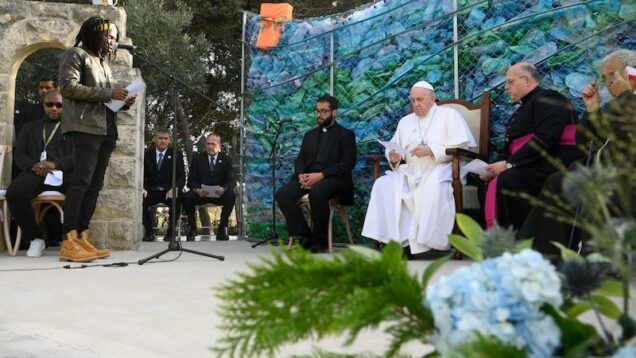
At the start of the last day of his trip to the Mediterranean island, Francis visited the grotto in the town of Rabat.
According to tradition, St. Paul lived there for two months after he was among 75 people shipwrecked on their way to Rome in the year 60 AD.
The Bible says they received unusual kindness.
“No one knew their names, their place of birth or their social status; they knew only one thing: that these were people in need of help,” the pope said in a prayer in the grotto.
The 85-year-old pontiff is suffering from a flare-up of leg pain and had difficultly walking in the small grotto.
At a Mass for about 20,000 people afterwards, he mostly sat while Valletta Archbishop Charles Scicluna led much of the liturgy.
Francis had to use a lift to board his flight in Rome and disembark on arrival in Valletta on Saturday, and at the end of Sunday’s Mass, he skipped the traditional exit procession with all the bishops.
Malta is one of the more important routes used by migrants who cross from Libya to Europe.
“Help us to recognise from afar those in need, struggling amidst the waves of the sea, dashed against the reefs of unknown shores,” the pope said in prayer at the grotto.
The government of Prime Minister Robert Abela insists that the island, by far Europe’s most densely populated country, is “full up”, refusing to allow the disembarkation of migrants other than those rescued within its own rescue zone.
Francis’ last stop was a visit to a centre for migrants, known as a “peace lab”.
There, he heard Daniel, a Nigerian, tell of his several attempts to reach Europe in un-seaworthy boats and how he was detained in Libya, Tunisia and Malta.
“Sometimes I cried! Sometimes I wished I had died … why were men like us treating us like criminals and not like brothers?” Daniel said.
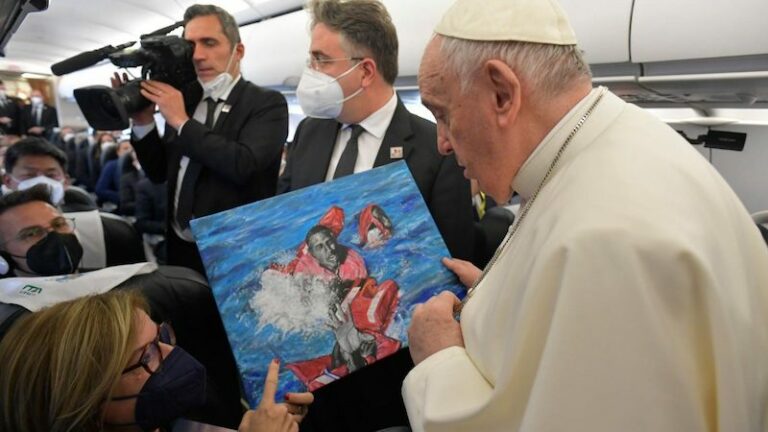
A painting of Daniel on the migrant crisis was presented to Pope Francis on Saturday in Rome, ahead of the visit.
Francis told them that the humanitarian crisis of migration was “a shipwreck of civilisation which threatens not only migrants but all of us”.
Mistreatment of migrants sometimes occurs “with the complicity of competent authorities,” he said.
On Friday, the German NGO ship Sea Eye IV was outside Maltese territorial waters seeking to disembark 106 migrants rescued from Libyan waters and was denied entry.
Human rights organisations have criticised the island for its involvement in “pushbacks” where migrants rescued in coordination with Malta are taken back to Libya.
The organisations say this breaks international law since Libya is not a safe country.
Speaking to Maltese government officials on Saturday, Francis denounced “sordid agreements with criminals who enslave other human beings”.
He has in the past compared conditions in centres holding migrants in Libya to Nazi and Soviet camps.
Malta argues that Europe should have an effective “burden-sharing” mechanism.
Francis also has called several times for shared responsibility for migrants among European countries. Source: www.expressiveinfo.com
BLANTYRE-(MaraviPost)-President Lazarus Chakwera on Monday April 4,2022 launched the Malawi National Tourism Masterplan with promises to invest adequate political will and resources
Chakwera said Tonse government fully understands how tourism development remains one of the major drivers of the Malawi’s economy.
He observes that the tourism sector needs special attention with policy-making apparatus.
Chakwera again with ambitious Tourism Investment Masterplan
“Investing in our tourist attraction sites will make our beautiful country a regional and international tourist destination, thereby creating more jobs and bring more forex into the country.
“We promise to invest adequate political will and resources to the success of the investment tourism masterplan,” he said.
Chakwera added the administration will also create an enabling environment for the private sector for them to be reliable partners in the growth of the tourism industry in the country.
He therefore called upon every citizenry to contribute effectively towards the success of the master plan.
Ministry of Tourism’s Principal officer Tamanda Kaleke observes that lack of readily available land for tourism development and inadequate infrastructure support and services are factors that necessitated the development of the masterplan.
Kaleke said with the promise from Chakwera to provide adequate resources hopes the plan will achieved as scheduled.
Tourism and Culture Minister Michael Usi said assured of working hand in hand with the government and the partners towards the Achievement of the masterplan.
The masterplan which is scheduled from 2022 to 2024, is a guide on how Malawi will implement 10 priority projects across the country as one way of transforming the country through tourism development.
The investments under the plan will be financed through Public Private Partnership Commission (PPPC) with African Development Bank Providing some financing.
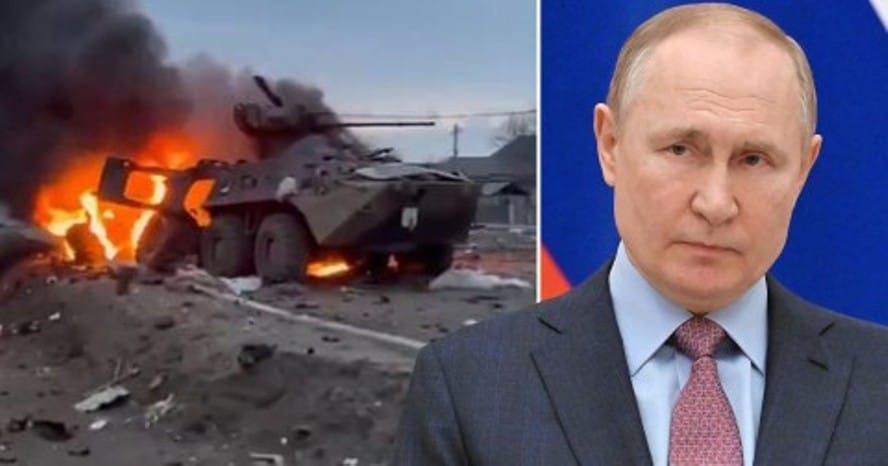
President Vladimir Putin of Russia: “People in some countries protest against me and call me killer, but they don’t see that I am at war with Nazis. I don’t rebuke those who are against me today, because people are not guilty. Some media has been able to trick people with their lies and provoke them against me and things are not what they seem. Today, tomorrow or someday the people of the world will understand everything”.
Russia-Ukraine war
In a world where it seems not possible for someone to make soberly comments that others may interpret as offensive to their parochial interests, then the vital right to freedom of expression is dead. This is the world in which we live today. The situation is even worst in Africa where some leaders do things contrary to the demands and aspiration of their citizens. And all these do not make coverage in the corporate media.
I know few people will not agree with this piece of opinion because to them everything in the media about Russia’s action in the Ukraine is the gospel truth. To these people one must not speak good things about Russia or you risk persecution or even declared persona non grata.
For the few of us who believe in democracy and freedom, the current malicious media war propaganda against Russia and in particular against the integrity and personality of the Russian leader, President Vladimir Putin is not new, and this won’t stop here, as long as one stands for the truth, justice and wellbeing of humanity. It is a game, and this game is being played everywhere, mostly in natural resource-rich countries, such as Libya, Syria, Afghanistan, former Yugoslavia, Sudan, Somalia, the Congo, Rwanda, Nigeria, Chad, Venezuela, Cuba, Nicaragua, North Korea, Iran, Yemen, Iraq and so on, and so on-the list is endless.
Coming to the main contents in my piece of opinion, I want to start by saying that in the aftermath of the collapse of the former Soviet Union and demise of the WARSAW Pact, the United States felt much more desperate in its quests for supremacy and to own the title of “only super power on earth”. I need not to discuss here how former President of the USSR, Mikhail Gorbachev’s glasnost and perestroika politics pulverized the hope of Soviet citizens; that is a matter for historians to write home about.
Consciously or unconsciously, former US Secretary of State during the first Gulf war in 1990, James Baker told journalists that the US had spent trillions of dollars to dismantle the Soviet Union. Well, he said it all as official policy of the US government. But my understanding after the fall of the Berlin wall was that, with the demise of the Soviet Union and WARSAW Pact, there is no need for another tailored cold war or arms race in the world. But this is not the case as actions of the United States and its partners depict contrary to my thought.
With the current crisis in the Ukraine, I beg to ask some pertinent questions: Who is responsible for war in Russia’s neighbor? What is the purpose of NATO after the demise of the Soviet Union and the Warsaw Pact? Who is to blame for the crisis in the Ukraine? Is NATO’s continued existence is part of a ploy to implement a new “Monroe Doctrine” that gives the United States the right to intervene in the former territories of the Soviet Union?
The war in Ukraine provides a vindication of early fears that NATO’s move eastward towards Russian borders would set a bad motion, if not the beginning of a new cold war, which Moscow will reject and react with whatever the Kremlin may deem necessary to defend Russia’s interest against any threats from outside its borders. Indeed, media disinformation and misinformation campaign agenda to distract domestic opinion is winning the war in Ukraine. But in reality Ukraine and the Ukrainian people bear the brunt of insensitive leadership. Sorry to say that President Volodymyr Zelenskyy doesn’t know the difference between being a leader of a nation and being a comedian or film actor.
On the question of NATO’s continued existence should not be a headache no more. I think immediately following the demise of the Soviet Union and WARSAW Pact, NATO has outlived its relevance and should be dissolved if the world is to avert another arms race or cold war. The tragic mistake of the United States is that, how can it build it military bases all over the world, if there are no ulterior motives? In a May 2, 1998 New York Times interview, George Kennan, the architect of America’s containment policy during the Cold War warned against the danger that would follow if NATO move eastward. But the US and allies did not give ears to Kennan’s assertion.
I agree with all amount of honesty that the US had enjoyed the status of the sole super power since the demise of the Soviet Union, and this has been given prominence in the headlines of news outlets for decades now. Others may prove me wrong, because I am not an expert in military affairs. Depending on how one sees the game play in the international arena. What is clear is that, the US attempts in recent years to make Ukraine and Georgia imperial satellite states cannot but should be seen here as provocative acts to prick the anger of Russia. One can now understand why Russia was complaining and warning all these years in the belief that the US can see reason and act in a friendly manner, to promote peace and security. Some will say it took Russia years waiting the United States to abandon its territorial ambition over eastwards. I will leave this for discussion at diplomatic circles.
In what supposed to be a warning alert to Washington and its allies, in his 2014 memoir, Duty, former Secretary of Defense in both the Bush and Obama administrations, Robert Michael Gates acknowledged that “trying to bring Georgia and Ukraine into NATO was truly overreaching.” That initiative, he pointed out, was a case of “recklessly ignoring what the Russians considered their own vital national interests.” Again the US ignored this and called Gates a bluff. Current CIA Director in the Biden administration in Washington, William J. Burns, had in 1995 warned against NATO’s provocative games towards the Russian Federation.
Rather than addressing the issue in its proper perspective, the Trump and Biden administrations opted to provoke the anger of Russia, pretending not to know the danger that would follow behind such a move. Washington saw President Volodymyr Zelenskyy as the good guy to use the territories of the Ukraine as staging posts to destabilize Russia. For many years now, Washington has been moving weapons to the Ukraine, conducted joint military exercises between U.S. and Ukrainian forces, and even pressured NATO to include Ukraine’s membership into the alliance. In response, President Vladimir Putin has time and again made the position of Moscow very clear in this matter, and had warned that, if NATO continued its unfriendly actions that are informed by the US territorial expansionism, Russia would be left with no other option but to make serious resistance, and even to respond with military action if that is what the situation will demand.
During this period of the demise of the Soviet Union, the US took the opportunity to advance its military hegemony around the world, and feathering NATO’s wings, feet and military closer to swallowing the Russian Federation. These actions do not end at eastwards, but extended also southwards to include poor countries in Africa, Latin America, and the Caribbean Region (With Venezuela in particular having sleepless traumas as the day passes on). The result of these is what we see currently in other countries such as Iraq, Afghanistan, Somalia, Libya, Syria, Yemen, etc with the attendant destruction of lives and property, and no one dares to question, not even the International Court of Justice has shown its concerns over what is really happening in those countries that I have mentioned above.
The threat to peace and security, and wellbeing of people goes on and on with no end in sight. If I am to believe sources from outside media outlets, there are reports suggesting that the US is working ceaselessly with a new plan to visit Venezuela with the same fate as in Libya, with the government of Colombia acting as the willy-nilly tool to US ill-intentioned agenda. Colombia is bordering Venezuela, and only recently the Venezuelan Security forces have arrested and detained armed terrorists from Colombia trying to infiltrate into Venezuela, and confiscated thousands of explosives and various types of narcotic drugs found in their possession. This development is creating panic in Latin America, a region that suffered greatly under the US Monroe Doctrine, which has left trails of misery, poverty, impoverishment and economic disarray in that region.
The Sahel region in Africa is already having its own share of the global destabilization efforts, for control of Africa’s rich and abundant natural resources and wealth. But recent events in Mali and Burkina for instance, and more importantly, Russia’s second coming to Africa, this time to help the continent to rid itself of the criminal activities of mushrooming terrorist outfits, Africans are now having a sigh of relief that a Daniel in the Holy Bible has come to justice on the side of poor, destitute and impoverished Africans.
As for the criminal wars currently being waged against Mozambique and Nigeria, the media claims are the activities of Islamic terrorist groups that are hell-bent on spreading their beliefs in those countries. The question now is who created, trained and armed these so-called Islamic groups, and who supplies them with intelligence about the security of those countries? I don’t have to wait for a soothsayer to give me answers because the blueprint of attacks from these groups in their terror actions speaks volumes. Suffice it to say that the wars in Nigeria and Mozambique I want to believe are proxies that are created to protect foreign oil and gas demands in Africa. Nigeria and Mozambique are endowed with rich natural resources; both countries have natural gas, which is badly needed in Europe and the US.
My view as African may be slightly different from that of an American or European. A sober minded thinking person will agree with me that the wars against Nigerian and Mozambique have three goals. First, to sabotage Russia’s economy by making European countries less attractive to Russia’s oil and gas; second to counter China’s growing economic thirsts in Africa; and thirdly, to see the continued merciless rape of Africa’s rich natural resources, by the same good guys. There may be other sinister goals, but the ones mentioned above are very visible.
Of course apologists of the good guys may find it difficult to indict Russia of stretching its military muzzle and stationing its troops in Africa to stash away the continent’s rich natural resources. But the truth of the matter is that, at the time when the US and Europe were propping the apartheid enclave in South Africa, and even helping the monstrous bandwagon (Apartheid) to design with the intent to produce, stockpile and use nuclear weapons against black freedom fighters, the Russians stepped in on the side of Africans to defeat the monster and clear the last clutches of colonialism on the continent. The media has also kept mute on the role of Russia in the African liberation struggle. Needless to mention again, the role of the Patrice Lumumba Friendship University in Moscow, which gave education to many Africans under Russian international scholarship programmes for Africa. This institution was named in honour of the murdered Prime Minister of the Congo, Patrice Hemery Lumumba.
In Syria, Libya, Yemen, Venezuela, Cuba, Bolivia, Honduras and Nicaragua, while the US and allies opted military intervention behind humanitarian aid, undeclared economic war, sanctions, embargo, and other coercive measures, Russia pursues peace, internal political dialogue, understanding and development. Inside Russia, I am one African who rejects tailored misinformation and disinformation circulating in the corporate media about the leadership role of President Putin. I refuse to be misled about Russia’s uncompromising action against the rise of Nazism and its vestiges in Europe.
It is now time for African leaders to stop being used as cheap pawns or goal keepers for the policies of foreign powers. In the case of the crisis in the Ukraine it would be naïve, if not ingratitude for any African leader to tow the malicious propaganda media campaign against Russia. What should preoccupy African leaders for now is to focus on fighting their own problems of corruption and poverty, other than throwing stones on Russia and Russian President Putin. I believe problems in the Commonwealth of Independent States (CIS) should be left for Russia and other members-states to handle.
To explain this in a simple but rather diplomatic construction, the problems in the African Union (AU) should be handled by its members; the problems in the European Union (EU) should be handled by its members; The Problems in the Organisation of the American States (OAS) should be handled by its members; the problems in the British Commonwealth should be handled by its members; the problems in the League of Arab States should be handled by its members; the problems in the Association of South East Asian Nations (ASEAN) should be handled by its members; the problems in the Gulf Cooperation Council (GCC) should be handled by its members; and above all, the problems of the world should be handled by the United Nations-here also there are serious cracks in the interpretation of UN Charter, Principles and International Law.
After the economic devastation and looting of Russia in no small measure aided by foreign powers, President Vladimir Putin has able to patch up the pieces and Russia is back on track. Under President Putin, Russia has successfully rejuvenated. This development has frustrated the US, which now looks unto former territories of the Soviet Union, particularly the Ukraine and Georgia, to stage military posts against Russia.
I have been monitoring the situation in the Ukraine with keen interest through the controlled media since there is complete news blackout here and there is no way one can get the side of Russia. What I have gathered in the corporate media hysteric war is that the Ukrainian conflict is not the making of powerful forces outside the CIS, notably the US and NATO. It blames the Russians, and the Russian government on its side has defended its action as a step to protect territories of the Commonwealth of Independent States (CIS) and the civilian population that had been under attacks by the Ukrainian government. Russia has also claimed that its action is directed at quenching the increasing activities of Nazis occultism in Ukraine.
Obsessed stealthily with the selfish ambition to emerge as the sole superpower in the globe, the US has placed itself above international rule of law. It can commit crime in any country it wills. The war in Iraq would have been averted in 2003 had the US owed respect towards United Nations Charter, Principles and International Law. The presidencies of Bill Clinton, George Bush II and Barrack Obama in the US, for instance, are on record to have murdered millions of innocent civilian lives in all the countries they had invaded. For a long time the US tried to repeat the strategy it had employed to destabilize former Yugoslavia in order to seduce other countries, say for instance, Iran, North Korea, Cuba, Venezuela, Nicaragua, et cetera, into submission.
To my candid opinion, Russia wants peaceful co-existence with Ukraine and all other members of the CIS. This, the Ukrainian government had refused because of the vague promised it received from the US and NATO allies. Suffice it to say that the Ukrainian President Volodymyr Zelenskyy saw himself as the good guy, who is ever willing to pay back the US and NATO allies for helping to destabilize the legitimate and democratically elected government of former President Lukashenka. The agenda in Kiev is to allow the US to use the territories of Ukraine as staging posts to export the Yugoslavian-type destabilization into Russia. This has been the US project in the 21st century and NATO has been put in place to do its clinical execution. The notion of a ‘balance of power’ angers the US most. The European Union, United Kingdom and other allies in NATO have no say but to remain satellite states for US foreign policy implementation and world domineering ambition.
The US claims to be the police man of the world, calling itself the apostle of freedom. Where are the American values when they denied others of their peace, freedom and development? It claims Ukraine is a sovereign State and is free to choose a path that pleases it by joining NATO. Why then is the US fighting countries like Cuba, North Korea, Venezuela, Nicaragua, Syria, Iran, which want to be left alone to choose the path pleases them by pursuing their own development agendas? Why is the US threatening African leaders to accept gay marriage or risk losing US aid?
Russia’s case for stopping the expansion of NATO towards its borders cannot be judged from mere media hysteria, but on Moscow’s security concerns and the threat of the increasing activities of Nazis groups in that part of the world. Those following the discussion between Russia and NATO will agree that the situation in the Ukraine is a provoked reaction. Russia was left with no other option but to attack the Ukrainian military and its neo-Nazis outfits, to protect civilians against Kiev’s terrorism and to stop the advance of any threat to its (Russia) borders.
Russia is the biggest and largest country in Europe with a population of over 144 million people. Russian population swallows the whole of Europe. The current war had started since 2004 when Ukraine started unleashing attacks on its Eastern side against Russian speaking population. Russia had warned the Ukrainian government to stop its heinous military attacks against the civilian population; to stop the activities of Nazis groups in the Ukraine and desist from provoking confrontation with Moscow. But this, the Ukrainian President UkraineVolodymyr Zelenskyy had ignored, and instead took President Putin for a child’s play.
The current crisis would have been averted should the President of Ukraine Volodymyr Zelenskyy acted wisely, and placed peace first before any vicious foreign agenda. It is only regrettable that this battle is not on the mahogany table, but involves blood-spilling, which I condemned outright. There is no good war, and no war is justified. Had U.S. abandoned its thirsts for weakening Russia militarily and economically, using President Volodymyr Zelenskyy as the good guy in order to achieve stated goal, there would have been no war either in Georgia or the Ukraine.
The democratically elected government of the Ukraine led by constitutional President Alexander Lukashenka, like former President Manuel Zelaya of Honduras was overthrown in a coup with the support of the US and Israel because Lukashenka had refused to be used against Russia. It comes to say that the legitimacy of President Volodymyr Zelenskyy does not go beyond forceful overthrow of constitutional order in the Ukraine. Besides, President Volodymyr Zelenskyy is an Israeli citizen, who was imposed on the Ukrainian people. I am happy to understand that the vast majority of American and European citizens do not buy the agenda of their ultra-nationalist leaders, for unipolar world dominated by the US.
I want to make a point here to avoid my opinion being misconstrued as supporting war. No war ever fought in history was good; war is not good; every war is evil, because it destroys innocent lives and makes people to suffer. It doesn’t sound decent when watching the body of the murdered Libyan leader Colonel Muammar Gaddafi, Iraqi Saddam Hussein, the slaying of Palestinian children, the killings and maiming of unarmed civilians in Yemen, Syria, and the list goes on, being displayed on international satellite TVs. No sane-thinking person can support war anywhere. Suffice it to say that the right to self-defence when attacked or threatened to be attacked is a moral principle and right, which every members-state of the United Nations reserves.
I can understand the frustration in Washington and Western Europe about the crisis in Ukraine. But who is to blame? You can blame anyone, depending your understanding of the truth or how one looks at it from a moral viewpoint, and not from what is being peddled and disseminated in the corporate media. I may differ in my own opinion, which is informed by my understanding of the situation that prompted the Russians to launch military action on Ukraine. What the corporate media is saying is that President Putin should just sit idle, while the threat to Russian borders is visible. The US 21st century policy of containment towards Russia can be understood from the childish behavior of the Ukrainian leader.
The US and NATO allies cannot escape blame that their activities are in effect the result of the current crisis in Ukraine. As one analyst rightly puts it: “One can readily imagine how Americans would react if Russia, China, India, or another peer competitor admitted countries from Central America and the Caribbean to a security alliance that it led—and then sought to add Canada as an official or de facto military ally. It is highly probable that the United States would have responded by going to war years ago. Yet even though Ukraine has an importance to Russia comparable to Canada’s importance to the United States, our leaders expected Moscow to respond passively to the growing encroachment”.
Totting a military alliance that one super power (the US) dominates, and pushes it towards the borders of a great power like Russia is tantamount to destabilization and provocative action. When two elephants fight a battle, the grass suffer, so says the wise African adage. And this is where the Ukrainian people find themselves today. The US and NATO armed the Ukrainian government against its people and by extension against Russia and now the Russians are fighting back to remove the threat to its security along its borders. Students of International Relations should look at this crisis from a moral view point.
As the situation stands now, the only solution is peace! And I join other voices around the world to demand an end to the crisis and return of the Ukraine to normalcy. There should be an immediate and unconditional ceasefire; a corridor for the safe return of refugees and displaced persons, ending all military operations and the media hysteria, which only pour fuel to the ugly situation. The immediate dismantling of NATO will go a long way to ensure peace and security, not only in Europe, but also the world over. European leaders should be seen to be honest in their response to the Ukrainian crisis.
In Africa, we are still fighting to grasp with the debilitating effect of NATO’s led military campaign and destruction in Libya, including the brutal murder of Colonel Muammar Kaddafi. One wonders if NATO would start a war against Russia who will really suffer; it’s the ordinary European citizens who have nothing to do with decisions, policies and activities of European politicians. I am afraid if not now, but in the future that Europe may risk becoming another battlefield for NATO’s territorial expansionist ambition.
The position of the Global South in the Ukrainian conflict contrasts with that of its Western European counterparts. This is normal in a world where one supports peace and the other sees war as an avenue to stash away natural resources, and to claim supremacy over the rest. From a moral standing, countries like South Africa, Iran, Venezuela, Cuba, Nicaragua, North Korea, and Eritrea. China, India, Pakistan, Brazil, Ethiopia, Bangladesh, Mexico and Vietnam have blamed the US and NATO for creating the crisis in Ukraine. These countries represent the Global South and views of the majority of the world’s population. While more countries have decided to remain neutral, Western European powers due to pressure from Washington have imposed sanctions on Russia.
I am not surprised at the decision of European leaders to impose sanctions on Russia to promote US hegemony in the world. How can an institution like the European Union accept the membership of the Venezuelan fugitive Leopoldo Lopez into the European Parliament? What would other countries, particularly African countries learn from this, democracy or what? This piece does not represent the opinion of any government or organization. It is the expressed opinion of an African from Sierra Leone. It is subject to discussion.
Those who have hurt humanity so much are the very ones confusing us that Russia is a bad guy. Where is it written in the Holy Books or International Law that slavery, colonialism, apartheid or State sponsored terrorism are justifiable? I believe NATO members-states and Russia should try to do the world a noble service-to find appropriate antidote to their political differences. The killings in Ukraine and other war torn countries should stop now. No to war! No to war! No to war!
Kenyan motorists endured another day of major fuel shortages on Monday, with hours-long queues and strict rationing at petrol stations as pumps across the country ran dry.
The government blamed hoarding and panic buying for the snaking lines at bowsers that worsened over the weekend, but oil dealers said they were owed outstanding subsidy payments from the state.
“If you know any gas station in your area that has fuel, comment with name, location, available fuel,” the Motorist Association of Kenya said on Twitter in a public appeal to ease congestion at pumps.
“Help spread this message, help a stuck motorist.”
At many locations in Nairobi and elsewhere, motorists able to find petrol after many hours in line with cars, motorcycles and minibuses were limited to a rationed amount.
The crunch began last week in Kenya’s west following a row between oil marketing companies and the government over subsidy payments, sources said.
The government pays oil providers to subsidise costs at the pump for motorists, but these companies said they were waiting on four months of outstanding payments.
The Energy and Petroleum Regulatory Authority (EPRA) said at the weekend that the government was working to settle all arrears owed to dealers.
But the government blamed hoarders for the shortfall and insisted it had sufficient reserves to supply the East African nation of nearly 50 million.
State depots were in possession of more than 69 million litres of petrol and 94 million litres of diesel as of Saturday, the Kenya Pipeline Company said.
Kenya consumes nearly 400 million litres of petrol and diesel every month, according to government data.
“Our global stock holding is adequate to serve the region, with more ships queued in Mombasa for discharge,” the state-run company said in a statement.
EPRA said the shortage was also exacerbated by “changing supply dynamics” on international markets worsened by the invasion of Ukraine.
Under an agreement with the government, retailers capped the price for petrol this month at 135 Kenyan shillings ($1.17, 1 euro) per litre.
Blackmarket operators, however, have reportedly been selling at 160 shillings as the shortage bites.
There are fears the fuel crunch could see public service providers jack the cost of fares and add to cost of living pressures.
KARONGA-(MaraviPost)-Women of Karonga District have been urged to embrace routine screening for cancer to enable early diagnoses and timely treatment.
Women Coalition against Cancer (WOCACA) Executive Director Maud Mwakasungula made the call recently following awareness campaigns on cervical cancer that were conducted at Kasoba and Mpata in the area of Traditional Authority (T.A) Kyungu in the district.
Women Coalition against Cancer (WOCACA) Executive Director Maud Mwakasungula
In an interview Mwakasungula, said the campaigns were conducted to raise demand for cervical cancer screening among women amid the COVID-19 pandemic.
Adding, cancer had become a silent killer with many women living with unknowingly in rural areas especially.
“Since the COVID-19 pandemic what has been happening is that a lot of women have been shunning going to health facilities to seek services as a result of misinformation among other things that they have hence the numbers of women going for cancer screening had decreased significantly,” she said.
Never the less Mwakasungula expressed optimism with the efforts that are being made in getting more women go for cancer screening saying as an organization they are satisfied with how communities have responded to the campaign messages.
Eneless Nthakomwa who gave a testimony on cervical cancer screening, urged fellow women to take routine screening seriously since early detection can save their lives.
However District Coordinator for Cervical Cancer Control Program for Karonga Spain Chimaliro, disclosed that despite the number of people going for cancer screening tripling in the past two years a lack of enough service providers remains a challenge in reaching out to more people.
“As a district we screened over 3000 women from July/December 2021 double that of the same period the previous year but we need more trained personnel in cancer screening which will enable us to reach out to more women because so far we are only providing services in 11 sights out of the 17 health centers that we have,” added Chimaliro.
With funding from Management Sciences for Health WOCACA has implemented a 10 month cervical cancer awareness campaign in five health facilities amidst COVID-19.
BLANTYRE-(MaraviPost)-The Maravi Post has established that some needy students at the Malawi University of Science and Technology (MUST) are struggling with school because the money that were given to them by the loans board for accommodation and other necessities is believed to be used by other school staff members.
One of the concerned students (name withhold), has disclosed this in an audio which Maravi Post has in possession.
The student says in 2022 academic year, he applied for a loan and bonding fee at the loans board and luckily enough he was picked for both.
MUST campus in Thyolo
He says, what surprised him is that the time he was told by the board to check the money in his account, he did not find the money deposited into the account.
” As a needy student, I applied for loan and bonding fee at the loans board knowing that on my own I can’t afford the expensive life at school. Luckily enough I was picked for both.
“We were told to check into our accounts if the money has been deposited, surprisingly, I and other fellow students didn’t find any amount in the accounts. This forced us who did not received our amounts to go to the Dean of Students and find why our money was not deposited. Honestly, we didn’t get a tangible reason to this,” he says.
The needy student added that, they were told that the loans board was not yet processed their amounts.
“We were told that our money was not yet processed by the loans board. In the process of pressuring them on this, others were told to go and check into the accounts where they found the money deposited, so we were shocked of what was happening. We believed that they wanted to use the money for their own purposes,” says a student in an audio.
He reveals that this has been happening for long, that is from first semester and now into second semester.
“This started last semester, and it has been happening all the time. Now this is second semester this still happening. I was just told to go different offices to check this but nothing worked out. We don’t know if this is indeed how it works at the loans board,” he reveals.
He says, he was told to go to the accounts officer who told him that the half of his amount has been deposited into the account and he should go and withdraw.
” I was told by the laison Officer to go to the accounts officer. While there, the accounts officer told me that the half of my loan amount has been deposited into my account. I had questions in my head, why only half?, does this happen with the loans board?,” He says.
The Accounts Officer also told him to go the Dean of Students where he was told for the two (Dean of Students and Accounts Officer) to discuss his matter.
There after, he was asked what if may be given the half of his tuition fee.
To dig deeper into the matter, we tried to talk to the Dean of Students at the institution Davies Mweta who refused this to be happening at the institution.
“I don’t know and in my view, according to the manner in which loans board grants loans.It’s not possible to go to another person, no matter what,” said Mweta.
MUST Communications Manager, James Mphande also refuted concerned student claims.
“This cannot be true because of the way such loans are managed,” said Mphande.
He then referred us to the Laons Board Acting Chief Executive Officer (CEO) Prince Phwetekere.
Upon queried, Phwetekere said the matter has to be done with the University and the Students, saying for them, they just disburse the tuition funds into the University account and it is the institution that further allocates the amount into the students accounts.
Phwetekere disclosed that only upkeep allowances are those that are directly deposited into the students accounts by the board.
The concerned students have however vowed to engage the country’s leadership on the matter for intervention.
LILONGWE-(MaraviPost)-In the midst of the fuming steam, the Electricity Supply Corporation of Malawi (Escom) is demanding a total of MK170 million from 17 business premises accuses of buying electricity from parallel markets.
Innocent Chitosi Escom Public Relations Manager confirmed the development, saying the parallel market involved some companies and individuals dubiously buying electricity from Escom and Electricity Generation Company (Egenco) employees.
“We have issued letters of reversal of units to 17 business premises. We are demanding over MK170 million from these customers. What is happening is that we are reversing the remaining units in the meter to the employees and charge what has been used,” he said.
Meanwhile, a blame-game has ensued between Escom and Egenco over the alleged involvement of the latter’s employees in the billing scam.
As Escom claims that it has lost huge sums of money to the fraud, Egenco maintains that Escom could not have lost any revenue from Egenco employees’ units because the said electricity was fully paid for.
The Daily Times has written”we have information that one of the Egenco employees had units of electricity worth over MK2 million loaded in four different meters traced to four different names and locations in just over a year”.
Hence acknowledging such dealings, Egenco Public Relations Officer Moses Gwaza maintains that Escom did not lose the money.
“We have seen some of those names you are talking about and action will be taken because, as we have been saying, we do not condone the abuse of privileges. That said, if you saw our earlier statement, we did not say this is not happening.
“What we said is that Escom could not have lost any money in these transactions because all the electricity given to Egenco employees was fully paid for. We go to the counter, just like any other customer, and buy the electricity given to our employees. What the person does with the electricity is between him/ her and Escom.
“Again, we are saying that it is not our responsibility to track how these electricity units are being used. In this case, this employee you are talking about was not doing this by herself. She was writing Escom to say I want to replace my meter number with such and such number, so on and so forth. Throughout the changes, she was paying service fees; so, you can see that, at the end of the day, it is the responsibility of Escom to check how people are using tokens. It is their system,” he said.
However, Chitosi said the illegal selling of electricity units was robbing the company of an opportunity to sell the electricity at a price recommended and approved by the regulator.
He claimed that some of the units bought by Egenco for its employees when the tariff was low are being sold now.
“Some of the implicated customers have explained to us that they were being offered lower prices than what obtains on the market. Had these customers bought from Escom, they would have paid the right amounts. In any case, Escom is the only entity allowed to buy units from power producers and sell them to customers.
“Egenco compiles a list and particulars of its employees who it is paying for. It is Egenco that presents the list to us, Escom, as authentic. Why has Egenco been tolerating the tendency of its employees to pretend to change houses every two or three months? If one were to talk of presenting falsified documents, would the blame go to its employees or to Egenco?
Chitosi said Escom employees implicated in the fraud were categorized into two; those who sold units and those who processed transfers of units.
Malawi breaking news and World News. News about Malawi, Malawi Business, Malawi Tourism, Malawi Politics, Malawi News, World and Africa Top News.