
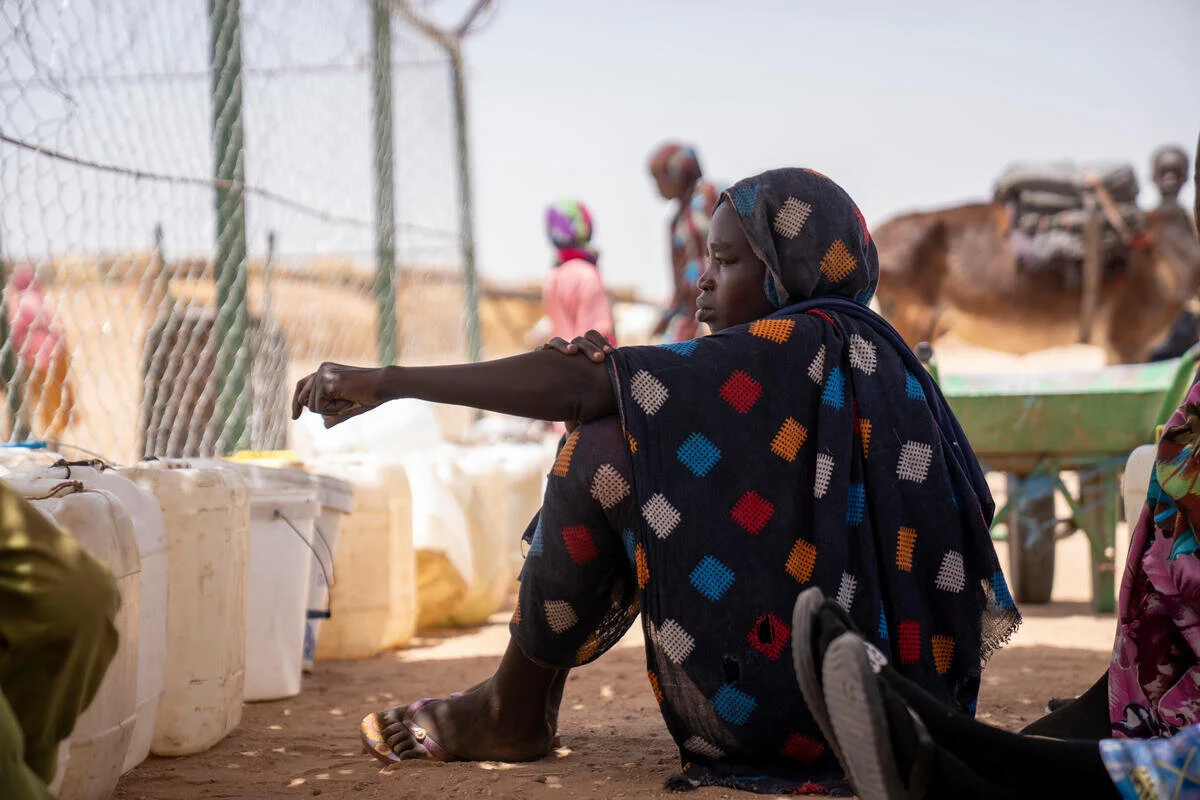
Three years of war: Sudan’s people abandoned and hungry

Rome, Italy,14 April 2026 -/African Media Agency(AMA)/- On the eve of three years of devastating war, the Sudanese people are still being left to cope with intense fighting and widespread suffering. Conflict is killing and injuring countless civilians, and leaving millions without access to food, shelter or sanitation, the United Nations World Food Programme (WFP) warned today.
The international community has failed to prevent and end this conflict and to protect the Sudanese people from atrocities,” said Carl Skau, WFP’s Deputy Executive Director, who just returned from Darfur. “The people I met in camps have been through hell. They have fled their homes leaving everything behind and now live in appalling conditions. They deserve so much better. We need to make sure they are not let down again and provide the basic support they need.”

More than 19 million people still face acute hunger in Sudan, and famine continues to haunt parts of the country as violence, displacement and economic collapse grind on. Communities have been cut off from food, markets, and aid, and children have been forced to miss three years of education, with their future hanging in the balance. Sudan remains the world’s largest humanitarian crisis, with almost two‑thirds of the population now in urgent need of assistance to survive.

Sudan’s hunger crisis now risks being compounded by the escalation of the conflict in the Middle East. Disruptions in the Red Sea are delaying critical imports, driving up the cost of food, fuel and fertilizer. Fuel prices in Sudan have increased by over 24 percent, driving up food prices and leaving millions unable to afford the most basic staples.

These same disruptions are also directly impacting humanitarian operations, with delayed shipments and higher transport costs. The combined impact could push families across the country deeper into food insecurity.

“The women I spoke to across Sudan told me they don’t have enough to feed their children and have no access to the most basic services,” warned Skau. “WFP and the humanitarian community have the experience and capacity to step up our support. But to do so, we need humanitarian aid to be allowed to move freely, safely and at scale – and we need far more funding.”

WFP is hyper‑prioritizing famine zones and hard‑to‑reach areas, reaching 3.5 million people each month with emergency food, cash and nutrition assistance. Two‑thirds of those WFP assists are in Darfur and Kordofan, where famine is confirmed and where fighting is heaviest. More than two million children under five and more than 500,000 pregnant and breastfeeding women and girls benefited from nutrition assistance last year.

WFP is also sustaining livelihoods and local food systems: During the last harvest season, WFP-supported farmers produced nearly one fifth of the country’s wheat, strengthening the local economy and reducing food insecurity.

“We need to continue investing in the future of the Sudanese people,” said Skau. “We can help communities rebuild their lives by expanding our support for farmers to grow their own food again and by providing school meals to help enable children to return to school. But we need the funding to do it.”

WFP food assistance has dropped by 14 percent since January, as compared to last year, due to a lack of resources; the agency urgently requires more than USD 600 million to sustain life-saving operations in Sudan for the next six months.

Distributed by African Media Agency (AMA) on behalf of Word Food Programme

Note to editors:
High-resolution photos available here
Broadcast quality video footage can be downloaded here

About World Food Programme
The United Nations World Food Programme is the world’s largest humanitarian organization saving lives in emergencies and using food assistance to build a pathway to peace, stability and prosperity for people recovering from conflict, disasters and the impact of climate change.
Follow us on X, formerly Twitter, via @wfp_media

The post Three years of war: Sudan’s people abandoned and hungry appeared first on African Media Agency.

What’s exactly NASA’s Artemis global moon mission?

CALIFORNIA-(MaraviPost)-The Artemis program is a Moon exploration program led by the United States’ National Aeronautics and Space Administration (NASA).

NASA’s Artemis global Moon mission is led by the US space agency, aiming to return humans to the lunar surface within this decade, to build a long-term presence and test technology, using new spacecraft and international partnerships for future missions to Mars.

NASA’s Artemis program entered a major new phase, with the successful launch of Artemis II in April 2026—the first crewed mission toward the Moon in over 50 years.

The mission is carrying four astronauts: Reid Wiseman, Victor Glover, Christina Koch, and Jeremy Hansen, aboard the Orion spacecraft on a 10-day journey around the Moon, testing life-support systems, navigation and deep-space travel capabilities without landing.

This follows Artemis I (2022), an uncrewed test flight that proved the rocket and spacecraft could safely travel to the Moon and back.

So far, the key developments are:

Artemis II has successfully launched and is currently in progress, marking humanity’s return to deep space beyond Earth orbit

The mission is testing critical systems needed before astronauts can land on the Moon again

Future missions like Artemis III and IV are being prepared to land humans on the Moon and begin building a long-term presence .

Zimbabwean businessman Wicknell Chivayo pays U$5m upkeep to ex-wife Sonja Madzikanda

HARARE-(MaraviPost)-Zimbabwean businessman Wicknell Chivayo has agreed to pay his ex-wife, Sonja Louise Madzikanda, $5 million for child maintenance.

The former couple have two children; one was born in 2018 and the other in 2019.

The dispute escalated to court in March 2026, when Chivayo filed a case seeking access to his children, alleging that Madzikanda, an accountant by profession, had denied him contact with the minors.

These restrictions allegedly included prohibiting Chivayo from visiting the children in school, receiving updates on their education, and restricting him from attending their special events.

Chivayo, 43, said that his former spouse had placed stringent conditions on him, demanding that she be paid millions of US dollars before he could have access to the children.

According to court papers, Madzikanda, 34, was seeking a lump sum payment of $25 million for child maintenance and a spousal upkeep of $40,000 per month until she remarries.

Madzikanda also petitioned the court to order Chivayo to surrender to her some luxury vehicles, including a Rolls Royce, a Lamborghini, and a Mercedes-Benz Maybach.

Chivayo says his marriage to Madzikanda was ‘never registered’

Chivayo’s former spouse also sought to be awarded shares in his logistics and petroleum companies.

Chivayo contested Madzikanda’s demands, saying that his ex-wife did not contribute to his wealth creation.

Fleeing Sudan’s war, refugees rebuild their lives in Uganda

On the outskirts of the Ugandan town of Biale, tents are scattered along dirt roads that give way to open fields. The Kriandongo camp sits between a shattered past and a life tentatively being rebuilt. Here, the story does not end with fleeing war. Another phase begins, one where days are measured not in hours, but in the weight of loss and the effort to carry on.

CELEBRATION OF 24TH ANNIVERSARY OF PEACE AND SOLIDARITY – A TRIUMPH OF DEMOCRACY IN THE BOLIVARIAN REPUBLIC OF VENEZUELA

The triumph of democracy is observed annually in Venezuela on11-13 April. It stands as one of the most significant and cherished dates in the history of the Bolivarian Republic of Venezuela.

This historic occasion commemorates the triumph of democracy, an event that occurred when the Venezuelan people marched out in their thousands and millions to reverse the US sponsored coup against President Hugo Chavez. The Venezuelan nation looked on in horror as, with guns blazing, the fascist coupists assaulted, terrorised and held captive public officials and political leaders, including also President Hugo Chavez himself. When the dust had settled, hundreds of people were dead, over a thousand wounded and property worth millions upon millions of dollars damage had been incurred in and around the capital city-Caracas. This date marks as a profound reminder of the resilience, wisdom, and collective will that restored Venezuela’s lost dignity.

Fuelled by external influences, the coup was staged on 11th April 2002 and lasted for forty-eight (48) hours, after it was thwarted by the mass of the Venezuelan people, Hugo Chavez was reinstated. Since then, the journey to this milestone has been arduous, marked by imperialist hostile policies, sanctions, sabotage, undeclared economic war, and as well as the treacherous behaviours of domestic traitors.

The triumph of democracy in Venezuela, 24years ago is more than a commemoration; it is a reaffirmation of the Venezuelan people’s commitment to resist imperialism and defend their hard-won homeland dignity, under the Bolivarian project. It symbolizes the unity of purpose that binds the oil-rich Latin American nation together, transcending ethnic, regional, and political differences. The occasion calls to action for international resistance against imperialism and fascist terrorism in whatever form or manifestations and anywhere the evil gives expression. It calls for citizens to cherish and protect the values of peace, democracy, the rule of law, human rights, human dignity, freedom and sovereignty.

Today we at the Hugo Chavez International Foundation for Peace, Friendship and Solidarity (HCIF-PFS) join with the rest of the global community to celebrate 24th anniversary of the triumph of democracy in Venezuela. In doing so, we call for the immediate and unconditional release of President Nicolas Maduro and First Lady Cilia Flores. This is a naturally-acclaimed demand, which could lead to peace and progress, not only in Venezuela, but also to the entire global community. Because what happened to President Nicolas Maduro is an act of state-sponsored terrorism, which must be condemned and resisted by peaceful and freedom-loving people everywhere in the world.

As we observe this very significant moment in the solidarity movement, the Hugo Chavez International Foundation for Peace, Friendship and Solidarity takes this opportunity to extend greetings to all Venezuelans, both inside Venezuela and in the Diaspora. The 24 years since the triumph of democracy in Venezuela in April 2002, was not without challenges. The Venezuelan people were tested at various points, suffered collective punishments initiated and unleashed by the government of the United States of America, but on every occasion, despite the severity of what confronted them today, their resilience and patriotic zeal to rise above those challenges and to forge ahead, prevailed. It is a clear demonstration of the Venezuelan people to work assiduously and to sustain collective efforts to defend sovereignty and homeland dignity.

This year’s anniversary of the failed coup in Venezuela is commemorated also as a tribute to those who made the ultimate sacrifice in order that the Venezuelan democracy may live forever. It is also a time to recommit the Venezuelan people to not allow in any manner imperialism to thrive in that country.

On this occasion, the Hugo Chavez International Foundation for Peace, Friendship and Solidarity stands in solidarity with the Venezuelan people and their relentless struggle in defence of homeland sovereignty, the independence of Venezuela and the sovereign right of Venezuela to carve its own path, free from any external influence.

God bless Venezuela!

Signed: Alimamy Bakarr Sankoh
President of the Governing Council (GoC),
International Executive Director (IED)
The Hugo Chavez International Foundation for Peace, Friendship and Solidarity

HCIF-PFS

Lake Party Tragedy: Malawi Police Set Record Straight on Salima Death, Dismiss Social Media Claims

The death of 22-year-old Abdul Aziz Panjwani in Salima has been widely misrepresented online, with unverified social media posts and petitions on Change.org pushing what the Police in the lake shore district describe as a misleading narrative.

According to the authorities, the events began at a birthday party held at WheelHouse Cottage in the lakeshore district, where two groups of young men had gathered. Music played through a Bluetooth speaker, and as the night progressed, a minor disagreement arose over the device, largely involving some who had been drinking while others remained sober. To avoid further tension, the other group decided to leave the venue and drove off, distancing themselves from the situation.

After travelling a short distance, one of them realized he had left his phone behind, where it had been charging in the bar at the cottage premises, prompting them to return. Upon arrival, only one person got out of the car to retrieve the phone, while the rest remained inside. 

As he returned to the car, members of the other group, including Abdul Aziz Panjwani and his friends, followed him toward the car park area. It was here that tensions escalated and a fight broke out at the car between Abdul Aziz Panjwani and the driver.

In the course of the struggle, Abdul Aziz Panjwani is said to have jumped onto the moving vehicle while the driver attempted to leave the scene following a gun shot an unknown person fired in the air. In the confusion, Panjwani was struck by the moving vehicle during the incident and later sustained fatal injuries.

An eye witness at the Cottage said the matter was reported to police, who attended the scene and conducted investigations. The driver was taken to police by his father, detained, and is currently awaiting to be charged. He is on remand at Maula prison. The other occupants of the vehicle were interviewed and released after giving statements, as no evidence linked them to any criminal conduct.

Despite this, petitions circulating on Change.org are calling for the arrest of all individuals alleged to have been present, while social media posts continue to suggest a coordinated or deliberate killing. Police have dismissed these claims, emphasizing that in Malawi, arrests are based on evidence and individual responsibility, not association or public pressure.

“The law does not permit the arrest of passengers in the absence of wrongdoing, and to do so would be unlawful,” said a police spokesperson.

Authorities have also expressed concern over the circulation of names and images of individuals not charged with any offence, warning that such actions risk harming innocent people. They stress that the Malawi Police Service is guided by the law and cannot be directed by online campaigns or external voices. Investigations remain ongoing, including efforts to establish the full circumstances of the incident and any related firearm discharge, but officials insist that justice will follow the facts, not misinformation.

Dr Zizwa Msukuma’s books push Malawi education reforms

LILONGWE-(MaraviPost)-For many years, education stakeholders in Malawi have spoken about the gap between policy and what actually happens in classrooms.

For Dr Zizwa Msukuma, that conversation has gone a step further—into writing.

The journey to writing and publishing these books began in 2022, driven by a deep conviction that education is the cornerstone of national development and social transformation.

Each book emerged from pressing needs observed in Malawi and across the region—particularly the persistent gaps between policy and practice, curriculum and classroom realities, and training and labour market demands.

Over the past four years, Msukuma has produced nine books, which will soon be available on the market, reflecting a deliberate effort to influence both thinking and practice in the education sector.

Through this growing portfolio, he explores teacher education, higher education governance, technical and vocational training (TVET), early childhood development, and research methodology—consistently offering practical, research-based solutions.

His book Teacher Education and Quality Assurance in Malawi: Bridging Curriculum, Classroom Realities, and Professional Development tackles the disconnect between curriculum design and classroom practice, proposing ways to better align training with real teaching experiences.

In Accreditation, Governance and Total Quality Management in Higher Education, he highlights the importance of strong systems and accountability in improving standards in universities and colleges, and has further suggested the introduction of Quality Assurance as a dedicated academic programme in public universities.

He extends this thinking in Cross-Sectoral Quality Assurance and Leadership in Malawi’s Secondary and Higher Education, emphasising leadership, coordination, and accountability as key to effective and responsive education systems.

His work also spans foundational and skills-based education, including Early Childhood Development in Malawi: Policy Coherence, Quality Assurance, and Institutional Alignment and Governance and Innovation in TVET: Building Skills for Malawi’s Future, linking early learning and vocational training to national development priorities.

Additional publications such as Quality Assurance in Higher Education and Industry, Quality Assurance, Equity, and Teacher Competence in Basic Education, Research Methodology Manual: A Scholarly Guide to Academic Inquiry, and Skills for the Future: Reforming Secondary Education further reinforce his focus on quality, equity, and relevance in education.

Beyond publishing, Msukuma has contributed to developing key frameworks, including the Lesotho Qualifications Framework (2015) and the Malawi Qualifications Framework (2019), underscoring his broader influence on education systems.

As Malawi continues to pursue education reform, one question remains: will these ideas move beyond the pages and into real change in classrooms and institutions?

Escom new Chief William Kaipa gets down to work

BLANTYRE-(MaraviPost)-It is a new chapter for the Electricity Supply Corporation of Malawi (ESCOM) Limited as the newly appointed Chief Executive Officer, Eng. William Kaipa, officially hit the ground running this week.

​Following his official introduction to the Executive Management team by the Board Chairperson Alfred Nhlema on Monday Kaipa wasted no time in diving into the core operations of the Corporation.

Kaipa in black suit (from right)

The Board Chairperson emphasized that the appointment is a declaration of a new direction for the utility; one defined by urgency, discipline and a culture of execution.

​The CEO’s first week has been marked by a series of high-level engagements, including strategic briefings with the Board of Directors.

The momentum continues on Tuesday, April 14th, with a marathon of sessions with various Board Committees, including the Business Strategy and Risk Committee and the Technical and Projects Committee.

​Board Chairperson Nhlema noted that these intensive briefings are designed to provide the new CEO with a comprehensive overview of ESCOM’s current status, ongoing infrastructure projects and financial health.

The Chairperson made it clear that the focus is shifting away from inherited excuses toward measurable results and restored national confidence.

​”The Board did not appoint Engineer William Kaipa to manage continuity; we appointed him to lead transformation.

The era of silos must end and from this day forward, we must lead as one ESCOM to restore the trust of the nation we serve,” said the Board Chairperson.

​Kaipa takes the helm with a clear mandate to stabilize the system, mobilize the workforce and reposition ESCOM as a resilient national utility fit for Malawi’s future.

A life of service: Malawians unite in mourning Catholic priest Father Francis Damaseke

LILONGWE-(MaraviPost)-In a poignant display of respect, Vice President Dr. Jane Ansah led the tributes to Father Francis Damaseke, who passed away after a brief illness.

The funeral ceremony, taking place at Likuni Catholic Parish in Lilongwe, has drawn mourners from across the country, all coming to pay their last respects to the fallen priest.

As the ceremony gets underway, Christians are gathering to bid farewell to Father Damaseke, who leaves behind a legacy of dedication and passion for his community.

His impactful ministry, particularly in championing social media evangelisation, has made a lasting impression on many.

Father Damaseke’s commitment to spreading the word of God was evident in his work as curate at Nathenje Parish and his previous roles as National Communications Secretary and Research Coordinator for the Malawi Conference of Catholic Bishops.

His work with Tiyankhuleni Ambuye, a social media platform, showcased his innovative approach to evangelisation.

The presence of Vice President Ansah and other dignitaries at the funeral ceremony underscores the high esteem in which Father Damaseke was held.

His life’s work serves as a testament to his unwavering commitment to serving others, and his passing is a significant loss to the Catholic community in Malawi.

Exit mobile version