
Tag Archives: Boats

The Best Surf Spots In Cape Town

Cape Town is uniquely positioned to offer surfers great conditions all year round. From point breaks to beach breaks and giant reef breaks, the Mother City has options galore, whether you’re a total noob or a seasoned pro, no matter how the wind’s blowing.

In Cape Town winter is surf season – the more powerful swells generated by winter storms sees many water babies don a wetsuit and hit the waves.

Here are some spots worth checking out:

Muizenberg

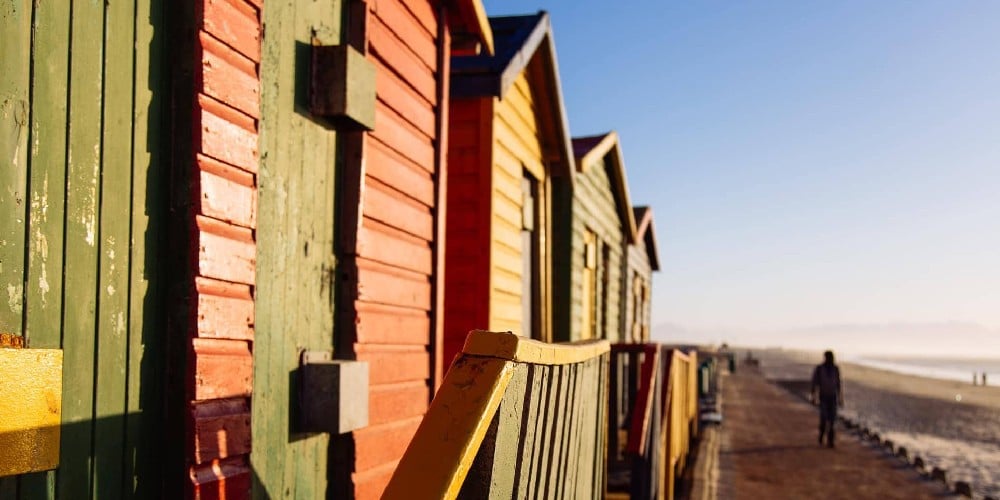
Surfer’s Corner, on the False Bay coast, is arguably the most popular haunt for local surfers. Just 30 minutes southeast of the city bowl, Muizenberg is one of Cape Town’s most frequented surf spots. Its gentle waves are perfect for beginners and are a longboarder’s paradise. Muizies, as it’s known, goes offshore in a northwesterly wind, and the small, rolling waves can be ridden almost year-round, cranking up a notch in winter swell. There are plenty of places to rent boards and wetsuits or even get a lesson or two. There is also a selection of restaurants for a post-surf bite or cup of coffee.
Milnerton Beach

Just 15 minutes north of the CBD is Milnerton beach, easily located by the towering lighthouse at Woodbridge Island, a beach break that has something for everyone. It works best in a south-to-south-easterly wind, but it can get a bit heavy for beginners. No boards for hire here, but there are some restaurants around the beach area to have a coffee after a cold surf.

Big Bay

Another beach break that offers fun for surfers of all skill levels, Big Bay is situated just north of Bloubergstrand, up the coast from Milnerton. The waves are short but fun, and it’s best surfed in a south or south-easterly wind. The spot is especially popular with kite surfers. You can rent boards and wetsuits, book a lesson at Surf Big Bay Surf School, grab an after-surf coffee or bite at one of the many restaurants.

Long Beach

For intermediate to advanced surfers, local favourite Long Beach lies southwest of the city near the laidback suburb of Kommetjie. It’s one of the most consistent breaks on the Cape Peninsula, with solid swell and a southwesterly wind delivering near-perfect waves that break both left and right. Long Beach can get big, so check the surf reports before you visit. There are no board rentals or shops on the beach, so bring your board and something to snack on.

Llandudno

This one’s for the intermediate to advanced surfers. Llandudno is another favourite among locals and is one of the most scenic breaks in the city. To get there, drive along Victoria Road, through the residential area, where you will find parking. Parking is limited, but the views more than make up for it.Llandudno is a crystal clear, hollow wave that works in a south-to-southeast wind. No board rentals here, so do bring your own surfing equipment.

Llandudno

Dungeons

Dungeons is a world-famous, big-wave surfing spot located off the coast of Hout Bay. Dungeons can get big, with waves of up to 60ft ridden here. As with most big waves, Dungeons only work during certain times of the year, but when the waves are pumping, you can see many spectators watching from boats as surfers on their ‘guns’ try to tame this beast.

Glen Beach

Located just beside the stunning Camps Bay, Glen Beach is a favourite playground for intermediate to advanced surfers looking for fast, powerful waves. When the surf’s up, the lineup can get busy, so be ready to share the water, and watch out for the rocks and occasional shark sightings. The best time to catch consistent, clean waves at Glen Beach is in autumn, with April often serving up perfect rideable swells and light offshore winds.

Surf Lessons

If you are looking for surf schools, here are some to consider:

NexGen Surf

Located in Muizenberg, NexGen Surf offers surf lessons, equipment rentals like boards to wetsuits, immersive multi-day surfing experiences, and private coaching.

Visit: nexgensurf.co.za

Surf Emporium

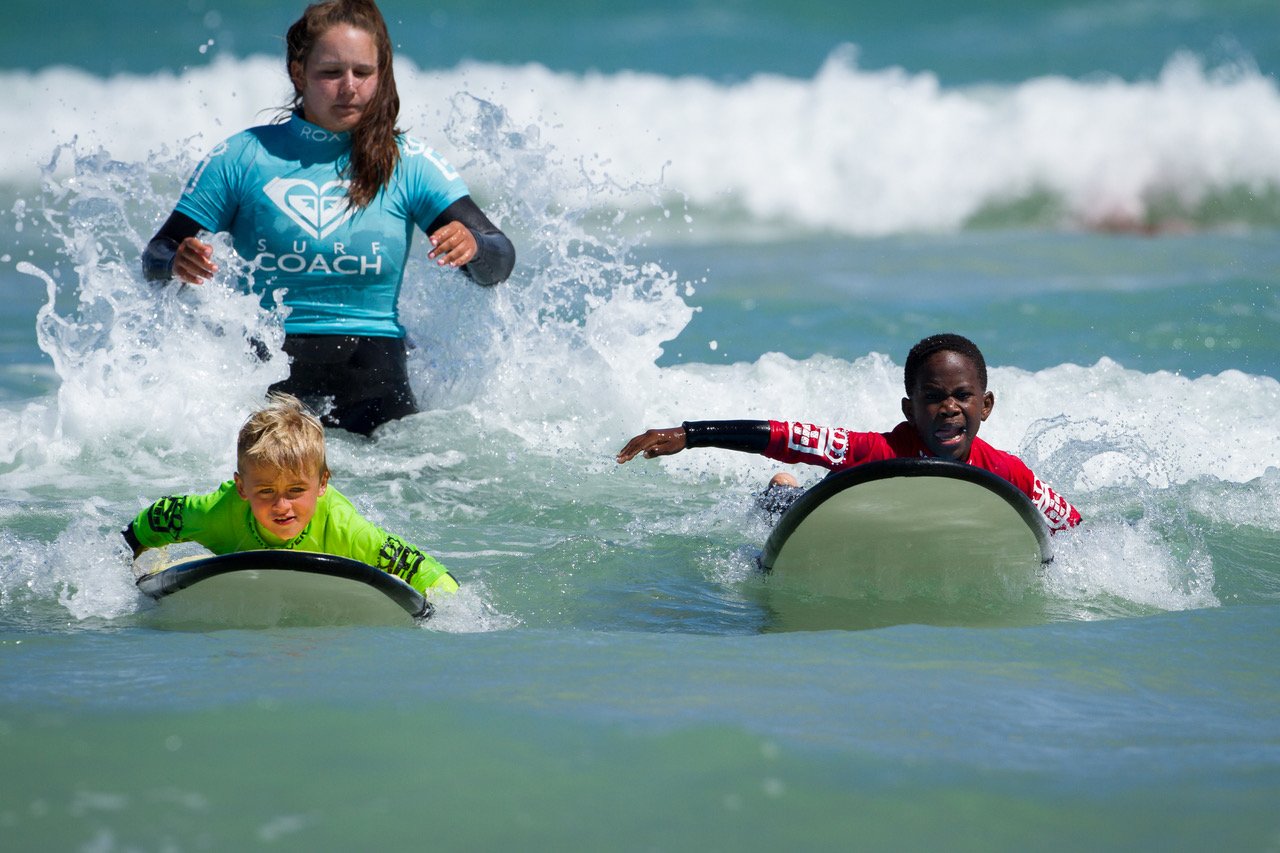
Surf Emporium, located on the Muizenberg beachfront at Surfers Corner, is an accredited Surf and SUP School, high quality equipment rental hub, and retailer of leading Surf and SUP brands all under one roof. Surf Emporium is also the only officially Surfing South Africa accredited Adaptive Surf School in South Africa, offering regular surf clinics and group or private adaptive surfing lessons.

Website: surfemporium.co.za/
Learn to surf in Cape Town

Surf Big Bay Surf School

Located in Bloubergstrand, you can enjoy thrilling group and private lessons for all skill levels. Kids aged 5 and up are also welcome. Each 90-minute lesson includes everything you need: surfboards, wetsuits, and expert guidance. Most beginners catch their first wave within a single session.

Website: capetownsurflessons.co.za/

Surf Safety in Cape Town

Cape Town offers some of the best waves in the world, but it’s important to stay safe while enjoying them.

Here are a few tips:

Know your limits: Many breaks (like Dungeons and Long Beach) are powerful and best left to experienced surfers. Try not to challenge yourself in conditions you are not familiar with.

Check conditions: Always check the local surf report and be aware of swell direction, wind, tides, and rip currents.

No lifeguards at most spots: Surf with a buddy and avoid going out alone, especially in remote locations.

TravelWise - Beach safety

Related Articles

The post The Best Surf Spots In Cape Town appeared first on Cape Town Tourism.

London court sentences Egyptian man for smuggling people to Italy

A London court on Tuesday sentenced an Egyptian man to 25 years in prison for smuggling people from North Africa to Italy.

Ahmed Ebid, who arrived in the U.K. in October 2022 after crossing the English Channel in a small boat, pleaded guilty at Southwark Crown Court to conspiracy to assist unlawful immigration.

Judge Adam Hiddleston said Ebid played a key role in an organized crime group and that his “primary motivation was to make money” from human trafficking.

Since his arrival in Britain and until June 2023, Ebid, 42, was implicated in at least seven separate boat crossings as part of a 12 million-pound ($16 million) operation that carried 3,781 people, including children, into Italian waters from North Africa.

Britain’s National Crime Agency cited some of those who had entered the U.K. illegally as saying that Ebid even told an associate to kill and throw into the sea anyone onboard caught with a mobile phone.

Ebid “preyed upon the desperation of migrants to ship them across the Mediterranean in death trap boats,” said Jacque Beer of the agency.

In one crossing, on Oct. 25, 2022, more than 640 people were rescued by the Italian authorities after they attempted to cross the Mediterranean Sea in a wooden boat, the agency said. The boat was taken into port in Sicily and two bodies were recovered.

“Vulnerable people were transported on long sea journeys in ill-equipped fishing vessels completely unsuitable for carrying the large number of passengers,” said Tim Burton, specialist prosecutor for the Crown Prosecution Service.

“His repeated involvement in helping to facilitate these dangerous crossings showed a complete disregard for the safety of thousands of people, whose lives were put at serious risk,” Burton added about Ebid.

Source: Africanews

Somalia celebrates the International Day for Women in Maritime

Somalia, supported by the United Nations, celebrated the International Day for Women in Maritime on Sunday, with an event designed to celebrate women’s role in the country’s sea-based industries.

Somali officials announced the launch of a new initiative to empower women through education and job creation.

Faced with gender discrimination, Somali women remain underrepresented in the maritime field.

“The Ministry of Ports and Maritime Affairs pledges to break down the barriers that prevent women from participating in maritime activities, as well as to combat any discrimination and will work to create jobs and leadership opportunities for Somali women”, said Fartun Abdukadir, Somalia’s Deputy Minister of Ports and Marine Transport.

In 2023, the Somali government and the UN had already introduced the Women in the Maritime Sector National Action Plan, to increase opportunities for women.

There are no comprehensive figures on the proportion of women within the Somali maritime sector. Women represent between 4% and 5% of fishing boats owners, according to the Food and Agriculture Organization of the United Nations (FAO).

The country has the longest coastline in mainland Africa, stretching about 3,333 kilometres along the Indian Ocean and the Gulf of Aden.

The event on Sunday also recognised Somali women’s contribution to the sector by honouring 23 people and one youth organisation with the Women in Maritime Awards.

Among the recipients was Ikran Mohamed Abdulahi, the head the Ministry of Fisheries and Blue Economy’s human capital development department, who encouraged women “not to lose hope.”

The situation of women within the maritime sector is not specific to Somalia. Women represent only 1.2% of the global seafarer workforce, according to the International Maritime Organization (IMO).

“To all the Somali women in Maritime, your leadership, vision and courage are shaping Somalia’s future and inspiring the region”, said Nasrin Khan, the Head of the Rule of Law and Security Institutions Group at the United Nations Transitional Assistance Mission in Somalia (UNTMIS), during the event.

“You are not just part of the maritime story; you are leading it.”

Source: Africanews

Senegal’s fishing crisis: Overfishing, migration, survival

Overfishing by foreign vessels is decimating fish stocks in the West African country of Senegal, which is in turn fueling migration to Spain, according to a report released Tuesday. The Environmental Justice Foundation, a London-based group specializing in environmental and human rights issues, said illegal overfishing and destructive practices by foreign vessels are responsible for increased irregular migration to Spain. It based its conclusions on interviews with fishermen in Spain and Senegal and its prior research on foreign overfishing.

The group found that 57% of fish stocks in Senegal are in a “state of collapse,” with foreign vessels playing a significant role in declining numbers. Its analysis showed 43.7% of licensed vessels in Senegal are foreign-controlled, predominantly of Spanish and Chinese origin. As fish populations dwindle, local fishermen are facing income loss, and many have turned to migration as a last resort. Fishing is an important economic sector in Senegal that employs 3% of the workforce.

Irregular migration to the Canary Islands almost doubled in 2024, according to the Spanish Interior Ministry, reaching 46,843. While exact figures aren’t known due to a lack of information on departures from West Africa, Senegal is one of the top three nationalities of arrivals to the Spanish islands. The Atlantic route from West Africa to the Canary Islands is one of the deadliest in the world. The Spanish migrant rights group Walking Borders estimates the victims were in the thousands last year. Migrants and former fishermen in the Canary Islands told the Environmental Justice Foundation that the treacherous journey to Spain was a last resort, a way to provide for families when fishing in Senegal could no longer put food on the table. “If I was able to gain enough money in fishing, I would never have come to Europe,” said Memedou Racine Seck.

Local activists in Senegal have voiced their frustration with foreign overfishing and its contribution to the migration crisis. Karim Sall, President of AGIRE, a Senegalese organization operating in the Joal-Fadiouth marine protected area, condemned foreign nations for their role in the crisis. “I get so angry when (foreign nations) complain about immigration because they are the real pirates and what they did is worse than clandestine immigration. It’s theft, plundering our resources to feed their own inhabitants while we suffer,” said Sall. Industrial foreign fleets, many of which use bottom trawling techniques, are exacerbating the crisis. These vessels drag heavy nets across the seafloor, indiscriminately catching young fish and destroying marine ecosystems like seagrass and coral reefs, which are vital for fish reproduction. As a result, fish stocks are unable to recover, deepening the hardships of local fishing communities and eaters.

Fish plays an important role in food security in Senegal, especially for protein consumption. Due to declining fish stocks, consumption per capita in Senegal has fallen from 29 kilograms per year to 17.8 kilograms per person. The report also pointed to a lack of transparency in fishing licenses and inadequate government management of fisheries as contributing factors. Despite efforts by the Senegalese government to address the crisis, experts warn that without stricter regulations on industrial foreign fleets, the situation will worsen. Migrant and former fisherman Souleymane Sady, who arrived in the Canary Islands in 2020, summed up the situation fishermen in Senegal face: “Since the government cannot regulate the boats and we cannot work normally, we choose to run away from the country to come for stability,” he said.

Source: Africanews

Dwindling humanitarian supplies in South Sudan put 60,000 malnourished children at risk

Along the White Nile River in South Sudan, children are desperately hanging on to dwindling humanitarian supplies. 

More than 60,000 malnourished children in Upper Nile State now risk plunging into deeper malnutrition, the United Nations World Food Programme and UNICEF warned last Thursday. 

The White Nile River is the main humanitarian supply corridor into Upper Nile but intensified fighting means no food aid has reached the area in almost a month. 

WFP and UNICEF expect to exhaust their nutrition supplies by the end of May without urgent action. 

“Children are already the first to suffer during emergencies, if we can’t get nutrition supplies through, we are likely to see escalating malnutrition in areas already at breaking point”, said Mary-Ellen McGroarty, WFP Representative in South Sudan.

In the past weeks, boats carrying thousands of metric tonnes of food and nutrition supplies have been forced to turn away due to security concerns. 

“We have reluctantly taken the unprecedented step of holding back supplies for fear that they will not reach the children that so desperately need them, due to the ongoing fighting, looting and disruption of the river route”, said Obia Achieng, UNICEF Representative ad interim in South Sudan.

The two UN agencies have called for safe access to deliver treatment supplies.

Upper Nile state has some of the highest malnutrition rates in South Sudan, with over 300,000 children affected by moderate or severe malnutrition in the past year. The area also has to handle an outbreak of cholera. 

Since February 2025, a surge of violence in the region has increased the number of displaced families and heightened food insecurity. 

The escalation comes amid growing tensions between South Sudan’s President Salva Kiir and his political rival First Vice President Riek Machar, jeopardising the fragile 2018 peace agreement that put an end to the country’s civil war.

Source: Africanews

Reports of US plans to deport migrants to Libya spotlight rights abuses

News that the US may be planning to deport migrants to Libya has been met with consternation by rights groups.

The Trump administration continues to expand its efforts to remove migrants to third-party countries, despite legal challenges. On Wednesday, a US judge ruled that migrants could not be deported without being given the opportunity to challenge it in court.

Libya’s rival governments have also both said they would refuse to accept the deportees and the country’s highly restrictive asylum procedures also raise questions about the deportees status on arrival.

Libya is a major transit hub for asylum seekers trying to reach Europe and each year, thousands attempt a dangerous Mediterranean crossing. An estimated 800,000 migrants are currently in Libya and their mistreatment has been widely documented.

A United Nations-backed, independent fact-finding mission in 2024 found evidence that crimes against humanity had been committed against migrants in Libya. Victims were subjected to enslavement, forced disappearance, torture and murder, among other crimes, the investigators found. Dead migrants have been found in mass graves across the country, while tens of thousands of others have drowned trying to escape Libya on smugglers’ boats.

Deterrent factor

Libya’s brutal reputation for migrants may be part of the reason it appeals to Washington, says Camille Le Coz, Director of the Migration Policy Institute Europe.

“What’s striking about the choice of Libya is that this is a country where the conditions are particularly challenging for refugees and other migrants.

“Many migrants end up in detention centres, centres that are managed by militia or the government, where they get tortured, where their families get blackmailed to secure their release. There’s been repeatedly reports of mass graves, most recently in February, in different parts of the country. In 2024 International Organization for Migration reported that there’d been about 1,000 migrants who’d been killed in Libya, but we know the figures are likely to be much higher.”

“This type of operation is expensive, it’s difficult to set up, and so, we can speculate that it might be, you know, to show that if you get to the US you might be sent to this place that is extremely dangerous for migrant populations and that this may deter people from coming.”

Both the Tripoli-based government of Prime Minister Abdul Hamid Dbeibah and its rival administration in eastern Libya controlled by military commander Khalifa Hifter have denied signing a deportation deal with the Trump administration.

Despite documented abuses in Libya, the European Union and Italy have for years funded, trained and equipped Libyan groups, including the coast guard, to stop migrants from reaching European shores.

Source: Africanews

Lampedusa: Honouring the migrants who died at sea

In a quiet corner of Lampedusa cemetery retired professor, Fabio Giovanetti waters plants and tidies rubbish from the graves of migrants of who have died crossing the Mediterranean Sea. “We have never seen or met these people, none of them have given us their name or their story. We don’t know anything, but they are still human beings who had the misfortune to encounter a shipwreck,” he says.

Lampedusa is the gateway to Europe for the thousands of migrants who cross the Mediterranean every year. This small island in the middle of the sea has for decades welcomed anyone who arrives, alive or dead, after the long journey to the European coasts. In 2024 the Italian Red Cross welcomed over 45,000 people. More than 9,000 people have already arrived in Lampedusa in 2025. Some of those who don’t survive the sea journey and whose story ends here in Lampedusa, are buried in the local cemetery. Often little is known about them, sometimes their name is known, sometimes not even that. Giovanetti, is a member of the Forum Lampedusa Solidale, a group of citizens who help those in need on the island, local and migrant alike.

Every migrant grave in this small cemetery tells a story. The Forum volunteers decided to decorate them with writings and drawings that restore dignity to people, but at the same time the tombstones tell the drama of those who die without an identity. On the tombs, the sea is often drawn wrapped in barbed wire, like in a prison. Over the years the Forum has managed to reconstruct fragments of stories, a form of respect towards these victims of the sea. One grave is for a man the group have named ‘Yassin’ from Eritera. “We don’t actually know what his name was. Yassin arrived dead in Lampedusa, but we wrote Yassin because a shipwrecked survivor said that someone near him was shouting this name” explains Giovanetti. Giovanetti tells the story of Ester Ada who died in 2009. “A Turkish merchant ship, the Pinar, rescued 153 migrants, including a dead woman. A dispute opens between Italy and Malta and despite being in Maltese waters, Malta refuses to welcome the merchant ship. The standoff lasts four days and in the end Italy welcomes the migrants together with the body of Ester Ada, this young woman who died during the crossing.”

Another young woman known as Welela is one of the very migrants buried in Lampedusa whose name and story we know says Giovanetti : “She was an Eritrean girl who was trying to reunite with her brother and during the journey she suffered a very serious accident that left her with burns all over her body.” “Once she arrived on the island (dead) she was taken to the mortuary and a lady from Lampedusa temporarily donated her tomb, so we were able to bury her here. Trying to reconstruct the history and identity of this person, our research intersected with that of her brother who lives in a city in Northern Europe and it was he who told us the whole story of this unfortunate girl,” he adds.

A few kilometres from the cemetery, on the Favaloro pier, patrol boats continue to disembark people rescued at sea. On April 21, 85 people were rescued by the coast guard in the stormy sea, along with the body of a young man, according to the Italian Red Cross. The latest confirmed victim of over 30,000 deaths in the Mediterranean in the last ten years, according to the International Organization for Migration.

Imad Dalil runs the migrants hotspot in Lampedusa for the Italian Red Cross. He says: “We are here to welcome people, alive as you said, inside the hotspot and guarantee them, with the multidisciplinary team, all the services both material and health and psychiatric support. Also dead people arrive at the dock and we are here for them too.”

Valeria Passeri, an aid worker for Mediterranean Hope, a refugee and migrant programme of the Federation of Protestant Churches in Italy says Lampedusa is a place where migrants pass through, but those who die enroute remain and the cemetery is a place where they can be remembered and belong. “The cemetery is a very important place because today it is the place where the people of Lampedusa and the people on the move meet. The only place where they are together. It is a place where it is possible to remember and taking care of that space means dedicating attention, honouring and welcoming people even if they did not make it.”

Source: Africanews

Nigeria: Probe begins into death of 40 passengers on boat

Authorities in Nigeria are probing the death of 40 passengers on a boat. Local officials say the wooden boat was ferrying more than 50 farmers to their fields across the river near Gummi town in Zamfara state. “Only 12 were rescued yesterday shortly after the accident,” said Na’Allah Musa, a political administrator of the flood-hit […]

The post Nigeria: Probe begins into death of 40 passengers on boat appeared first on Africa Feeds.

Source: Africa Feeds