
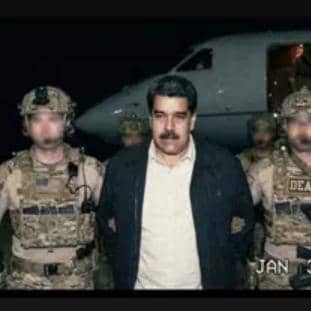
The capture of Nicolás Maduro on January 3, 2026, marks a seismic shift in the political landscape of Venezuela and carries profound implications for international relations, regional stability, and the ongoing battle against narcotrafficking.
Maduro’s life story is one of rise from humble beginnings to the pinnacle of power, intertwined with controversy and conflict.
His dramatic arrest by United States forces in a covert helicopter raid in Caracas represents both the culmination of years of geopolitical tension and the potential dawn of a new era for Venezuela.
Born on November 23, 1962, in Caracas, Nicolás Maduro’s early life in a working-class family, nurtured by a socialist environment, set the stage for a career deeply embedded in leftist politics.
His father’s role as a trade union leader undoubtedly influenced Maduro’s worldview, fostering his commitment to labor rights and socialism.
Yet, Maduro’s educational journey was unconventional; he did not complete high school but instead directed his energies toward union activism and grassroots political involvement.
His beginnings as a bus driver in the Caracas Metro system were humble, but his role as a union leader quickly elevated him to the forefront of Venezuela’s labor movement.
Maduro’s political maturation coincided with the rise of Hugo Chávez, a charismatic and polarizing figure who sought to reshape Venezuela’s political and social fabric through what was termed the Bolivarian Revolution.
Maduro’s loyalty to Chávez was unwavering, campaigning for his release after the 1992 failed coup attempt and later becoming a central figure in Chávez’s government.
Holding pivotal roles such as President of the National Assembly, Foreign Minister, Vice President, and eventually President after Chávez’s death in 2013, Maduro’s ascent was closely tied to the continuity of Chávez’s socialist agenda.
The nature of Maduro’s administration has been deeply divisive.
Domestically, his leadership style has been described as authoritarian, with critics accusing him of suppressing opposition voices, manipulating elections, and perpetuating a regime resistant to democratic norms.
Supporters, however, viewed him as a steadfast defender of socialism and a champion for the marginalized sectors of Venezuelan society.
This duality shaped the Venezuelan perception of Maduro—one of polarized loyalty and widespread unrest.
Internationally, Maduro’s tenure was marked by escalating tensions with the United States and other Western nations.
The U.S. government’s accusations that Maduro’s regime operated as a “narco-state” fundamentally altered the diplomatic landscape.
Sanctions, indictments on charges of narco-terrorism, and conspiracy to import cocaine painted Maduro as a global criminal figure rather than merely a national leader.
This framing justified increasingly aggressive actions, culminating in the daring helicopter raid that led to his capture.
The significance of Maduro’s capture cannot be overstated.
For decades, Venezuela has been mired in political instability, economic collapse, and humanitarian crisis. Maduro’s regime was widely blamed for these conditions, which saw hyperinflation, shortages of basic goods, and mass emigration.
His removal from power by external forces symbolizes a potential turning point for Venezuela’s future. It offers a prospect—albeit fraught with challenges—for political renewal, reestablishment of democratic governance, and the rebuilding of a shattered economy.
From a geopolitical perspective, Maduro’s arrest by U.S. forces in the heart of Caracas is unprecedented.
It sends a stark message about the lengths to which the United States is prepared to go to combat narcotrafficking and authoritarian regimes perceived as threats to regional security.
This operation also serves as a warning to other authoritarian leaders who may be engaged in illicit activities or who defy international norms.
The extraction of Maduro for trial on U.S. soil underscores the global reach of American law enforcement and the international community’s commitment to accountability.
However, the aftermath of Maduro’s capture will require delicate handling. Venezuela’s political environment is deeply fractured, and any vacuum of power risks further instability or violent conflict.
The international community, regional actors, and Venezuelan civil society must navigate the complexities of transitional governance and reconciliation.
The process of rebuilding trust in institutions and addressing the humanitarian crisis will be monumental yet essential.
Moreover, Maduro’s arrest highlights the intertwined nature of narcotrafficking and political power in certain states.
His indictment on narco-terrorism charges reflects broader concerns about how illicit networks can sustain and corrupt national leadership.
The capture and forthcoming trial may expose further details about these networks, potentially disrupting the flow of illegal drugs and weakening criminal enterprises that have long plagued the Americas.
Nicolás Maduro’s life represents a narrative of dramatic contrasts—rising from modest origins to wielding immense power, championing socialist ideals while facing accusations of authoritarianism and criminality.
His capture by U.S. forces on January 3, 2026, closes a turbulent chapter in Venezuelan history and opens a new one filled with uncertainty and hope.
The event is not merely a triumph of law enforcement but a catalyst for potential transformation in Venezuela and a signal of shifting power dynamics on the world stage.
As Venezuela grapples with this new reality, the international community must remain engaged, supporting efforts toward democratic restoration, economic recovery, and justice.
The world watches closely, recognizing that the implications of Maduro’s fall will reverberate far beyond Venezuela’s borders, shaping the future of regional politics, the fight against narcotrafficking, and the global commitment to human rights and the rule of law.
Feedback:+265992082424
Email: jonesgadama@gmail.com
