
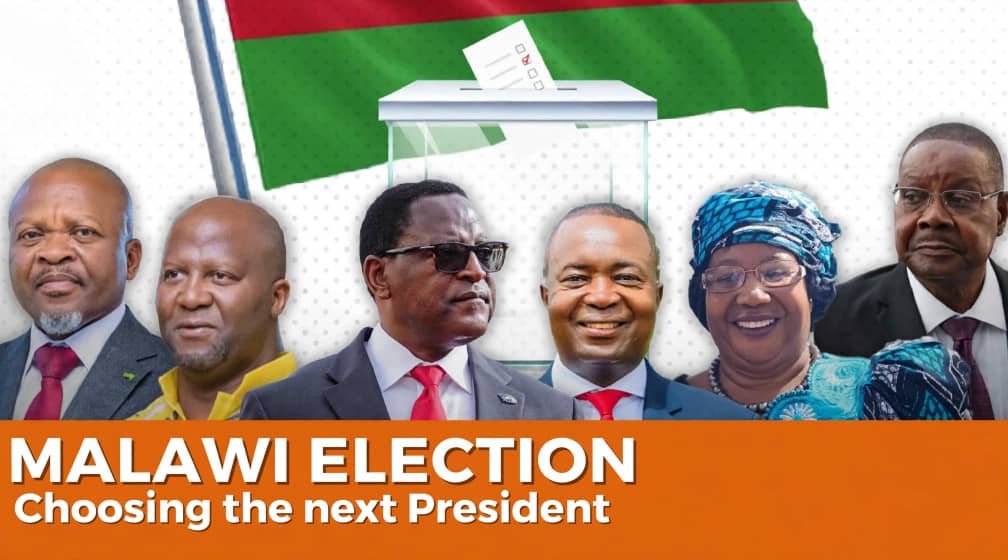
LILONGWE-(MaraviPost)-September 20, 2025, was a day of intense political uncertainty in Malawi, coming four days after millions of Malawians had voted to elect a president, members of Parliament and local government representatives.
Local press reports indicated that the country remained on edge as the Malawi Electoral Commission (MEC) continued receiving, verifying and announcing presidential results, while unofficial tallies were increasingly showing former President Peter Mutharika in the lead even though the commission had not yet declared a national winner.
The uncertainty was particularly significant because the 2025 presidential election was being conducted under the more-than-50-percent requirement.
A candidate needed to secure more than half of the valid votes to win outright; otherwise, a second-round election would have been required.
Seventeen candidates contested the presidency, although public attention had largely centred on incumbent President Lazarus Chakwera and former President Mutharika.
The question facing Malawians on September 20 was therefore not simply who was ahead, but whether the eventual leader would cross the constitutional threshold required to avoid a runoff.
The uncertainty also carried memories of Malawi’s recent electoral history.
The disputed 2019 presidential election had been nullified by the courts before the 2020 fresh presidential election, which Chakwera won. That history placed renewed public attention on the credibility of electoral results, verification procedures and the role of MEC in determining the final outcome.
By September 20, results from polling stations and electoral councils were being processed, but the national presidential verdict remained outstanding.
The distinction was important.
MEC was responsible for receiving, verifying and consolidating results before announcing the official national outcome. Individual council results therefore represented pieces of the national picture rather than the final presidential verdict.
At a press briefing in Lilongwe, MEC Chairperson Justice Annabel Mtalimanja said the commission had physically received results from 16 of the country’s 36 councils, but had completed verification for only four councils. Those were Likoma, Kasungu Municipality, Luchenza Municipality and Mwanza.
The first batch of official results provided the public with a clearer glimpse of the contest.
In Likoma, Chakwera received 1,817 votes against Mutharika’s 4,177. In Kasungu Municipality, Chakwera led with 8,818 votes against Mutharika’s 7,831.
Mutharika recorded much larger margins in Luchenza Municipality and Mwanza, where he received 7,547 and 30,576 votes respectively, compared with Chakwera’s 336 and 2,228.
Those figures were official results from individual councils, but they did not amount to a national presidential declaration.
That distinction became increasingly important as media organisations, political parties and other observers compiled figures from results available to them.
Unofficial tallies were showing Mutharika with a substantial lead, but they remained subject to verification and could not legally replace the MEC’s national tally.
The difference between an unofficial tally and an official result was therefore at the heart of the uncertainty.
A media organisation could calculate a running total from results it had obtained, but only MEC could determine the final national vote and formally declare the president-elect.
The September 20 process was also affected by controversy surrounding the Nkhoma Constituency tally centre in Lilongwe.
Police confirmed that eight election officials, including data clerks and a presiding officer, had been arrested over allegations of attempting to manipulate electoral data. Police said investigations were continuing to establish what had happened and for whose benefit.
The incident followed a crisis involving the Nkhoma Constituency Returning Officer, who was placed in police custody after a reported suicide attempt. MEC subsequently assigned a replacement returning officer so that electoral work in the constituency could continue.
These developments intensified public concern about the integrity of the tallying process, but the allegations themselves were matters for investigation and due process rather than proof that the national election result had been altered.
MEC also urged candidates and political parties to use the formal complaints mechanisms provided by the electoral process rather than relying on social media claims or informal submissions.
The political uncertainty was taking place against a difficult economic backdrop.
Malawians had gone to the polls amid concerns over the cost of living, food shortages and other economic pressures. These issues formed part of the broader campaign environment and shaped the stakes surrounding the election.
For voters, therefore, the election was about more than personalities and party competition.
It was also about the country’s economic direction and expectations for the government that would emerge from the election.
By the end of September 20, Malawi had moved beyond the immediate uncertainty of the first days after voting, but it had not yet reached the certainty of an official presidential result.
The ballot had been cast.
Results were being received and verified.
MEC had begun announcing official council-level results.
Unofficial national tallies were pointing towards a Mutharika lead.
Political parties and candidates were scrutinising the process.
And the public was waiting for MEC to bring the pieces together.
The following days gradually transformed the uncertainty into a clearer electoral picture.
By September 21, UTM presidential candidate Dalitso Kabambe had conceded defeat and congratulated Mutharika and the DPP, while other candidates also acknowledged that the emerging results were not favouring them. However, these concessions did not constitute an official presidential declaration.
By September 23, partial results from 24 of the country’s 36 electoral councils showed Mutharika with a commanding lead, further reducing uncertainty about the eventual outcome. The official national result, however, still belonged to MEC to announce.
On September 24, Chakwera conceded defeat several hours before MEC formally announced the final presidential results.
Later that day, MEC declared Mutharika the winner with 3,035,249 votes, representing 56.8 percent of the 5,347,757 valid votes cast. Chakwera received 1,765,170 votes, or 33 percent, while Dalitso Kabambe received four percent.
Mutharika’s 56.8 percent was above the constitutional threshold, meaning no runoff was required.
His victory marked his return to the presidency after his defeat by Chakwera in the 2020 fresh presidential election.
The subsequent election results also reshaped Parliament, with the DPP emerging as the largest party in the National Assembly, although independents and other parties also secured significant representation.
Looking back, September 20 was therefore not the day Malawi officially knew who had won.
It was the day the emerging electoral picture was becoming increasingly clear, while the official verdict remained in the hands of the electoral commission.
It was a day of partial official results, unofficial national tallies, electoral allegations, economic concerns and intense public attention.
The votes had been cast.
The numbers were beginning to speak.
The political camps were watching.
The public was waiting.
But MEC had not yet delivered the final national verdict.
Four days later, the waiting ended.
Malawi finally knew.
Leave a Reply