




By Chad Kumusha
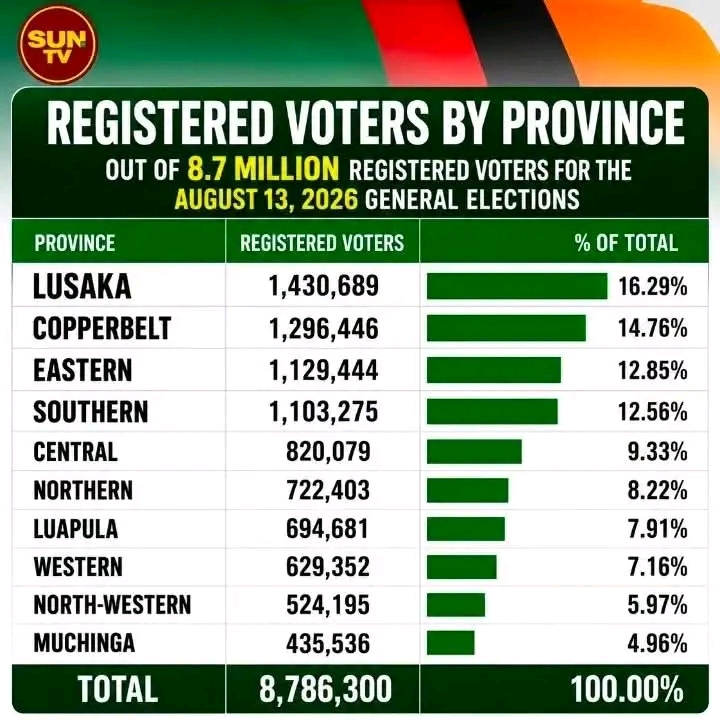
With 8.7 million registered voters set for Zambia’s General Elections on 13 August 2026, four provincial blocs are expected to determine who goes to State House.
Analysts say this election will not be won by strongholds alone.
They say the party that wins will do three things: turn out its base, limit damage in hostile territory, and win the middle ground in Lusaka and the Copperbelt.
Former Patriotic Front media director Antonio Mwanza breaks down the country’s four electoral blocks.
The Four Voting Blocs
*1. UPND Stronghold*
Southern, Western and North-Western Provinces
Total registered voters: 2,256,822
*2. Opposition Stronghold*
Northern, Muchinga and Luapula Provinces
Total registered voters: 1,852,620
*3. Urban Battleground*
Lusaka and Copperbelt Provinces
Total registered voters: 2,727,335
*4. Kingmaker Provinces*
Central and Eastern Provinces
Total registered voters: 1,949,523
1. Strongholds Set the Base, But Don’t Win It
The 2016 and 2021 elections showed how important strongholds are.
President Hakainde Hichilema ran up huge numbers in Southern, Western and North-Western. The Patriotic Front did the same in Northern, Muchinga and Luapula.
Those results gave both parties a big head start before votes in competitive provinces were even counted.
But history also shows this: winning your stronghold is not enough.
What matters is:
A) High turnout
B) Big winning margins
C) Cutting losses in your opponent’s strongholds
A province delivered with 80% turnout and a 30-point margin is worth far more nationally than one won with 50% turnout and a 10-point margin.
That is why turnout will be one of the most decisive factors in 2026.
2. Lusaka and Copperbelt Are The Main Battleground
With 2.7 million registered voters, Lusaka and Copperbelt are Zambia’s biggest electoral bloc.
Unlike traditional strongholds, these two provinces swing. And they usually decide the national result.
Urban voters tend to vote on bread-and-butter issues:
– Cost of living
– Jobs
– Power supply
– Fuel prices
– Economic growth
– Service delivery
– Corruption and governance
Because the vote is usually close here, even a small shift can mean hundreds of thousands of votes nationally.
Candidates who perform well in Lusaka and the Copperbelt have historically gone on to win the presidency.
3. Central and Eastern Could Tip The Scales
Central and Eastern have 1.9 million registered voters between them.
Eastern has traditionally leaned PF, though the UPND made gains there in 2021. Central has long been Zambia’s most competitive province, with both parties pulling significant support.
In a tight race, whoever wins bigger in these two provinces will likely take the election.
The Path To State House
The math is simple. The winner will likely be the candidate who:
A) Maximizes turnout in their strongholds
B) Wins by convincing margins
C) Minimizes losses in opponent strongholds
D) Performs strongly in Lusaka and Copperbelt
E) Stays competitive in Central and Eastern
The Bottom Line
Strongholds provide the foundation.
Lusaka and Copperbelt are the battleground.
Central and Eastern are the kingmakers.
The presidency in 2026 will not be decided by regional loyalty alone. It will be decided by which campaign gets more of its people to the polls, runs up the score where it is strong, and builds a national coalition in the swing provinces.
Because in the end, elections are won by votes cast — not just voters registered.
The illustration below courtesy of Sun Tv shows the breakdown:
