



By Burnett Munthali
LIMA-(MaraviPost)-The months of May and June typically mark the onset of cooler temperatures and increasingly winter-like weather in Lima, Peru, a Southern Hemisphere city home to more than 10 million people.
But things have been different this year.
Instead of cooling off, it’s getting warmer.
People have flocked to the beach amid summer-like 80-degree warmth and waded into ocean waters that have recently risen almost 10 degrees Fahrenheit above average.
In Paita, Peru, north of Lima, waters have risen a remarkable 14.2 degrees Fahrenheit above average.
That’s because a wave of record-breaking undersea warmth has traversed the depths of the Pacific over the past two months and is now arriving along the country’s shores.
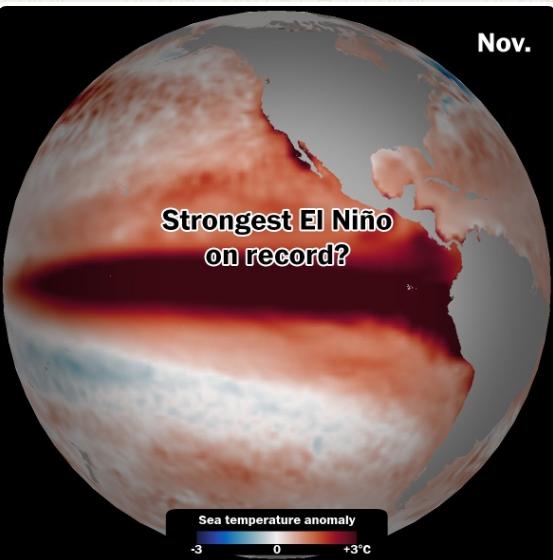
The wave is associated with a developing El Niño, which according to latest modeling could become the strongest one on record.
Abraham Levy, director of a meteorological consulting firm in Peru, described the ocean warmth as “something unimaginable in a normal year” and said Peruvians are watching the situation with great concern, even as they take advantage of the time outdoors.
Then on Sunday, Lima faced coastal flooding.
Because of the extremely warm temperatures, sea levels had risen, turning the situation into a dangerous one.
Model forecasts recently released by the European Center for Medium-Range Weather Forecasts have once again trended toward a more intense El Niño this year, with the average scenario showing a 3.5 degree Celsius rise in central equatorial Pacific Ocean temperatures by November.
That would break records set in 2015 and 1877 and have sweeping consequences on global climate into 2027.
New climate model information highlighted a range of possible impacts across the planet as El Niño intensifies in the season ahead.
These potential impacts include reduced hurricane activity in the Atlantic and possible droughts in the Caribbean islands, increased typhoon and hurricane activity in the Pacific, and unusually high summer temperatures across parts of North America and Europe.
Unusual downpours and humidity are also expected for parts of the western United States, while drier than normal conditions and possible droughts may develop in parts of northern South America, north-central Africa, central and northern India, Indonesia, Australia, and some South Pacific islands.
Unlike a storm that suddenly hits your town, El Niño’s influence on the global climate will gradually build in the months ahead, influencing weather patterns through at least next winter.
But in some places, such as Peru, the effects of El Niño are already being felt.
“The consequences are already being felt by the fishing sector due to the suspension of the industrial anchovy fishery, one of the largest fisheries in the world,” Levy said.
He also said agricultural productivity is down because of a lack of cooler temperatures and that the textile industry is being affected by unusual consumer purchasing patterns because of the warm weather.
Levy warned that the rapidly warming coastal waters, known locally as El Niño Costero, bring the possibility of catastrophic rainfall along the coast in Peru, particularly during the rainy season from next December to April.
“A strong or very strong El Niño Costero is a matter of major importance for national security for Peru,” Levy said.
The first signs of a possible El Niño, and the elements that are contributing to conditions in Peru this year, can be traced back to December.
But it was a rare triplet cyclone pattern in early April that set a freight train of warm water into motion beneath the surface of the Pacific.
This pulse of warm water, called a Kelvin wave, has rivaled the strength of one that fueled a super El Niño in 1997.
As this freight train of warmth arrives along Peru’s shores, a new burst of wind in the central Pacific will provide yet more momentum to El Niño’s formation and strength.
Because of the long-term increase in ocean temperatures, there’s more warmth available for El Niño to harness in 2026.
This probably means this year’s El Niño will have a higher potential intensity than the strongest historical ones in 1877, 1888, 1972, 1982, 1997 and 2015, giving it a real chance to become the strongest event on record.
“Now is the time to prepare,” Levy said.
