



By IOMMIE CHIWALO
BLANTYRE-(MaraviPost)-The picture emerging from Bridgepath Financial’s market weekly report, which tracked eight key developments shaping the financial landscape, shows Malawi’s economy delivered a mixed performance with easing inflation and lower fuel prices offering households some relief even as a steep fall in tobacco earnings and deep public finance gaps signalled ongoing strain.
The financial analysts also observed that the situation reflects an economy at a crossroads, where short term improvements are being weighed down by structural and fiscal headwinds.
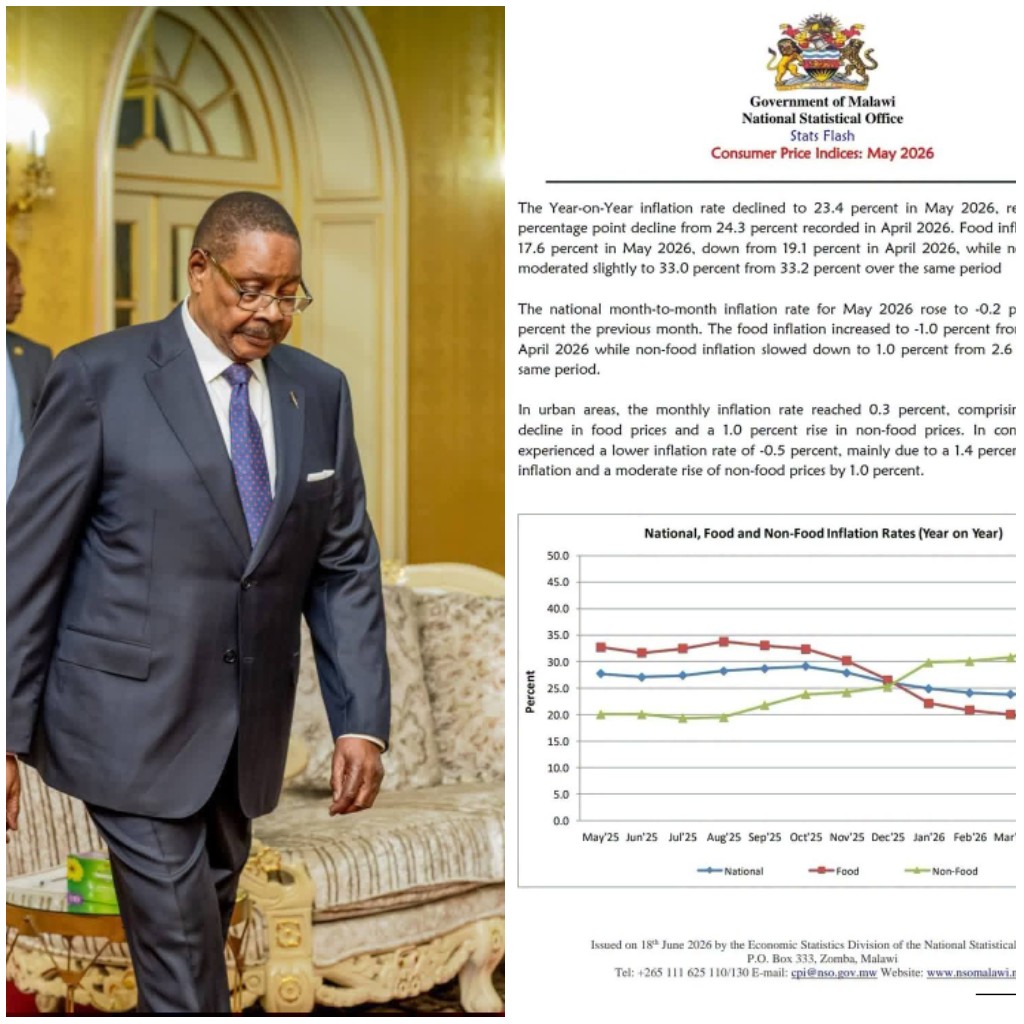
According to the National Statistical Office, year-on-year inflation eased to 23.4% in May 2026 from 24.3% in April.
Bridgepath noted that food inflation was the main driver of the slowdown, falling to 17.6 percent from 19.1percent and recording negative 0.1 percent on a month-on-month basis.
Non-food inflation also edged down to 33.0 percent from 33.2 percent.
Rural households experienced month-on-month deflation of 0.5 percent, while urban areas posted 0.3 percent inflation.
The financial market report also recognises the relief brought about by the Malawi Energy Regulatory Authority (MERA) which saw fuel pump prices cut.
Currently petrol is down by 9.50 percent to K5,619 per litre from K6,209, and diesel by 5.70 percent to K6,306 from K6,687, effective 19 June 2026.
MERA said the Automatic Pricing Mechanism kicked in after Free on Board prices dropped and inbound landed costs fell beyond the ±5% trigger band, saying freight rates, railage, insurance, levies and margins were all factored into the revised prices.
However, according to Bridgepath, the gains were tempered by poor tobacco performance after it is reported that cumulative sales as of 18 June 2026 raised only USD145.15 million, compared to USD276.46 million in the same period last year.
“Volumes dropped to 69.92 million kg from 110.27 million kg, while average prices fell to USD2.08/kg from USD2.51/kg. With tobacco remaining Malawi’s leading forex earner, the 47% year-on-year plunge in earnings puts pressure on foreign exchange availability going into the second half of 2026,” reads the financial market weekly report.
The report has also expressed concerns on public finance management after revelations that the Auditor General’s report for the year ended 31 March 2024 identified financial irregularities totaling K158 billion across government ministries, departments and agencies.
Bridgepath highlighted missing audit documents linked to over K8 billion, payment vouchers worth MK233 million without supporting documents, procurement breaches, stalled projects and revenue management failures.
In the report that we have seen, the Auditor General cautioned that the persistent failure to submit documents could indicate attempts to conceal fraud, though further investigations are needed.
However, there is something to smile about as within the week in review there were bright spots on development and investment.
For instance the European Union launched a EUR100 million Regional Responses to Climate Displacement Programme, with Malawi allocated EUR17 million, about K34 billion.
“In banking, FMB Capital Holdings secured in-principle approval from the Bank of Mauritius to establish a new bank in a 50:50 joint venture with Rogers Global Financial Holdings. The bank will target trade and investment flows between Mauritius, Africa and the wider region, building on FMBCH’s First Capital Bank operations in five SADC markets. A World Bank Country Private Sector Diagnostic report added that Malawi could create over 100,000 jobs by scaling tourism, agribusiness and mining.
“Tourism and mango production could each draw over USD100 million in investment and create 60,000 jobs. Rutile and graphite mining could deliver USD1.9 billion in annual exports by 2033, potentially doubling current export earnings,” reads the report.
IFPRI data showed national average retail maize prices fell 2% in May to K736/kg, or K36,800 per 50kg bag.
The North averaged K707/kg, Central K727/kg, and South K747/kg.
Bridgepath concludes that while easing inflation and fuel cuts give households a breather, the sharp tobacco decline and audit gaps highlight fiscal risks.
“The test ahead is whether modest consumer relief can hold as the country navigates a weak agricultural season and tight public finances, even as EU funding and private sector deals point to medium term potential,” reads the report in conclusion.
Meanwhile the Reserve Bank of Malawi (RBM) has hinted on another policy rate cut if the inflation rate continues going down.
Writing on his Facebook page, RBM Deputy Governor for Operations Kisu Simwaka said the drop in headline inflation is good news that predicts a good outlook.
He says should June and July data confirm a sustained downward trend, the case for a subsequent policy rate cut will strengthen.
RBM cut the policy rate (the baseline rate at which banks borrow from the central bank) from 26 percent to 24 percent in March this year on the back of a declining inflation rate then.
