


By Twink Jones Gadama
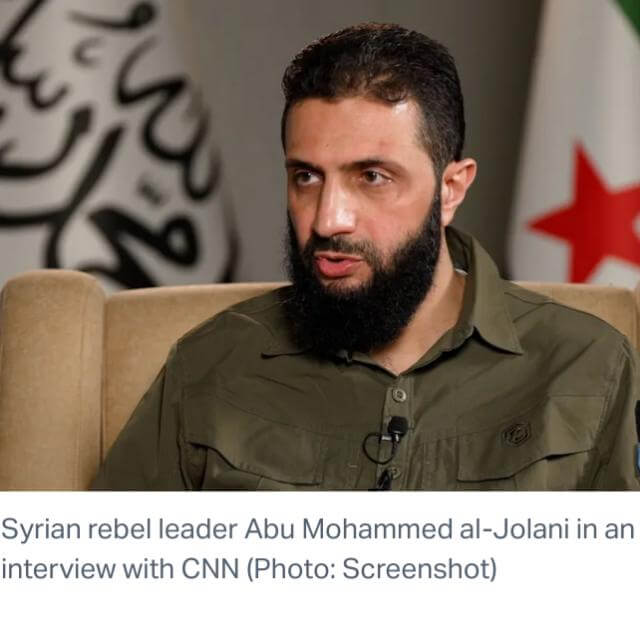
Abu Mohammed al-Jolani, the leader of the Syrian rebel group Hayat Tahrir al-Sham (HTS), has been making headlines lately for his role in overthrowing Bashar al-Assad’s regime after 54 years of rule.
But who is this man, and what’s behind his sudden shift from a radical extremist to a reformed leader?
Born Ahmad al-Ashra, al-Jolani adopted the pseudonym “al-Jolani” as a reference to his claimed family heritage in the Golan region, which was seized by Israel after the Yom Kippur War.
His journey into conflict began in 2003, when he joined al-Qaeda forces in Iraq following the U.S. military invasion.
This ultimately led to his arrest in 2006 and subsequent imprisonment by the United States.
After his release in 2011, al-Jolani returned to Syria and founded the al-Nusra Front of al-Qaeda.
However, in 2016, he announced a split from al-Qaeda, rebranding his group as Jabhat Fateh al-Sham [Front for the Conquest of the Levant].
The following year, the group merged with another jihadist rebel group to form HTS, which managed civil and municipal affairs in the group’s stronghold of Idlib.
Al-Jolani’s recent statements, especially since the taking of Aleppo, have presented a more moderate image, rejecting sectarianism and even notifying minorities, such as the Christian population in the city, that they had nothing to fear from his forces.
He has also promised not to engage in retaliatory attacks against Alawites, the Islamic sect to which the Assad family belongs.
But while al-Jolani’s newfound moderation may be genuine, some analysts believe it’s also pragmatic.
Aron Lund of the think tank Century International told German news site 20 Minuten that al-Jolani’s efforts to present himself as a responsible actor rather than a toxic jihadi extremist will make his task easier.
“The less panic there is at the local and international level, and the more al-Jolani appears to be a responsible actor rather than a toxic jihadi extremist, the easier his task becomes,” Lund said.
However, while al-Jolani has said he has no interest in “external action,” the very name of the group, and his pseudonym “al-Jolani” indicate that the group may decide to take a hostile stance towards Israel in the future.
As the world watches, one thing is clear: Abu Mohammed al-Jolani is a man with a complex and tumultuous past, and his future remains uncertain.
Abu Mohammed al-Jolani’s rise to power and his sudden shift from radical extremism to moderation have left many analysts and observers wondering what’s next for Syria and the region.
As the dust settles, one thing is clear: the world will be watching closely to see how al-Jolani’s HTS group will shape the future of Syria and the Middle East.
Syria’s Government Has Fallen: Rebels Enter Damascus

By Burnett Munthali
In a stunning turn of events, Syria’s government has effectively fallen after rebel forces stormed the capital, Damascus, in a rapid military offensive. Rebel groups claim to have entered the city and taken up key positions, marking a significant turning point in the ongoing conflict. A source familiar with the rebel movement confirmed to CNN that “militarily, Damascus has fallen,” after the rebels’ swift advance across the country.
According to the rebels, Syrian President Bashar al-Assad has fled Damascus, although officials from Syria’s presidential office and Iran previously insisted that Assad had not left the capital. However, U.S. officials indicated that the Assad regime’s collapse may be imminent, and rebels claim they are in communication with high-ranking Syrian officers who are contemplating defection.
The statement from the Syrian Prime Minister, recorded amidst the chaos, acknowledged the shift in power and expressed the government’s readiness “to cooperate with any leadership the people choose.” This open declaration of willingness to cooperate suggests that the regime’s hold on power has weakened dramatically.
The fall of Damascus follows another significant victory for the rebels, who reported the “full liberation” of Syria’s third-largest city, Homs. This came just over a week after the rebels captured Aleppo, another major urban center. In Homs, scenes of joy erupted as residents tore down posters of Bashar al-Assad, echoing the pro-democracy protests that swept the region during the Arab Spring more than a decade ago.
The images from Homs and Aleppo signal not only a shift in military control but also a strong desire among the population for political change. The collapse of Assad’s regime appears imminent as the momentum of the rebel forces accelerates, backed by widespread support from disillusioned citizens.
With the fall of Damascus and the significant rebel gains in key cities, Syria now stands at a critical juncture. The future of the nation is uncertain, as various factions vie for control, and a post-Assad leadership emerges. Internationally, the world watches as the power vacuum left by Assad’s regime has the potential to reshape the political landscape of the Middle East.
While Syria faces a difficult road ahead, with questions over the new leadership and the rebuilding of the country, the fall of Assad’s government signifies a monumental shift in the region’s power dynamics. The next few weeks and months will be crucial in determining Syria’s future, as the rebel forces and the international community seek to navigate the complex challenges that lie ahead.
