

Human Rights

Witch Burning: Victims Cry for Justice

2 Min Read
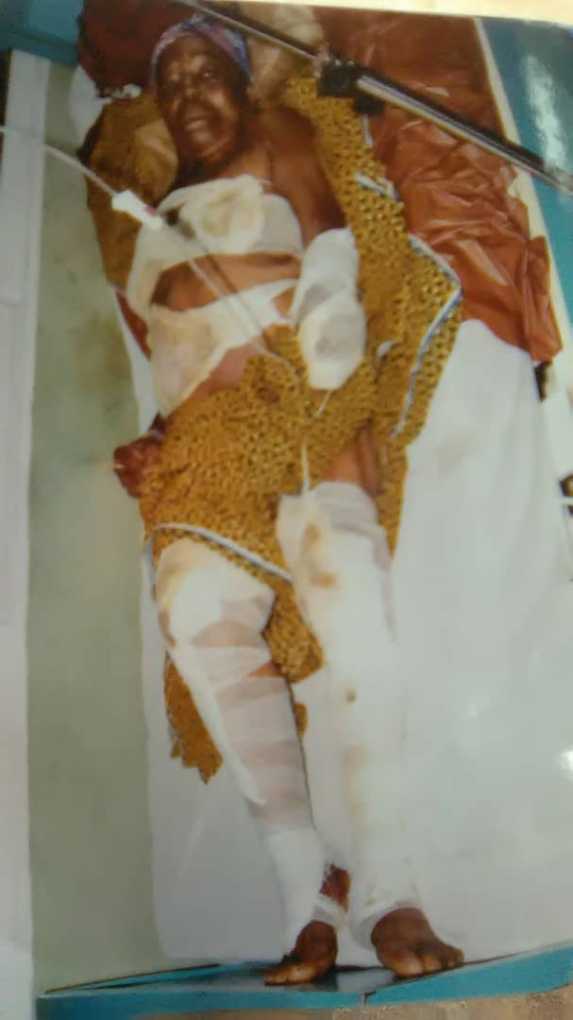
another victim of witch-burning in Cross River State in Southern Nigeria

The Advocacy for Alleged Witches(AFAW) has received a photo of another victim of witch-burning in Cross River State in Southern Nigeria. Last month an aide to the state governor, Thomas Obi Tawo (aka General Iron) led some thugs to set ablaze several persons, suspected of witchcraft in Boki LGA. Two of the victims have died as a result of the burns, while others such as the woman in the photo are battling for their lives at various hospitals.

AFAW calls for the arrest and prosecution of Thomas Obi Tawo and others accused of perpetrating this horrific violence. Nigerian authorities should not allow this matter to die as usually the case when persons who are connected to those in power are implicated in a crime. Even though General Iron is part of the government in the state, he should be made to answer for his crimes. Tawo abused his political position and should not be allowed to get away with this atrocious act.

The Police Public Relations Officer (PPRO) in the state has confirmed that investigation is underway. But many are saying that no real investigation is being conducted. This is because Thomas Tawo and the ring leaders of the lynch mob have yet to be arrested. Victims have yet to be interviewed. There are serious concerns that the perpetrators are trying to use their political connections to evade justice.

Victims and their relatives are crying for justice. The police and Cross River State government should not let them down. The police will be sending very wrong signals if they do not arrest and prosecute Thomas Tawo and others who are alleged to have perpetrated this savage act. The police should use this incident in Boki LGA to send a strong message to other would-be witch hunters in the region that Cross River is a state where the rule of law not jungle justice applies. Cross River state government should rise to its responsibility to protect the lives and property of people in the state.

The government should take all necessary measures to ensure that this form of violence does not repeat itself in the state. AFAW is in touch with some of the victims and is helping defray the costs of their medical treatment. AFAW is providing humanitarian support to those affected by this horrific attack in pursuant to its objective of eradicating witch persecution in Africa by 2030

Leo Igwe

Leo Igwe (born July 26, 1970) is a Nigerian human rights advocate and humanist. Igwe is a former Western and Southern African representative of the International Humanist and Ethical Union, and has specialized in campaigning against and documenting the impacts of child witchcraft accusations. He holds a Ph.D from the Bayreuth International School of African Studies at the University of Bayreuth in Germany, having earned a graduate degree in Philosophy from the University of Calabar in Nigeria. Igwe’s human rights advocacy has brought him into conflict with high-profile witchcraft believers, such as Liberty Foundation Gospel Ministries, because of his criticism of what he describes as their role in the violence and child abandonment that sometimes result from accusations of witchcraft. His human rights fieldwork has led to his arrest on several occasions in Nigeria. Igwe has held leadership roles in the Nigerian Humanist Movement, Atheist Alliance International, and the Center For Inquiry—Nigeria. In 2012, Igwe was appointed as a Research Fellow of the James Randi Educational Foundation, where he continues working toward the goal of responding to what he sees as the deleterious effects of superstition, advancing skepticism throughout Africa and around the world. In 2014, Igwe was chosen as a laureate of the International Academy of Humanism and in 2017 received the Distinguished Services to Humanism Award from the International Humanist and Ethical Union. Igwe was raised in southeastern Nigeria, and describes his household as being strictly Catholic in the midst of a “highly superstitious community,” according to an interview in the Gold Coast Bulletin.[1] At age twelve, Igwe entered the seminary, beginning to study for the Catholic priesthood, but later was confused by conflicting beliefs between Christian theology and the beliefs in witches and wizards that are “entrenched in Nigerian society.”[1] After a period of research and internal conflict due to doubts about the “odd blend of tribalism and fundamentalist Christianity he believes is stunting African development,” a 24-year-old Igwe resigned from the seminary and relocated to Ibadan, Nigeria