


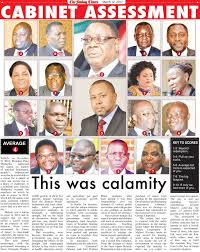

LILONGWE-(MaraviPost)-The Times Group 2016 president and cabinet assessment, which analyses the seating head of state and his ministers’ performance, shows that the executive arm of government was a total mess and failed to meet Malawians expectations for the year.
This is a daunting reality which the Democratic Progressive Party (DPP) administration needs to critically take into serious account the report while attempting to put its house in order and sustain the trust of 34 percent of Malawians that voted for the party the 2014 tripartite elections.
The cabinet assessment looks at the president and every minister on their achievements or the activities they failed to accomplish upon assuming their respective offices particularly on policy direction and actions, because they are the political heads of their various ministries.
Additionally, the assessment assigns scores to each cabinet minister on how he/she performed in their respective portfolios and are place in five categories. These are 1-2 (Beyond redemption), 2-3 (Pull up your socks), 5-6 (Average but more is expected of you), 7-8 (The big leagues), and 9-10 (If only we had more of you).
The 2016 cabinet assessment supplement headlined, “This was calamity,” published in The Sunday Times of February 12, 2017, highlights that only one cabinet minister Joseph Mwanamveka, scored seven points while George Choponda earned a zero score.
Times Group observed that Malawi was in a crisis in 2016 and says the assertion that the nation has turned a corner, is an exercise in self delusion.
The assessment said that despite the fact that in the past year started promisingly with the government estimating a Gross Domestic Product (GDP) growth of about five percent, everything spiraled down through the year.
In the health sector, the assessment highlights the unique situation in which public hospitals went scrounging for food because government could not adequately fund them.
The record that have been hospitals running out of medicines, read like scenes in a tragic play; ambulances were reportedly parked and patients en route to the health facilities died because of long distances.
“In education, both Mutharika and his education minister Emmanuel Fabiano had their Pontius Pilate moments after each denied it was not their responsibility over the closures of various public universities and colleges due to one problem or another (most of which are chronic).
“Most schools continue to exist in a state of disrepair, and children still learn in unconscionable environments. Teaching remains a poor man’s option for a job, while those who sacrificed to educate the nation remain unemployed”, reads in part Times’ Cabinet Assessment.
The Assessment cites that the agriculture sector, was total a mess ranging from drought to chaos in the Farm Inputs Subsidy Program (FISP), and with the center stage of the suspicious purchase of maize from Zambia by the Agriculture Development and Marketing Corporation (Admarc).
There was no shortage in disasters in the agricultural sector that culminated in the dismissal of ex minister Chaponda. It is not a wonder he gets zero points in the Assessment.
The Assessment went further saying that Malawi had to contend with the awful performance in the energy sector where the Electricity Supply Corporation of Malawi (Escom) broke its own record for keeping Malawians almost half of the year in blackouts.
It was hardly the sort of environment in which anyone could expect the industry to thrive or to entice foreign investments. The jury is still regarding Escom’s contribution towards Malawi achieving the paltry 2.5% GDP growth at the end of 2016.
“This Assessment is premised on the fact that Cabinet Ministers had to operate in such a hostile economic environment. Some of them, like dead fish, went with the flow while others went out on their way to fulfill the mandate they have even in the face of tough economic situation,” concludes the Cabinet Assessment report.
General Assessment
President Peter Mutharika is a “backseat leader,” got 5 out of 10 for leadership failure, war against the media, and his poor (non-existent) fight against corruption. But Mutharika has been recommended for assenting to ATI Bill, improving road network and maintaining lean cabinet.
Saulos Chilima, The Vice President is “more into theory not practical” eventually scored 5 out of 10 for managing disasters passably well, progress in some public reforms and the signing of the Memorandum of Understanding (MoU) with the Malawi Defence Force and Police. Chilima has however, been lonely in a crowd, too many parables which create vagueness of message.
Joseph Mwanamveka, Minister of Trade and Industry, “Star performer”, got 7 out 10 for launching of collateral registry to simplify lending, buy Malawi strategy, investments forums and improving the nation on doing business index. But Mwanamveka, has ignored the tourism sector development, and he is doing too much too fast.
Jappie Mhango, Minister of Transport and Public Works, “On the rails”, scored 6 out of 10 for construction or rehabilitation of several roads, Malawian airlines expansion to operate to Kenya and Zanzibar and improved services delivery at DRTSS. But he has failed to address corruption at DRTSS, no boats for the departments of Marines and over-reliance of road for import and exports of commodities.
Nicholas Dausi, Minister of Information and ICT (Government Spokesperson), “forced to be good” got 5 out 10 for being everyman’s man, signing of ATI and switching from analogue to digital broadcasting. But Dausi has evasive on straightforward issues, no position on independence of MBC and focusing much on information role leaving out ICT.
Samuel Tembenu, Minister of Justice and Constitutional Affairs, “Too much about the same things”, scored 5 out of 10, for establishing computerized case tracking system and record number of bills drafted and passed. But the Minister has done badly in prosecution of cash gate cases too slow, conflict between Director of Public Prosecution (DPP) And Ant-Corruption Bureau (ACB), disagreements between the Attorney General (AG) and Office of Ombudsman.
Atupele Muluzi, Minister of Lands, Housing and Urban Development, “In no man’s land”, attained 5 out of 10 for passing of 10 related land laws and success implementation of decent and affordable housing subsidy program. But the Minister has done badly in mishandling of Thyolo land issue, government offices facing closure and poor urban development.
Peter Kumpalume, Minister of Health, “Health on sick bed” scored 5 out 10 for the convictions of drug thefts, implementing systems to beat inefficiencies and rolling out of Anti-drug theft unit in public hospitals. Kumpalume has failed to address food shortages in public hospitals, riddled by legacy problems and freezing recruitment of health workers.
Henry Mussa, Minister of Labor, Sports and manpower development, “Jack of all trades, master of none” scored 4 out 10 for opening Bingu National Stadium, construction of Mzuzu Youth Centre, increasing number of graduate from tertiary institutions. Mussa has however made too many promises with little to show, having irrelevant sport policy and failing to address high unemployment rates.
Francis Kasaila, Minister of Foreign Affairs and International Cooperation, “Stranded in diplomacy”, got 4 out of 10 for providing guidance on Lake Malawi dispute with Tanzania, holding several joint permanent commission for cooperation and spearheading reforms to deal with fraud in embassies. But he has failed to help stranded Malawians in Tanzania and Kuwait in time, no movement on fraud at Malawi Embassy in Ethiopia and bungling of Mutharika’s trip to UNGA trip.
Kondwani Nankhumwa, Minister of Local Government and Rural Development, “Master of secrecy” scooped 4 out of 10 for failing to restore HR issues in councils, secrecy in installing chiefs, tainted by suspicions of corruption. Nankhumwa has managed to upgrade city roads to asphalt surface, completion of several growth centre and devolution of human resources as a reform milestone.
Grace Chiumia, Minister of Home Affairs and Internal Security, “No safe ground”, got 3 out of 10 for failing to address corruption at police, immigration and DRTSS, lack of action on police officers in transgressing the law and shady recruitment of police officers. Chiumia has managed to intensify city and town patrols, enabling prisons to feed themselves and decongestion of refugee camps.
Goodal Gondwe, Minister of Finance, Economic Planning and Development, “No money, more problems”, scooped 3 out of 10 for wrong GDP estimates, inflation still high and out of ideas. But Mutharika has trust in him.
Emmanuel Fabiano, Minister of Education, Science and Technology, “Tertiary education on its knees”, got 3 out of 10 for closure of colleges and universities, denial of responsibility, failing to recruit about 23, 000 trained teachers. Fabiano managed to fund 5, 414 primary schools with grants, deploying 10,500 primary school teachers and procurement of 386, 280 textbook for secondary schools.
Bright Msaka, Minister of Energy, Natural Resources and Mining, “All at sea” scooped 3 out of 10 for erratic availability of electricity, fraud and corruption allegations at Escom and failure to compel some of millers to pay. Msaka has been commended for splitting Escom into two bodies (generation and distribution), tightening security at Viphya Plantation and Dzalanyama Forest reserves, and passing of National Parks and Wildlife Act Amendment Bill 2016.
Patricia Kaliati, Minister of Civic Education, Culture and Community Development, “destination: route clueless”, scooped 2 out of 10 for duplicating roles with other ministers, still making tentative steps towards autonomy, instructors pulling out adult literacy programs due to low honoraria. Kaliati however, managed to intensify awareness campaigns on electronic payments and adult literacy programs.
Jean Kalilani, Minister of Gender, Children Disability and Social Welfare, “too quite for activism”, got 2 out of 10 for failing to enforce the Child Care, Protection and Justice Act, rampant street begging, and unable to investigate cases of child molestation. Kalilani has been commended for rescuing Malawian Children from trafficking in South Africa, educating the public against the killing of people with albinism and reaching out to the vulnerable children through the social cash transfer.
George Chaponda, Minister of Agriculture, Irrigation and Water Development, “Gone but not forgotten”, scooped 0 out of 10, he is the worst performer, very bad in everything and only good on agriculture and irrigation policies.
Times Group is Malawi’s oldest publishing company and was founded and wholly owned by the father and founder of the Malawi nation, Dr. Hastings Kamuzu Banda, currently owned by his family. The Group publishes The Daily Times, Malawi News and The Sunday Times and other subsidiaries including Times Television, Radio and Currier, and Dzuka Book Publications.