
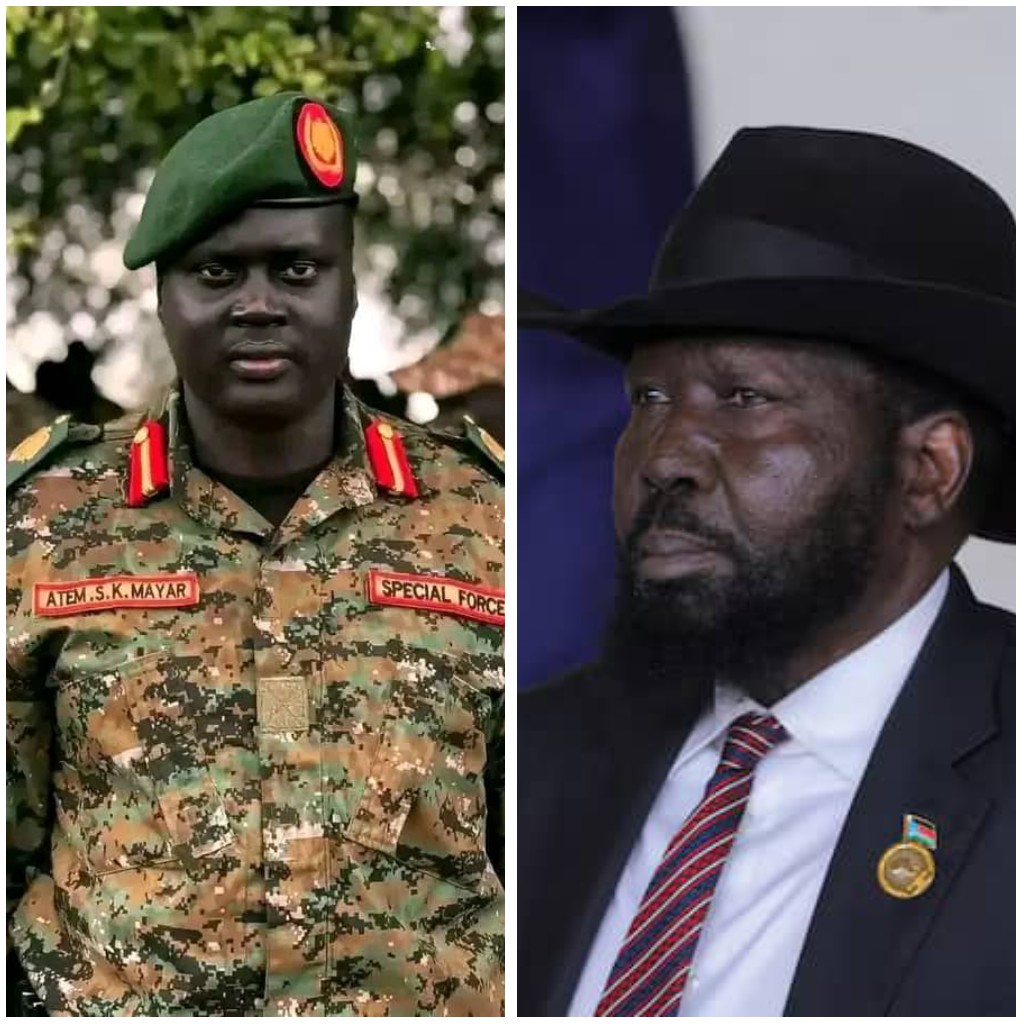
JUBA-(MaraviPost)-South Sudan President Salva Kiir Mayardit has appointed his son, Major General Atem Salva Kiir, to command the country’s elite presidential guard, placing the 36-year-old military officer at the centre of the security structure responsible for protecting the president and other senior officials.
Radio Tamazuj reported that Atem had been appointed commander of the presidential guard, known as the Tiger Division. The report said the appointment followed his recent promotion from brigadier general to major general.
Atem formally assumed command of the Tiger Division on September 11, three days after his appointment.
The unit is responsible for protecting the presidency and has also been involved in security operations around Juba, making its command a strategically important position within South Sudan’s security establishment.
Atem joined South Sudan’s military in 2012 and previously served as commander of a Special Force within the country’s National Security Service. His promotion to major general preceded his appointment to lead the presidential guard.
After taking command, Atem said he would focus on strengthening discipline within the unit and described his approach in terms of professionalism, unity and service to South Sudan.
The South Sudanese military has also defended the appointment amid public attention over Atem’s relationship with the president.
Military officials have maintained that his advancement followed established military procedures and rejected the suggestion that his appointment was based solely on his family connection to President Kiir.
Atem is not the first member of President Kiir’s family to receive a senior government role. In August 2025, Kiir appointed his daughter, Adut Salva Kiir, as Senior Presidential Envoy for Special Programmes.
She has subsequently represented her father at high-level engagements in South Sudan and abroad.
The appointment comes at a politically sensitive time for South Sudan, which is scheduled to hold presidential and parliamentary elections on December 22, 2026.
The country has repeatedly postponed elections since gaining independence in 2011, while implementation of the 2018 peace agreement has continued to shape the political transition.
The electoral process itself has faced a fresh development this week. On September 15, President Kiir dismissed Abednego Akok Kacuol as chairperson of the National Elections Commission and appointed Gabriel Bol Deng Majok, the commission’s former secretary general, as his replacement.
The change came roughly three months before the scheduled elections.
The timing of that decision has prompted questions from political analysts and election observers.
The Associated Press reported that some analysts believe the change could complicate preparations for the elections, including voter registration, while the legal basis for the dismissal has also been questioned.
Those assessments are attributed to the individuals who made them and do not establish that the government intends to delay the elections.
Against this backdrop, Atem’s appointment has attracted additional attention because it places a member of the president’s immediate family in command of one of the country’s most strategically important security formations.
However, the appointment itself does not establish that Atem is being prepared as a political successor to his father, and no such succession plan has been publicly announced by President Kiir.
South Sudan now faces the challenge of maintaining political and security stability while preparing for the December elections.
Atem’s new command will therefore place him at the centre of the country’s security operations during a particularly important period in its political transition.

Leave a Reply