
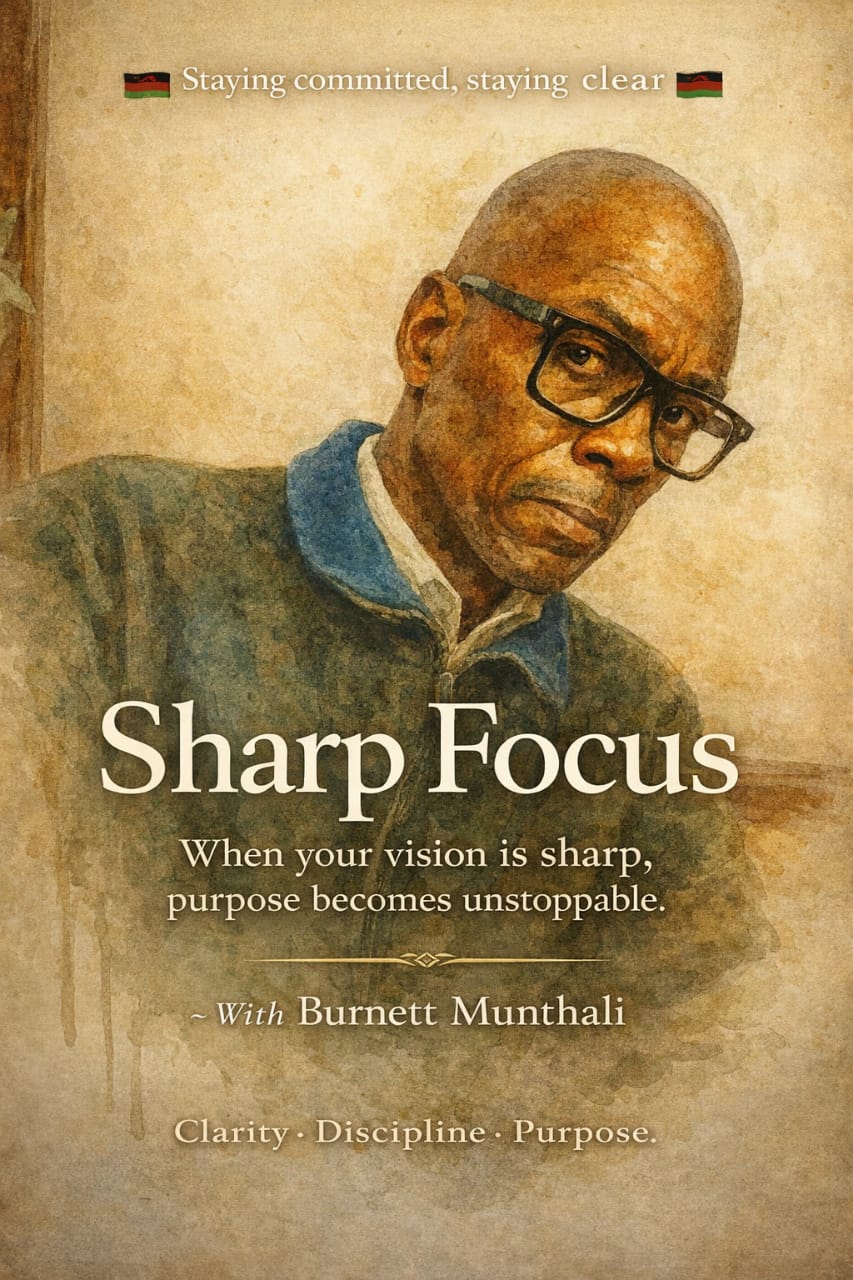


Sharp Focus
The power brokers who switched off accountability
By Burnett Munthali
Malawi did not wake up one morning to discover that K2.6 billion had become a subject of public controversy at the Electricity Generation Company (Egenco). The transaction happened through institutional processes, contractual arrangements and financial approvals that now demand serious scrutiny.
Let us be clear: this is not merely a disagreement over legal fees. It is a fundamental test of corporate governance, public financial management and the responsibility of those entrusted with running institutions that provide an essential national service.
Egenco is not an ordinary commercial enterprise operating in isolation from the public interest. It is one of the country’s most strategically important state-owned companies, responsible for generating electricity that powers hospitals, industries, schools, businesses and households.
When such an institution faces questions over a multibillion-kwacha payment, Malawians have every right to demand answers.
The question is not whether a private law firm can legally provide services to a state-owned company. The question is whether this particular engagement was necessary, properly procured, reasonably priced, adequately authorised and demonstrably beneficial to the public.
Those questions cannot be dismissed as political noise or social media speculation. They go to the heart of responsible management of public resources.
The K2.6 Billion Question
On November 17, 2026, Egenco suspended Chief Executive Officer William Liabunya and Director of Corporate Services and Company Secretary Videlia Mluwira.
The suspension letters, signed by Board Chairperson Justin Saidi, cited serious preliminary findings relating to procurement, organisational performance, integrity, professionalism, leadership, administration and the use of company resources.
The action followed growing scrutiny of Egenco’s payment of approximately K2.6 billion to M&M Global Law Consultants for services associated with recovering outstanding money owed to Egenco by the Electricity Supply Corporation of Malawi (Escom).
The Ministry of Finance, Economic Planning and Decentralisation subsequently instituted an investigative audit and directed the freezing of accounts associated with the transaction through the Financial Intelligence Authority.
These are significant developments. They demonstrate that the matter has moved beyond public debate and into formal institutional scrutiny.
However, suspension is not conviction, and an investigative audit is not a criminal judgment. The officials concerned are entitled to due process, while the public is entitled to a credible explanation of how the transaction was conceived, approved and implemented.
That distinction must not become an excuse for institutional silence.
The Defence That Has Not Ended the Debate
Liabunya defended the payment, explaining that Escom owed Egenco substantial sums arising from outstanding payments under power-trading arrangements.
According to Egenco’s explanation, the company engaged M&M Global Law Consultants after attempts to recover the debt through other channels had failed.
The law firm reportedly assisted in recovering approximately K14.8 billion, after which it received fees calculated at 15 percent of the recovered amount, together with Value Added Tax.
Egenco maintains that the arrangement was legitimate, that the firm was selected through its procurement framework and that the payment was for professional services rendered. The company has also rejected allegations circulating on social media that its executives personally benefited from the transaction.
These explanations deserve to be examined fairly. A company is entitled to recover money owed to it, and professional legal services are not inherently improper simply because they are expensive.
But an explanation is not the same as independent verification.
The central concern is the scale of the payment and the circumstances surrounding the engagement.
Why was an external law firm necessary to recover money owed by another government-owned institution?
What steps had Egenco taken before engaging the firm?
Was the procurement process properly documented?
Who approved the fee arrangement?
Was the 15 percent calculation established in advance, and was it consistent with the applicable legal remuneration rules and the actual contract?
Did the company assess whether the arrangement represented value for money?
These are not unreasonable questions. They are the minimum questions expected whenever a state-owned enterprise commits billions of kwacha to an external service provider.
Two Public Institutions, One Public Interest
Perhaps the most uncomfortable aspect of the controversy is that both Egenco and Escom are government-owned institutions.
This makes the debt-recovery arrangement particularly important to examine.
When one public institution owes another substantial amounts of money, government must have effective mechanisms for resolving the dispute without exposing public resources to unnecessary costs.
The fact that the companies operate independently does not remove the government’s responsibility to ensure sound financial management across the public enterprise sector.
If Escom owed Egenco money, that debt needed to be recovered. Egenco had a legitimate obligation to protect its revenue and financial position.
But the public deserves to know whether the engagement of external lawyers was the most economical and appropriate way of achieving that objective.
Could the dispute have been resolved through direct negotiations?
Were the relevant ministries involved in facilitating settlement?
Were the companies’ boards adequately informed?
Were internal legal resources considered?
Was the Attorney General’s office consulted?
The answers matter because the money involved ultimately belongs to institutions whose financial health affects the national economy.
The public should not be forced to accept expensive arrangements simply because they are described as contractual obligations.
The Audit Must Follow the Money
Government’s decision to institute an investigative audit and freeze accounts linked to the transaction is welcome.
However, the real measure of seriousness will be the quality, independence and transparency of the investigation.
Freezing accounts is a precautionary measure. It does not establish that money was stolen, nor does it automatically demonstrate that every aspect of the transaction was unlawful.
The audit must therefore establish exactly what happened, identify the people and institutions involved in each approval stage and determine whether the transaction complied with applicable procurement, financial-management and legal requirements.
It must establish the precise amount paid, the basis on which the fee was calculated, the contractual obligations of the law firm and the services actually delivered.
It must also examine the relationship between the amount recovered and the fee charged, including the treatment of VAT and any other applicable charges.
Most importantly, investigators must establish whether the transaction followed the procurement process Egenco says it followed and whether the relevant approvals were obtained before the financial commitment was made.
If the arrangement was lawful and represented value for money, the findings should establish that clearly.
If irregularities occurred, the investigation must identify them and recommend appropriate action.
Accountability cannot be selective. It must apply to everyone whose decisions or actions contributed to the transaction, regardless of position, influence or political connections.
A History That Demands Careful Scrutiny
The latest controversy has also revived public discussion about Liabunya’s previous difficulties at Egenco.
In October 2023, Liabunya and Mluwira were sent on forced leave as the board initiated forensic investigations into the management of infrastructure damage and power rationing following Tropical Cyclones Gombe and Ana.
They were subsequently charged alongside another Egenco executive, Orphan Chisasa, in connection with allegations involving K3.4 billion, money laundering and abuse of office.
However, the three were acquitted by the Blantyre Chief Resident Magistrate Court in November 2025 after the State indicated that it had no evidence to proceed with the case.
That acquittal must be respected. It would be wrong to treat the previous criminal allegations as proof of wrongdoing in the present matter.
Nevertheless, the history makes the latest suspension an important governance issue.
Liabunya returned to the position of Egenco chief executive in November 2025. Barely a year later, he finds himself suspended again while another major financial controversy is investigated.
This naturally raises questions about institutional continuity, leadership selection, board oversight and the effectiveness of governance safeguards at Egenco.
Who evaluated the institution’s leadership and management arrangements before the renewed appointment?
What measures were introduced to strengthen internal controls?
Were lessons from the earlier investigations incorporated into the company’s governance framework?
These questions should not be interpreted as an attempt to reopen a concluded criminal case. They concern the ability of a strategically important public enterprise to maintain strong leadership standards and prevent recurring institutional controversies.
The Public Pays the Price
The most important victims of weak corporate governance are not necessarily the people sitting in boardrooms. They are ordinary Malawians who depend on reliable electricity to sustain their livelihoods.
Hospitals require electricity to operate essential equipment and preserve medicines.
Businesses need dependable power to produce goods, provide services and create employment.
Farmers and agro-processors require electricity to support irrigation, storage and value addition.
Students need functioning electricity infrastructure to access digital learning and study effectively.
Every public institution responsible for electricity generation must therefore understand that its financial decisions have consequences extending far beyond its offices.
Egenco’s resources should be directed towards its core mandate: generating electricity, maintaining power stations, repairing equipment, improving operational efficiency and strengthening national energy security.
This does not mean that legitimate legal expenditure should never be incurred. It means that every significant expenditure must be justified, properly authorised and demonstrably connected to the institution’s objectives.
A country struggling with electricity shortages cannot afford complacency in the management of its power infrastructure.
Who Is Watching the Watchdogs?
The Egenco controversy should also trigger a wider examination of oversight across state-owned enterprises.
Boards of directors must not exist merely to approve management decisions and attend meetings. They are expected to provide strategic direction, enforce accountability, supervise executive management and protect institutional resources.
The Ministry of Finance must exercise effective oversight over public enterprises, while the relevant regulatory and investigative institutions must act independently whenever credible concerns emerge.
The Anti-Corruption Bureau, Auditor General and other legally mandated institutions should examine matters falling within their respective jurisdictions where evidence warrants their involvement.
Parliament, particularly through its relevant oversight committees, also has an important responsibility to demand explanations about the management of public enterprises.
However, investigations must not become instruments of political persecution. Evidence, established procedures and the rule of law must guide every decision.
Malawi needs accountability that is firm enough to confront wrongdoing but fair enough to protect innocent people from premature condemnation.
Malawi Must Not Allow This Matter to Disappear
The K2.6 billion controversy presents a defining opportunity to demonstrate that public institutions can be held accountable regardless of who occupies their offices.
The investigative audit must not disappear into bureaucratic corridors.
Government should communicate its terms of reference, identify the responsible investigative arrangements and provide a reasonable timeline for reporting its findings.
The public should eventually know whether the payment complied with the law, whether the procurement process was properly conducted and whether the expenditure represented value for money.
If wrongdoing is established, the appropriate disciplinary, civil or criminal processes must follow.
If no wrongdoing is established, the affected individuals and institutions must also receive a clear and credible outcome.
That is what justice and accountability require.
The controversy must also lead to institutional reforms. State-owned enterprises need stronger procurement controls, transparent contract approvals, independent internal audits and clear reporting obligations for substantial financial transactions.
The era of relying on defensive statements whenever public money attracts scrutiny must end.
Malawians deserve institutions that explain their decisions before controversies erupt, not organisations that become transparent only after leaked documents and public pressure force them to respond.
The Final Verdict Belongs to the Evidence
Egenco was established to generate electricity and contribute to national development, not to become a recurring subject of financial controversy.
Its leadership must understand that public office and executive authority come with obligations that cannot be separated from accountability.
The K2.6 billion payment may ultimately be found to have been lawful, irregular or improperly authorised. That determination belongs to the evidence and the institutions mandated to examine it.
But one conclusion is already unavoidable: the public has a right to know how such a substantial payment was approved, what services were delivered and whether the transaction protected or undermined public value.
The government must not confuse suspending officials with solving the problem. The board must not mistake issuing letters for fulfilling its oversight responsibility. And the investigators must not allow public attention to fade before the facts are established.
Malawi’s electricity crisis is serious enough without adding a crisis of confidence in the institution responsible for generating power.
The country does not need more public relations statements. It needs transparent investigations, responsible leadership and consequences wherever evidence establishes wrongdoing.
Egenco must generate electricity, not unanswered questions.
Public money must serve the public, not disappear into arrangements that cannot withstand scrutiny.
When accountability is switched off, the entire nation is left in the dark.

Leave a Reply