

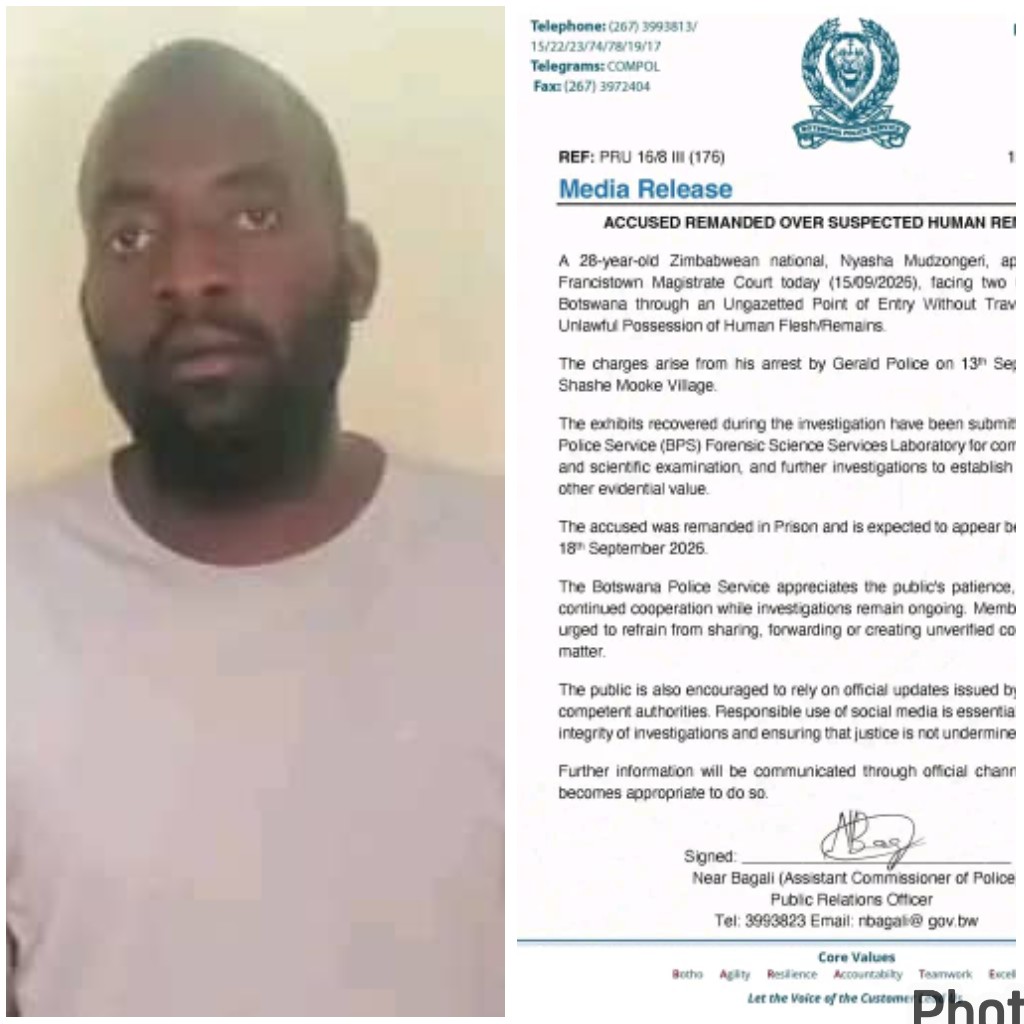

FRANCISTOWN-(MaraviPost)-A 28-year-old Zimbabwean national has been remanded in custody in Botswana after appearing in court on charges related to illegal entry and the alleged possession of suspected human remains, police said.
The man, Nyasha Mudzongeri, appeared before the Francistown Magistrates Court on Tuesday, 15 September 2026.
He faces two charges: entering Botswana through an unauthorised border point without valid travel documents, and being in unlawful possession of what authorities believe to be human flesh or remains.
According to the Botswana Police Service, Mudzongeri was arrested two days earlier, on 13 September, by officers from Gerald Police Station near Shashe Mooke Village in the northeast of the country.
During questioning, he told police that he works as a traditional spiritual healer.
Items recovered at the time of his arrest have been sent for analysis. Police said the suspected remains and other material collected as exhibits were transferred to the Botswana Police Service Forensic Science Services Laboratory.
Investigators are waiting for detailed forensic testing to confirm what the material is, where it may have come from, and whether it can be used as evidence in the case.
Because the forensic report is still pending, the court did not grant bail.
Magistrates remanded Mudzongeri in prison custody and set 18 September 2026 as the next court date, by which time investigators hope to provide more information.
Cross-border concerns
Cases involving alleged human remains often draw strong public attention in southern Africa, where beliefs around traditional medicine and ritual practices sometimes intersect with criminal investigations.
Botswana authorities said they are treating the matter seriously and following standard procedure for evidence handling and identification.
The arrest near Shashe Mooke, a village not far from the Zimbabwe border, also highlights ongoing challenges with irregular migration in the region.
Botswana shares a long, porous boundary with Zimbabwe, and police in both countries regularly conduct patrols aimed at curbing undocumented crossings and smuggling.
Many people cross the borders for work, trade or family reasons, but unauthorised entry remains an offense under Botswana law and can complicate other criminal investigations when it occurs.
Apparently, prosecutors told the court that they need time to await the forensic laboratory results before proceeding further.
The results are expected to clarify two key points: first, whether the material is in fact human tissue, and second, any possible link to missing persons reports in Botswana or neighboring countries.
Mudzongeri has not yet entered a plea on the substance of the possession charge, as proceedings are at an early stage. He was represented in court and informed of his right to legal counsel.
The Zimbabwean embassy in Gaborone has been notified of the arrest, in line with consular practice for foreign nationals detained abroad. It is not yet clear whether consular officials have had direct access to Mudzongeri.
For now, police say the investigation continues. Officers are conducting interviews in the area where Mudzongeri was arrested and are coordinating with forensic experts to trace the origin of the exhibits.
The Francistown court will reconvene on 18 September to review progress.
Until then, Mudzongeri remains in custody as authorities work to establish the full facts of the case.

Leave a Reply