



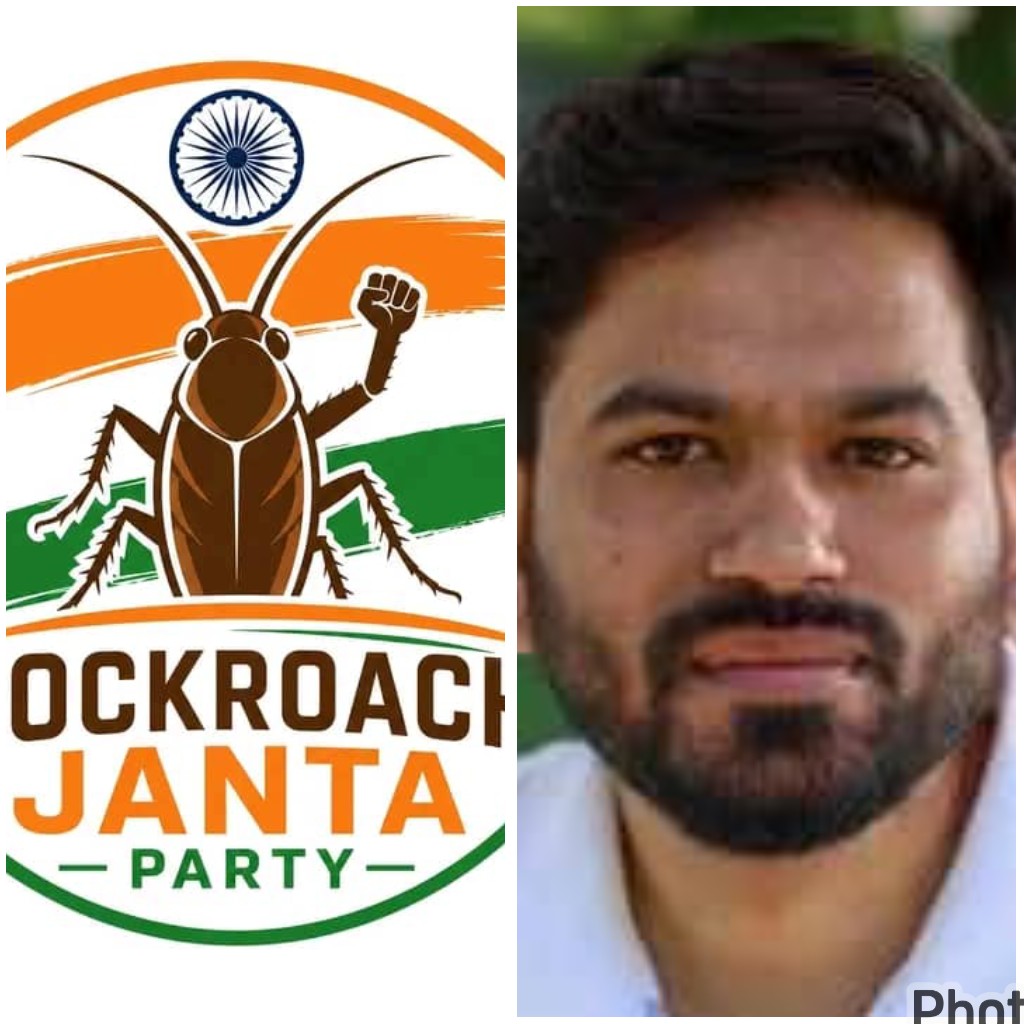
NEW DELHI-(MaraviPost)-What began as an unusual online joke in India has grown into a youth-led political movement attracting national attention.
The Cockroach Janta Party (CJP) has turned a controversial description of unemployed young people into a symbol of resistance, using social media and street protests to raise concerns about examinations, jobs and government accountability.
In an exclusive interview with the BBC, CJP founder Abhijeet Dipke explained how the movement developed and why young Indians embraced the controversial “cockroach” name.
The interview offers an insight into how a campaign that began online moved into the streets and became part of a wider debate about India’s education system, unemployment and the ability of young people to influence government decisions.
The CJP was founded by Dipke in May 2026. Its unusual name emerged after remarks attributed to India’s Chief Justice Surya Kant comparing some unemployed young people to “cockroaches”.
The Chief Justice later clarified that he was referring to people with fake or bogus degrees rather than unemployed young Indians generally.
Dipke and his supporters, however, turned the word into something different. Instead of accepting it as an insult, they adopted the cockroach as a symbol of survival, resilience and resistance.
That message quickly attracted young Indians who were already frustrated about education and employment.
For many supporters, the problem was not simply about examinations. Students were worried about examination irregularities, alleged paper leaks and mistakes that could affect their academic futures.
The bigger question was whether years of studying and obtaining qualifications would actually lead to jobs and better lives.
That concern gave the CJP a much wider audience.
India has a huge young population, making education and employment politically sensitive issues. Youth unemployment has also remained an important concern, particularly among those entering the labour market after completing school or university.
The CJP therefore emerged at a time when many young Indians were already looking for a way to express their frustration.
Unlike traditional political parties, the movement did not begin with offices, candidates or an established nationwide organisation. It began online.
Memes, short videos, satire and simple messages allowed the CJP to communicate with young people in a language that felt familiar. Its supporters did not need to attend political meetings or join a formal party to participate.
They could simply share the message.
But the movement’s real test came when it left social media and entered the streets.
Dipke returned to India from the United States and became involved in demonstrations in Delhi. Protesters demanded action over examination problems and called for the resignation of Education Minister Dharmendra Pradhan.
The protests grew beyond their original online audience.
The CJP was no longer just an internet phenomenon. It had become a visible youth movement capable of bringing people together around a common grievance.
On July 25, Pradhan resigned after weeks of protests. Reuters reported that the Indian government subsequently supported tougher penalties for examination leaks and established a panel to review the examination system.
For the CJP, the resignation was a major victory.
It showed supporters that organised young people could put pressure on government and achieve a political result without first becoming a conventional political party.
The development also changed how the movement was viewed.
What had initially appeared to be an unusual internet campaign was now being taken seriously as a new form of youth political activism.
But the CJP’s importance goes beyond the resignation of one minister.
Its rise reflects deeper concerns among young Indians about education, unemployment, corruption and public institutions.
For students, an examination is not simply a test. It can determine access to university, employment and future opportunities. When allegations of examination leaks or administrative failures emerge, the consequences can affect students and their families for years.
That helps explain why the CJP’s message spread so quickly.
The movement has also challenged the traditional idea of political power.
Most political parties seek influence through elections. They recruit members, select candidates, contest constituencies and attempt to form governments.
The CJP has so far chosen a different route.
Dipke said in August that the movement had no immediate plans to contest elections. Instead, he presented it as a public movement focused on restoring trust and accountability in institutions.
That strategy allows people to support CJP campaigns without necessarily joining a conventional political party.
But it also creates a major challenge.
A movement can unite people around one grievance more easily than it can build a lasting organisation.
As the CJP has become more influential, questions about leadership, internal decision-making and political independence have begun to emerge.
One sign of the tension is the creation of a breakaway group.
Former CJP volunteer Manish Brahmbhatt has launched the Cockroach Janta Party-Democratic, or CJP-D. Brahmbhatt has accused Dipke of sidelining activists and has raised concerns about alleged political influence within the original movement.
Those allegations are claims by a dissident and should not be treated as established facts without independent evidence. However, the dispute shows the difficulties that can arise when a rapidly growing protest movement begins developing a more permanent structure.
The CJP is also expanding its agenda.
Its activities have increasingly touched on education, employment and local governance, suggesting an attempt to remain relevant beyond the original examination controversy.
Punjab is one example.
CJP representatives have visited government schools in the state and highlighted differences in school facilities. Their activities attracted political attention after Aam Aadmi Party leader Arvind Kejriwal publicly praised CJP spokesperson Saurav Dass.
That development presents another difficult question for the movement: can the CJP work with established politicians without becoming politically controlled?
Independence has been one of its greatest strengths. Many supporters see the CJP as different from established political parties.
If people begin to believe that it has become an extension of another political organisation, some of that support could disappear.
But refusing all political engagement could also limit the movement’s ability to influence government policy.
The CJP therefore faces a difficult choice. It can remain a pressure movement outside electoral politics, or it could eventually build an organisation capable of contesting elections and directly seeking political power.
For now, its greatest strength remains its ability to mobilise young people.
The movement has demonstrated how quickly social media can transform a simple message into a national campaign. Its name is provocative, memorable and easy to share.
More importantly, the cockroach has become a symbol.
Instead of representing weakness, supporters use it to represent survival — the idea that young people can continue fighting for opportunities despite unemployment, economic difficulties and institutional problems.
That message has helped give the movement a distinctive identity.
But social-media popularity alone cannot build a government.
Millions of followers do not automatically translate into votes, strong local organisations or the ability to manage a country.
If the CJP eventually enters electoral politics, supporters will expect answers to much bigger questions.
How would it create jobs? How would it reform education? How would it fight corruption? What economic policies would it support? And how would it govern a country as large and complex as India?
Those questions will determine whether the movement can move beyond protest.
For now, however, the CJP has already demonstrated something important.
It has shown that young citizens can organise quickly around a common grievance and put pressure on powerful institutions.
The resignation of a senior government minister gave the movement a powerful example of what youth mobilisation can achieve.
Its rise also sends a message to established political leaders: young people are not simply future voters. They are already capable of shaping political debates and influencing government decisions.
The movement’s future will depend on whether it can maintain that influence without losing its independence.
If it develops transparent leadership, clear internal rules and a focused public-interest agenda, the CJP could become a lasting force in India’s civic and political life.
If internal divisions and allegations of political interference dominate its next phase, however, its rapid rise could be followed by fragmentation.
The Cockroach Janta Party began with an insult. It became a social-media campaign, moved into street protests and helped create pressure that culminated in the resignation of an education minister.
Its biggest challenge now is no longer attracting attention.
It is proving that the energy of a youth protest movement can be turned into lasting change.
For millions of young Indians watching the experiment, the question is simple: can the Cockroach Janta Party survive India’s complicated political environment and turn protest into meaningful reform?
The answer could determine whether the CJP becomes a short-lived internet phenomenon or one of India’s most important new youth movements.

Leave a Reply