


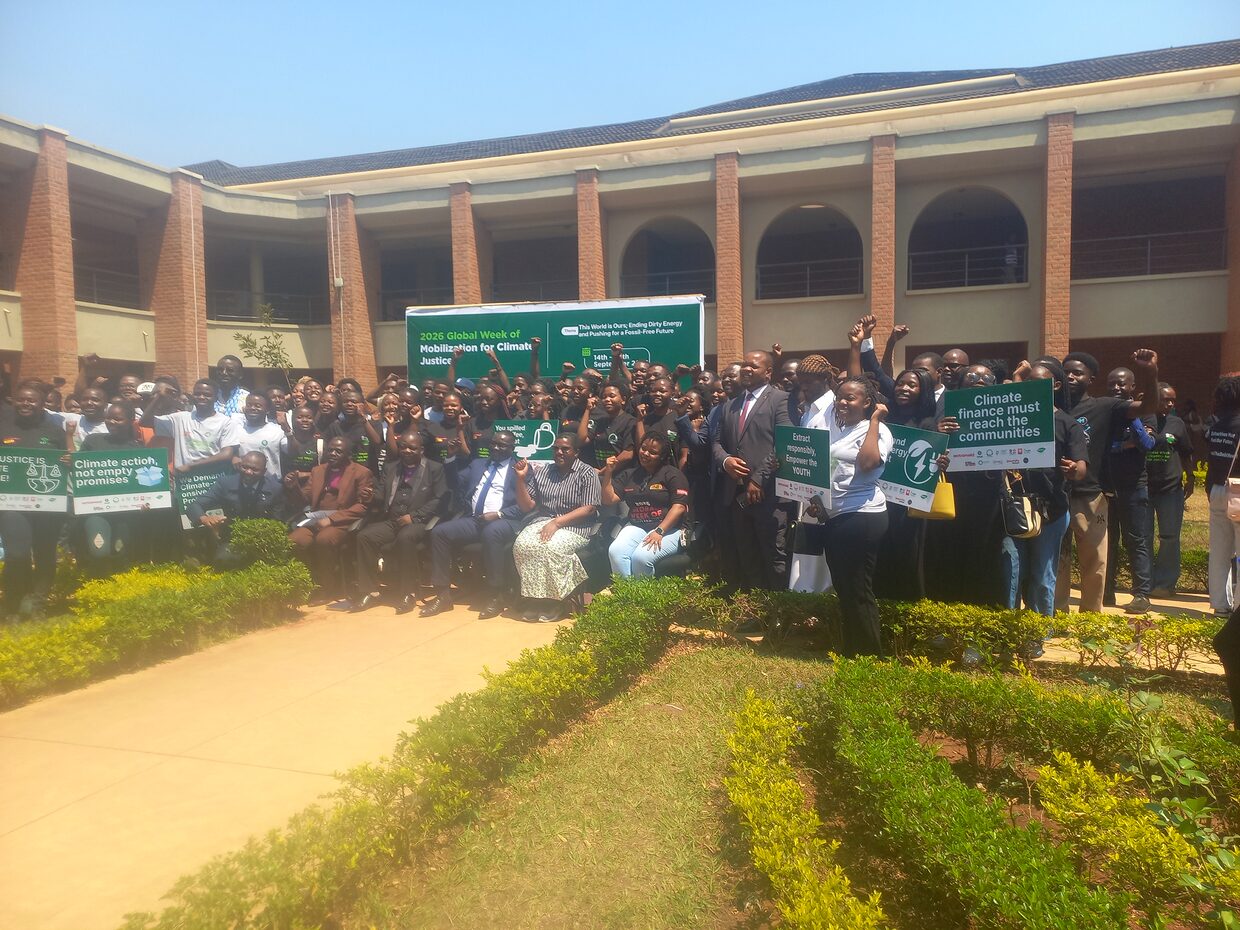
Theme: “This World is Ours: Ending Dirty Energy and Pushing for a Fossil-Free Future”
Today, we stand together at a critical moment for our planet and for humanity. Across the world, people are experiencing the devastating consequences of a climate crisis they did not create.
Communities are facing increasingly unpredictable rainfall, prolonged dry spells, floods, droughts, food insecurity, loss of livelihoods and displacement.
Women, young people, smallholder farmers and other marginalized communities are carrying the heaviest burden of this crisis, despite contributing the least to global emissions.
The climate crisis is not simply an environmental crisis. It is a crisis of justice, inequality, power and human rights.
As we launch the Global Week of Mobilisation for Climate Action 2026, under the theme “This World is Ours: Ending Dirty Energy and Pushing for a Fossil-Free Future,” we join millions of people around the world in demanding urgent, ambitious and people-centred climate action.
We are here to say clearly: our future cannot be sacrificed for profit. Our communities cannot continue paying the price for a crisis they did not create. And climate justice cannot be postponed.
Debt Justice is Climate Justice
Across the Global South, countries are trapped in unsustainable and unjust debt. Governments are forced to devote scarce public resources to debt repayment instead of investing adequately in health, education, social protection, resilient infrastructure, food systems and climate action.
For countries such as Malawi, this is particularly alarming. At a time when communities need resources to prepare for droughts, floods, cyclones and other climate-related shocks, public finances remain severely constrained.
We cannot fight the climate crisis while trapped in a debt crisis.
Debt cancellation is climate action. We therefore call for a fair and lasting solution to the debt crisis and for reforms to the global financial architecture that shift power towards the people and countries most affected by climate and economic injustice.
We further call for climate finance that reaches communities on the frontlines and is provided predominantly as grants, not loans that deepen the debt burden.
End Fossil Fuels and Destructive Extractivism
The continued expansion of fossil fuels and destructive extractive industries is incompatible with a safe and just future. We cannot continue investing public money in systems that pollute our environment, undermine livelihoods and accelerate climate change.
Malawi and other African countries need development pathways that protect people, biodiversity and ecosystems while creating decent and sustainable livelihoods.
We therefore call for an equitable and just transition away from fossil fuels and destructive extractivism, ensuring that workers, women, young people and communities are not left behind.
The transition must not simply replace one form of exploitation with another. The voices and rights of affected communities must be at the centre of decisions about natural resources, energy and development.
Fund People-Led Solutions
We know that solutions already exist within our communities.
Smallholder farmers, particularly women farmers, are demonstrating that agroecology and climate-resilient agriculture can strengthen food systems, restore ecosystems, protect biodiversity and build resilient livelihoods.
We call on Government, financial institutions and development partners to shift public resources and subsidies away from environmentally destructive industrial systems and towards agroecology, renewable energy, locally led adaptation and other people-led solutions.
Climate finance must reach the women, farmers, young people and communities who are already responding to the crisis on the ground.
Young People Must Have a Seat at the Table
This mobilisation is also a powerful reminder that young people are not merely beneficiaries of climate action; they are leaders, organisers and agents of change. Young people across Malawi and the world are demanding a future in which they can live with dignity, access decent work, participate meaningfully in decision-making and inherit a healthy planet. We call upon Government and all duty bearers to create meaningful spaces for young people, women and frontline communities to influence climate policies, budgets and investments.
Strengthen Accountability and Shift the Power
Climate commitments mean little without accountability. Governments, financial institutions, corporations and development partners must be held accountable for the decisions they make and the resources they control.
We therefore call for greater transparency, meaningful citizen participation and stronger accountability in climate financing, public debt management, extractive industries and environmental governance.
We must shift the power from systems that prioritise profit and extraction towards systems that prioritise people, equality, care and planetary wellbeing.
Our Collective Call
As civil society organisations, young people, women, farmers, communities, academics, faith leaders and climate justice movements, we stand united in demanding a climate action that
put women, young people and frontline communities at the centre of climate decision-making.
As we begin this Global Week of Mobilisation for Climate Action, we call upon all Malawians to raise their voices, organise, participate and demand action.
Let this week be more than a moment of mobilisation. Let it be a renewed commitment to building a Malawi and a world founded on justice, equality, dignity, resilience and solidarity.
On behalf of other orgainsation in Malawi including Oxfam and others.
By Yandura Chipeta, ActionAid Malawi Executive Director
Leave a Reply