



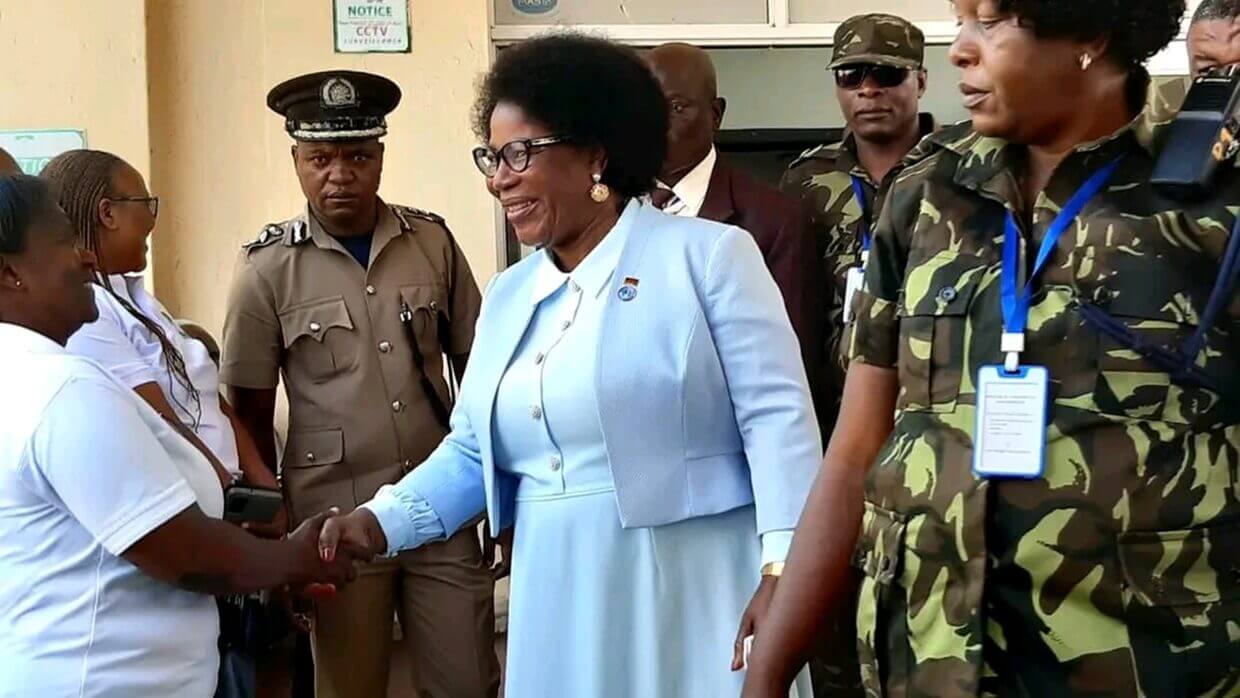
DEDZA-(MaraviPost)-Former President Lazarus Chakwera has returned to the national debate over Malawi’s electricity crisis and farmers’ worsening concerns about the prices they receive for their produce, but his intervention opens a harder question: after five years in power, what economic and energy system did his administration leave behind?
Local media reports say Chakwera made the remarks at Chimbiya Market in Dedza while returning from the funeral of Professor Zimani Kadzamira, where he criticised unreliable electricity and what he described as very low prices being offered to farmers for their produce.
Chakwera’s criticism comes as Malawi continues to struggle with a stubborn gap between electricity generation and national demand.
EGENCO says its generating system is still facing serious technical problems, including units requiring repairs and spare parts, while some generating units are expected to return to service only later in 2026 and 2027.
But this is not a crisis that suddenly appeared in 2026.
In August 2025, shortly before Chakwera left office, Malawi was already experiencing a substantial generation shortfall, with ESCOM reporting available generation of about 350 megawatts against peak demand of approximately 413 megawatts.
That is the first uncomfortable fact confronting Chakwera’s latest intervention.
He is speaking about a crisis that was already serious when his administration ended.
But the second uncomfortable fact is equally important: Chakwera did not create Malawi’s electricity crisis from nothing.
Malawi entered his presidency with longstanding weaknesses in generation capacity, transmission infrastructure, dependence on hydropower and inadequate investment.
Therefore, blaming the entire electricity crisis on one former president would be historically inaccurate.
But inheritance is not an escape from accountability.
A government takes responsibility for the country’s direction when it assumes office.
The question is therefore not simply whether Chakwera inherited an electricity deficit.
He did.
The harder question is what his administration achieved during five years in power to reduce that deficit and make the electricity system more resilient.
The record is more complicated than the politics
Chakwera’s administration did take steps in the energy sector.
Electricity-access programmes expanded connections, while major generation initiatives were pursued.
The Mpatamanga hydropower project, for example, reached a major development agreement during his presidency, while the Malawi Electricity Access Project expanded connections to households. These are important parts of the record and should not be erased simply because the generation crisis remains.
But there was a glaring contradiction.
Malawi was expanding electricity access while generation capacity remained inadequate.
More people were being connected to a system that still struggled to produce enough power to meet peak demand.
That is not the same thing as doing nothing.
It is evidence of a deeper problem: access expanded faster than dependable generation capacity.
And that distinction matters.
A country can increase the number of people connected to electricity while still suffering from serious blackouts.
The blackout is an economic tax
Electricity shortages are not merely an inconvenience.
They impose a direct economic cost.
When power disappears, a maize mill can stop.
A welding workshop can stop.
A refrigeration business can lose stock.
A manufacturer can lose production hours.
A farmer cannot reliably operate irrigation equipment.
A small trader can lose an entire day’s business.
The blackout therefore becomes an invisible tax on economic activity.
And when the problem persists for years, it becomes a structural constraint on growth.
Then came the wider economic crisis
The electricity problem cannot be isolated from the economic deterioration that confronted Malawi towards the end of Chakwera’s presidency.
The IMF’s July 2025 assessment found that Malawi was facing structurally low growth, persistent inflation, severe foreign-exchange shortages and unsustainable fiscal and debt dynamics.
Real GDP growth fell to 1.8 percent in 2024.
The overall fiscal deficit reached 10.1 percent of GDP in FY2024/25.
Public debt reached 88 percent of GDP by the end of 2024.
Inflation had peaked at 30.7 percent in February 2024.
These numbers do not prove that Chakwera personally caused Malawi’s economic problems.
The IMF itself identified external shocks and weak agricultural output among the factors affecting the economy.
But they establish the economic conditions confronting Malawi as Chakwera’s administration approached the end of its term.
And that record cannot simply be erased because he is now speaking as a former president.
Foreign exchange: the crisis beneath the crisis
Foreign exchange became another pressure point.
Malawi’s economy depends heavily on imported fuel, machinery, fertilizer, medicines and industrial inputs.
When foreign exchange becomes scarce, the problem travels through the entire economy.
Imports become difficult.
Production costs rise.
Businesses struggle to restock.
Agricultural inputs become harder to secure.
Transport costs increase.
And consumers ultimately pay more.
This is why the foreign-exchange crisis cannot be treated as an issue confined to central-bank statistics.
It reaches the market, the farm and the household.
But what about the farmer?
This is where Chakwera’s latest remarks require precision.
He was speaking about the prices farmers receive for their produce.
That should not be confused with retail maize prices paid by consumers.
Indeed, IFPRI’s latest August 2026 report shows that retail maize prices increased by an average of 20 percent during August, reaching an average of K960 per kilogram nationally, according to reporting based on the IFPRI data.
So Malawi can simultaneously have expensive maize for consumers and farmers complaining about inadequate prices for their own produce.
There is no contradiction.
The farmer’s problem concerns the price received at the point of sale.
The consumer’s problem concerns the price paid at the market.
Between the two are transporters, traders, processors, storage facilities, market structures, government policies and other costs.
That is why agricultural pricing requires a much deeper examination than simply asking whether maize is expensive or cheap.
The real agricultural failure
Malawi’s farmer does not need only fertilizer.
The farmer needs a functioning economic chain.
Affordable inputs.
Reliable electricity.
Irrigation.
Affordable credit.
Storage.
Roads.
Markets.
Processing.
Predictable prices.
And access to foreign exchange where imported inputs are required.
Break one part of that chain and the farmer carries the consequences.
Break several parts simultaneously and agriculture becomes a survival activity rather than a reliable engine of wealth creation.
That is the structural problem Malawi has failed to solve across successive administrations.
The Chakwera accountability question
Chakwera is entitled to criticise today’s government.
But citizens are equally entitled to examine the record of the government he led.
If electricity was already severely inadequate when he left office, what was done during his five-year tenure to close the generation gap?
If foreign exchange had become critically scarce, what structural measures were implemented to increase export earnings and reserves?
If debt dynamics had become unsustainable, why did fiscal pressures remain so severe?
If agriculture remained vulnerable to food insecurity and volatile markets, why had Malawi not built a more productive and commercially sustainable farming system?
These are not questions of revenge.
They are questions of governance.
But today’s government owns today’s crisis
There is another uncomfortable truth that cannot be ignored.
Chakwera left office in 2025.
The government currently in power is responsible for what has happened since then.
It cannot blame the previous administration indefinitely for today’s blackouts.
It cannot blame yesterday’s government forever for today’s food prices.
It must be judged by what it has done with the problems it inherited.
That includes electricity generation, foreign exchange, inflation, agricultural markets, debt and economic growth.
The current EGENCO situation shows why this distinction matters: the power crisis remains active, with generating units undergoing repairs and some capacity not expected to return until much later.
The political temptation will always be to push responsibility backwards.
The national responsibility is to fix the problem.
Was Malawi actually collapsing?
The phrase “on the brink of collapse” needs to be used carefully.
The evidence does not establish that Malawi as a state was literally collapsing.
It does, however, establish severe economic stress.
Growth was weak.
Inflation was high.
Debt was unsustainable.
Foreign-exchange shortages were severe.
Food insecurity remained significant.
Electricity generation was insufficient to meet demand.
The IMF’s description of Malawi’s fiscal and debt dynamics provides a much stronger factual foundation than simply declaring that the country was “collapsing.”
That distinction makes the analysis harder to dismiss.
The Chakwera reckoning
Chakwera’s latest intervention identifies problems that are real.
But some of those problems were already serious during his presidency.
That does not make his criticism false.
It makes his own record relevant.
The evidence therefore does not support the simplistic claim that Chakwera created Malawi’s current crisis.
Nor does it support the opposite argument that his administration can be separated from the conditions in which he left office.
He inherited structural weaknesses.
His government faced major external shocks.
His administration implemented energy-access programmes and pursued major generation projects.
But Malawi still had a substantial generation-demand gap when he left office.
The economy was also under severe pressure from weak growth, high inflation, foreign-exchange shortages and unsustainable debt dynamics.
That is the record.
And it is precisely why his latest criticism deserves scrutiny rather than applause or dismissal.
The harder lesson
Malawi’s problem is bigger than Lazarus Chakwera.
It is bigger than the current administration.
And it is bigger than MCP, DPP or any other political party.
The farmer needs a market that rewards production.
The business needs electricity it can depend on.
The manufacturer needs foreign exchange.
The family needs affordable food.
The taxpayer needs sustainable public finances.
And the country needs economic growth that creates jobs and opportunity.
Chakwera has reopened the debate over Malawi’s economic and power crisis.
The harder task is confronting the record behind that crisis—and demanding measurable results from whoever holds power today.
Malawi cannot keep treating electricity shortages, foreign-exchange crises, food insecurity and weak economic growth as political inheritance.
At some point, every government must own the problems it inherits, account for the problems it fails to solve, and deliver the results citizens were promised.
Leave a Reply