

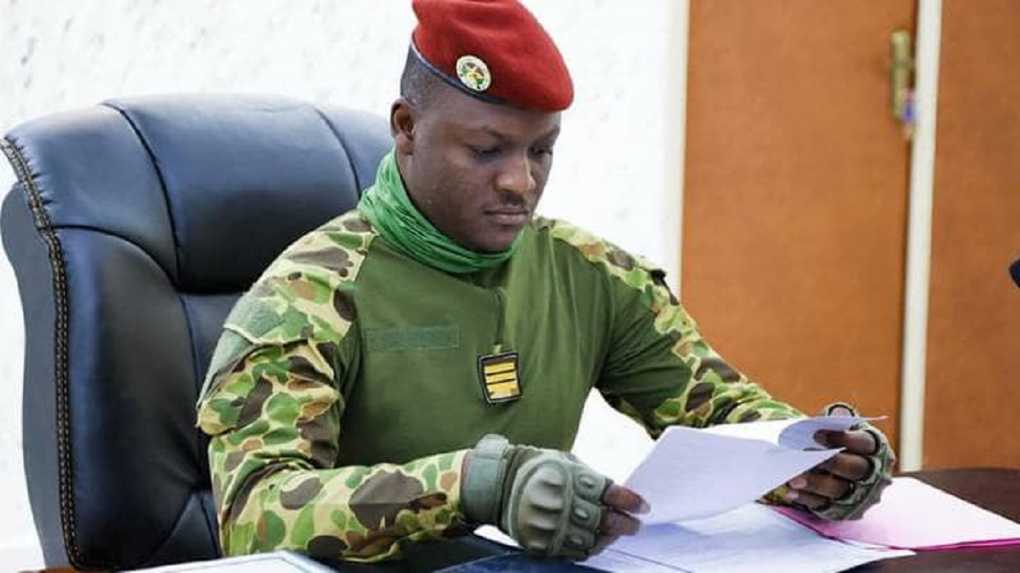


OUAGADOUGOU-(MaraviPost)-Burkina Faso’s military leader, Captain Ibrahim Traoré, is pursuing an ambitious programme of economic nationalism, resource control and foreign policy realignment, positioning the country at the centre of a growing debate about Africa’s independence, leadership and control of natural wealth.
Reports by Reuters, Associated Press, the International Monetary Fund (IMF), the World Bank and regional fact-checking organisations present a more complex picture of Traoré’s record than the celebratory claims circulating on social media. While his administration has made significant changes in the mining sector and international relations, several widely shared claims about debt repayment, salaries and security gains require correction.
Since taking power in September 2022, Traoré has made national sovereignty a central theme of his leadership. One of his most consequential foreign policy decisions was ending Burkina Faso’s military agreement with France, leading to the withdrawal of French troops in February 2023. The move reflected growing public opposition to France’s military presence and the government’s determination to pursue a different security strategy.
His administration subsequently strengthened cooperation with Mali and Niger, establishing the Alliance of Sahel States (AES). The three military-led governments formalised their confederation in July 2024, creating a framework for collective defence and cooperation on regional security and development.
Economic sovereignty has also become a major pillar of Traoré’s programme, particularly in the gold industry, which remains central to Burkina Faso’s export earnings.
In June 2025, the government completed the transfer of five gold-mining assets to the state-owned mining company, SOPAMIB, following a process aimed at increasing national participation in the sector. The administration has argued that greater state control will allow more mining revenue to remain within the country.
Another major development was the opening of Burkina Faso’s first gold refinery, Raffinor-BF, in Ouagadougou. The facility is designed to process locally produced gold rather than relying entirely on overseas refining services. Its establishment represents an important step towards capturing more value from the country’s mineral resources.
However, the claim that Burkina Faso has completely stopped exporting raw gold to Europe is not established by the available evidence. The refinery’s opening strengthens domestic processing capacity, but it does not automatically mean all gold exports have ended.
The administration has also faced scrutiny over claims that it paid off the country’s domestic debt and rejected IMF financing. These assertions are inaccurate. IMF records show that Burkina Faso continued receiving support under an Extended Credit Facility arrangement approved in 2023, with further disbursements and additional financing arrangements recorded in 2026. Public debt remains substantial.
Similarly, claims that civil servants received a 50 per cent salary increase are unsupported. Fact-checking investigations found that ministers’ salaries were reduced, but there is no evidence of the widely circulated 50 per cent increase for public employees.
Economic performance nevertheless offers some positive indicators. World Bank data show that Burkina Faso’s nominal GDP increased from approximately US$18.6 billion in 2022 to US$27.6 billion in 2025. The IMF has also reported economic growth, supported partly by stronger gold production and improved fiscal performance. These figures, however, do not establish that all the gains resulted from Traoré’s policies.
Security remains the administration’s most difficult test. The government reported that the proportion of national territory recovered from armed groups reached 72.7 per cent by June 2025. However, the country continues to experience serious insecurity, displacement and humanitarian challenges, while independent assessments have questioned the extent of government control.
Traoré has therefore become an influential figure in the debate over African sovereignty, but his leadership must be assessed through measurable economic improvements, security outcomes, democratic accountability and the welfare of ordinary citizens.
His political legacy will ultimately depend not only on challenging foreign influence or controlling natural resources, but also on whether Burkina Faso can achieve lasting peace, prosperity and accountable governance.
Leave a Reply