


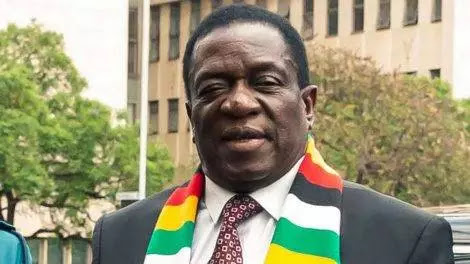
HARARE-(MaraviPost)-The Constitutional Court has postponed two landmark challenges to Constitutional Amendment Act No. 3, the law that extended President Emmerson Mnangagwa’s term and scrapped the direct election of the President.
Both matters were called in Harare at 8:00am today and the parties made submissions, but the full hearings on the merits did not proceed.
Addressing the media after the session, one of the lawyers, Tendai Biti said after hearing arguments on postponement and new legal issues, the court adjourned and postponed both cases.
Once again, Zimbabweans must wait for a decisive ruling on a law that is already in force.
The first case is the by opposition party Movement for Democratic Change (MDC) challenge brought by party leader Douglas Mwonzora on its behalf, under case number CCZ 275/26.
Mwonzora is represented by Biti and seeks to overturn provisions of the Constitution of Zimbabwe Amendment No. 3 Act of 2026, which replaced direct presidential elections with a parliamentary vote without first holding a national referendum. Initially slated for September, before being removed from the roll for case management, the matter had been set down for hearing today.
In court, Biti asked for more time to file supplementary heads of argument. Mwonzora also wants to introduce additional judicial precedents, including comparative jurisprudence from Germany. Biti introduced further legal arguments as well, prompting an exchange between the lawyers representing Parliament and the President over the issues raised. The court adjourned for 10 minutes to consider the requests before postponing the case to next week, to allow the applicants to file the supplementary heads and the additional precedents.
At the heart of the Mwonzora case is whether Parliament and the executive bypassed mandatory safeguards designed to protect citizen sovereignty. Under Section 328(6) of Zimbabwe’s 2013 Constitution, any amendment that amends, alters or affects any provision of Chapter 4, the Declaration of Rights, must be submitted to a national referendum after passing through Parliament. While the amendment formally changed Section 92, which falls outside Chapter 4, rather than explicitly altering Section 67, which guarantees citizens’ political rights and the right to vote, Mwonzora’s legal team argues that the substantive effect is identical. By stripping citizens of their direct vote for head of state, the amendment allegedly diminishes a core right protected under Section 67. The MDC further contends that Mnangagwa breached his constitutional duty under Section 110(2)(f) by assenting to the Bill without calling for a public vote. Mwonzora, a prominent figure in the drafting of the 2013 Constitution, now wants the court to also consider comparative jurisprudence from Germany, where courts have grappled with whether Parliament can use amendments to destroy the democratic core of a constitution.
The second case is the war veterans challenge, which has been postponed to December 2026. It was brought by six liberation war veterans, namely Reuben Zulu, Godfrey Gurira, Shoorai Nyamangodo, Joseph Chinyangare, Digmore Knowledge Ndiya and Joseph Chinguwa.
They are represented by Professor Lovemore Madhuku, together with Advocates Lewis Uriri and Tawanda Zhuwarara. The case specifically challenges the removal of the direct election of the President. Under Amendment No. 3, the President will no longer be elected by voters, but by MPs sitting together as an electoral college.
Speaking to the media, after the postponement, Madhuku said in this second case, it was not the applicants who sought time.
The lawyers representing the respondents applied for a postponement, and Parliament made a similar request.
The respondents are President Mnangagwa, Justice Minister Ziyambi Ziyambi, Attorney-General Virginia Mabhiza, and Parliament. The matter has now been postponed again, this time to December 2026.
The war veterans argue that the change takes away a right protected by Section 67 of the Constitution, the political right of every citizen to vote and to elect a President directly.
They contend that such a fundamental change required approval through a national referendum, and that Parliament alone could not effect it.
Madhuku has described securing direct access to the Constitutional Court as a very big victory, because it allows the case to be heard straight by the highest court, instead of starting in the High Court.
Both cases arise from the same law. On 7 July 2026, President Mnangagwa signed Constitutional Amendment Bill No. 3 into law, gazetting it as Act No. 6 of 2026. The legislation introduced sweeping changes to Zimbabwe’s governance.
Under the amended Section 92, the President is no longer elected directly by registered voters, but by members of the Senate and National Assembly sitting jointly as an electoral college.
The Act also extended presidential, parliamentary and local government terms from five years to seven years, postponing the next harmonised elections from 2028 to 2030. It also created ten additional Senate seats to be filled by presidential appointment, among other changes.
The postponements come days after the ConCourt reserved judgment on 18 November in related challenges brought by former opposition MP Prince Dubeko Sibanda and activist Vhurande Mahlupeko. Both applicants are also represented by Madhuku, as part of a broader legal battle over the amendments.
Politically, the shift from a popular vote to a parliamentary electoral college alters the balance of power in Zimbabwe. Critics and opposition leaders argue that removing direct elections insulates the presidency from broad public accountability and concentrates executive selection within a legislature dominated by the ruling Zanu PF.
Pairing that change with a two-year extension of current terms has fuelled debate over whether the amendments were crafted to entrench incumbents rather than advance institutional reform.
The ConCourt now faces a critical test of constitutional interpretation.
The bench must decide whether compliance is judged strictly by which specific clauses are textually amended, or by the broader practical impact those changes have on fundamental rights enshrined in the Declaration of Rights.
For now, the law remains in force. Mnangagwa remains in office under the extended seven-year term.
The next election remains set for 2030, not 2028.
And Zimbabweans remain in limbo, waiting for a court that keeps postponing the question of whether their right to vote directly for a President was lawfully taken away.

Leave a Reply